

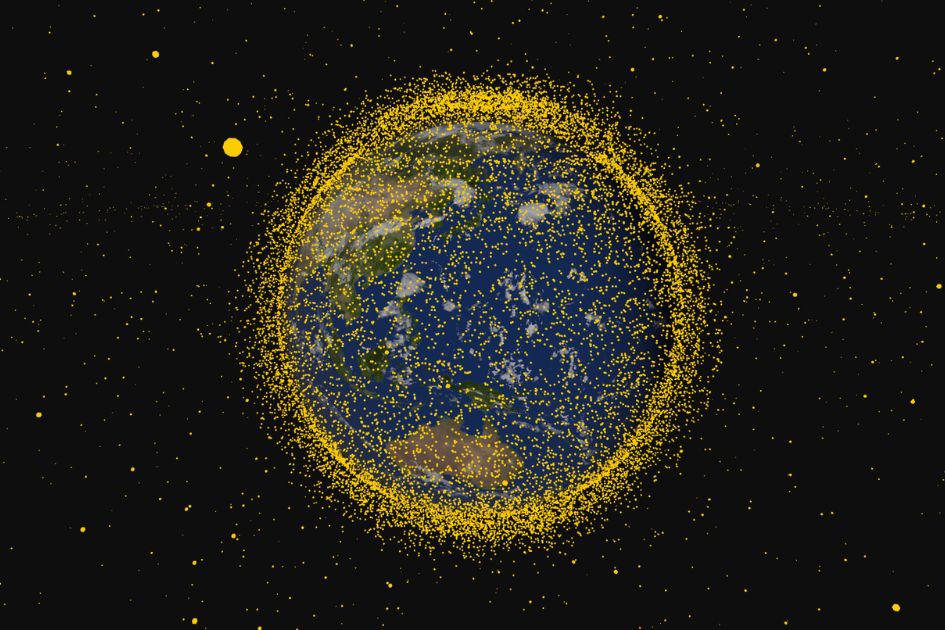

Thousands of satellites crowd Earth’s orbit, increasing debris and atmospheric pollution risks, threatening systems and ozone, while intensifying competition for lunar resources and raising urgent calls for sustainable space practices.
For most of human history space above our heads remained out of reach, but Earth’s orbit is now crowded with thousands of satellites.
What was once an empty expanse is rapidly filling up, raising concerns that the growing number of satellites could trigger a new environmental crisis in space research.
Space debris is not only threatening global communication systems but is also posing risks to Earth’s atmosphere and ozone layer. This race to dominate space is reshaping the relationship between Earth and outer space.
The Guardian reports that within just one generation Earth’s orbit has transformed from a vast emptiness into a congested zone packed with satellites.
While the Moon still lies largely beyond human reach, it is expected to become a major focus of competition among global powers such as the United States China and Russia in the coming decades.
Several countries are planning ambitious missions to send humans back to the Moon, this time not just for exploration but with the goal of establishing a permanent presence.
The report includes interviews with pioneers working to extract valuable minerals from the Moon, along with astronomers tracking the movement of thousands of satellites orbiting Earth.
It is an exciting time for scientists space enthusiasts and businesses. At the same time it is also a moment to reflect on humanity’s role and responsibility in space.
Environmental concerns
History is filled with examples of explorers who pushed into unknown frontiers only to later realise they had caused irreversible environmental damage.
Similar concerns are already emerging in the 21st century space age. A recent study found that about 10 percent of particles in the stratosphere, roughly 10 kilometres above Earth, contain metals linked to space activities such as rocket launches.
Research into the impact is ongoing, but scientists warn that these particles could alter the chemical composition of the atmosphere and damage the ozone layer, which protects Earth from harmful radiation.
A recent United Nations report stressed the need for sustainable practices, warning that the growing congestion of satellites and their environmental impact across all layers of the atmosphere must be addressed urgently.
One way to grasp the scale of human activity in space is to imagine the thousands of artificial objects orbiting Earth.
The Guardian has used an interactive scrollytelling format to show how Earth’s orbit has gradually filled with satellites over the decades, allowing readers to visualise this growing congestion.
Ashley Kirk, visual editor for the project, said one of the main challenges was finding reliable data.
“We needed not only information on current satellites but also data on those that have fallen out of orbit and been destroyed,” he said.
To ensure accuracy the team relied on multiple sources and worked with astronomer Jonathan McDowell to verify the data.
More than 14,000 satellites are currently orbiting Earth, alongside vast amounts of space junk, including discarded rocket parts and defunct satellites.
This increasing congestion raises the risk of collisions, some of which have already occurred.
In 2007 China deliberately destroyed a weather satellite during an anti-satellite weapons test, creating a dangerous cloud of debris.
Two years later a US satellite collided with a defunct Russian satellite, producing around 2,000 fragments.
Thousands of tiny metal pieces are now hurtling through space at high speeds. Scientists fear that future collisions could trigger a domino effect, turning Earth’s orbit into a hazardous minefield.
People around the world rely heavily on satellites for daily life, from navigation using Google Maps to internet services and weather forecasting.
Satellites also play a crucial role in monitoring Earth, helping researchers track deforestation desertification glacier melt and oil spills at sea.




