

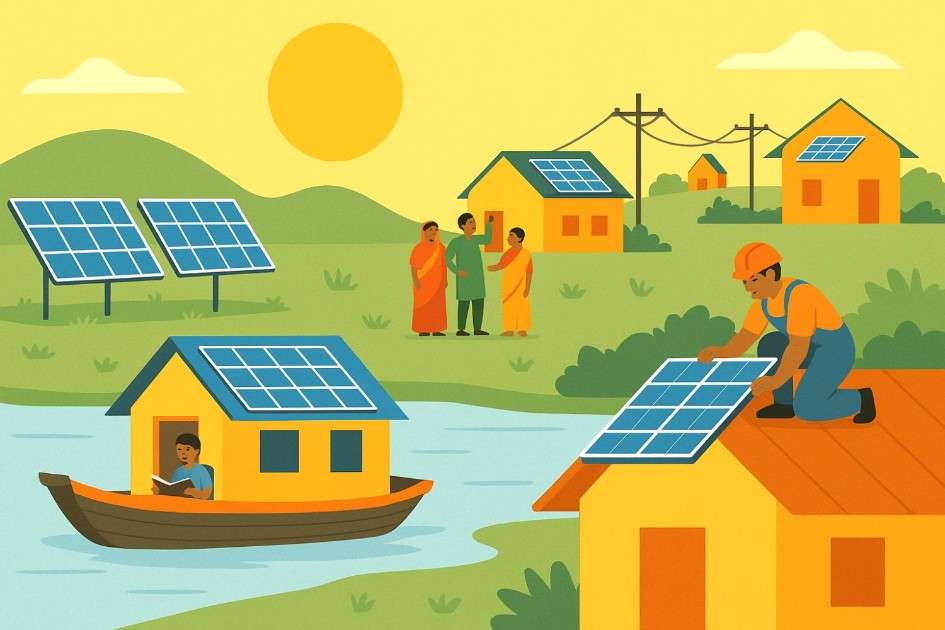

As Bangladesh adopts the Renewable Energy Policy 2025, experts stress community participation as key to achieving its solar ambitions. From floating schools to peer-to-peer smart grids, grassroots innovations are powering resilience, equity, and progress toward a people-centered renewable future.
The Interim Government has taken a timely step by approving the Renewable Energy Policy 2025, a new version of the energy policy introduced after 16 years.
The Renewable Energy Policy 2025 sets ambitious targets – 20% of power from renewable sources by 2030 and 30% by 2041, with a primary focus on large-scale utility projects.
However, after the political transition in Bangladesh, several under-construction renewable energy projects were immediately cancelled, creating significant challenges for the flow of foreign and private investment.
In addition, complicated administrative processes, high financial requirements for investment, and limited technological capacity remain major barriers preventing both private and public investors from scaling up large renewable projects.
According to a study by the Institute of Energy Economics and Financial Analysis (IEEFA), Bangladesh will require up to $980 million by 2030, and $1.46 billion beyond 2030, to achieve the new policy targets.
Beyond financial roadblocks, poor technological standards have reduced the sustainability of solar projects. Around 60% of the solar market is currently dominated by low-cost Chinese-manufactured equipment, which has been widely used in the ten solar parks initiated under the previous government.
Experts argue that community-based renewable initiatives, unlike large-scale projects, offer a more sustainable pathway, as they bypass environmental and demographic challenges such as land ownership disputes.
At the same time, large-scale projects often involve ecologically harmful practices, including the use of carbon-emitting materials to manufacture solar panels – an undeniably controversial issue.
In this context, full of challenges, Bangladesh may need to rely on more resilient, small-scale, and locally led approaches. However, the new policy places little emphasis on developing and supporting renewable energy communities.
Bangladesh’s renewable communities in action
At a time when Bangladesh is witnessing a “critical juncture” marked by energy vulnerability, economic instability, the urgency of energy transition, and ecological fragility, community-led solar initiatives are quietly reshaping the energy landscape.
“The future of energy begins with Bangladesh. If we can do it here, you can do it anywhere,” remarked Dr Sebastian Groh, CEO and Co-founder of SOLshare.
His words ring especially true for one of the most climate-affected countries in the world, where communities are turning to the sun to power their future.
Bangladesh receives abundant solar radiation, with the potential to generate up to 50% of its energy from solar power. Experts identify rooftop and floating solar projects as particularly suitable for the country.
One estimate suggests that utilizing just one-third of the nation’s ponds could generate up to 15GW of power.
In regions where centralized renewable transitions remain a distant dream, Bangladesh has inspiring stories of bringing solar-powered grids to remote villages in riverine charlands—empowering communities along the way.
Floating solar schools
In flood-prone Bangladesh, frequent inundation often prevents children from attending school. To address this, Mohammed Rezwan of Shidhulai Swanirvar Sangstha pioneered floating schools.
These boats double as school buses and classrooms, picking up students from riverside homes. Beyond education, these boats also serve as training centers for farmers and parents, theaters for evening shows, and mobile clinics and relief hubs during monsoon floods.
Powered by solar energy, these boats are equipped with lanterns that fuel schools, libraries, health clinics, workshops, and floating training centers – offering a model of resilience and adaptability.
Solar smart village grids
SOLshare’s Solar Smart Village Grids project has become a global example of how consumers can be transformed into entrepreneurs. Community-based projects like these are critical for creating both economic and environmental impact.
SOLshare pioneered the world’s first peer-to-peer ICT-enabled electricity trading network, integrating individual solar home systems with mini-grids to interconnect off-grid households in Shariatpur.
The smart meters generate 30% excess energy, which can then be sold to households without solar systems. Using an “Uber-like” model, sellers connect with buyers through a mobile app, earning revenue while ensuring wider access to clean energy.
By converting solar home systems into investments, the project helps reduce household energy costs by at least 25%. Such community-based models deserve far more policy attention, as they deliver both environmental and economic benefits.
Solar villages in the char lands
In 2009, Friendship, an international Social Purpose Organization (SPO), introduced solar microgrids to electrify remote char areas, where residents once relied on kerosene lamps.
The organization provided loans to households for installing solar home systems (SHS), with repayments structured to match the previous cost of kerosene. Community members were also trained as Para-Solar Technicians (PSTs) to maintain the systems.
In 2021, Friendship established a solar microgrid that electrified over 150 homes in Goynar Potol char, connecting schools, markets, and legal aid booths in an integrated development approach.
In 2022, Summit Power International partnered with Friendship to launch the second solar village in Kabilpur Char, Fulchari upazila of Gaibandha district, supplying electricity to 171 families and benefiting 3,000 residents.
By 2023, Friendship had installed 3,582 SHS and trained 739 PSTs. Today, 56 Sustainable Economic Development (SED) Hubs run by PSTs deliver villagers products, services, and training in solar electrification, livestock, fishing, and agriculture.
The path forward
To make the Renewable Energy Policy effective, the government must ensure community participation and ownership.
Bangladesh has several success stories of community-led renewable projects, even in the most remote and climate-vulnerable areas. With proper support, communities can meaningfully contribute to achieving the policy’s 2030 and 2041 targets.
Policymakers, advocates, and activists must work together to highlight and expand community-based renewable projects, placing them at the center of the clean energy transition.
As the world looks for inclusive renewable solutions, Bangladesh’s community-driven initiatives prove a powerful point: the most enduring revolutions begin with society itself.
Communities must therefore be at the heart of the renewable energy policy and climate finance agenda, driving the solar revolution in Bangladesh.




