

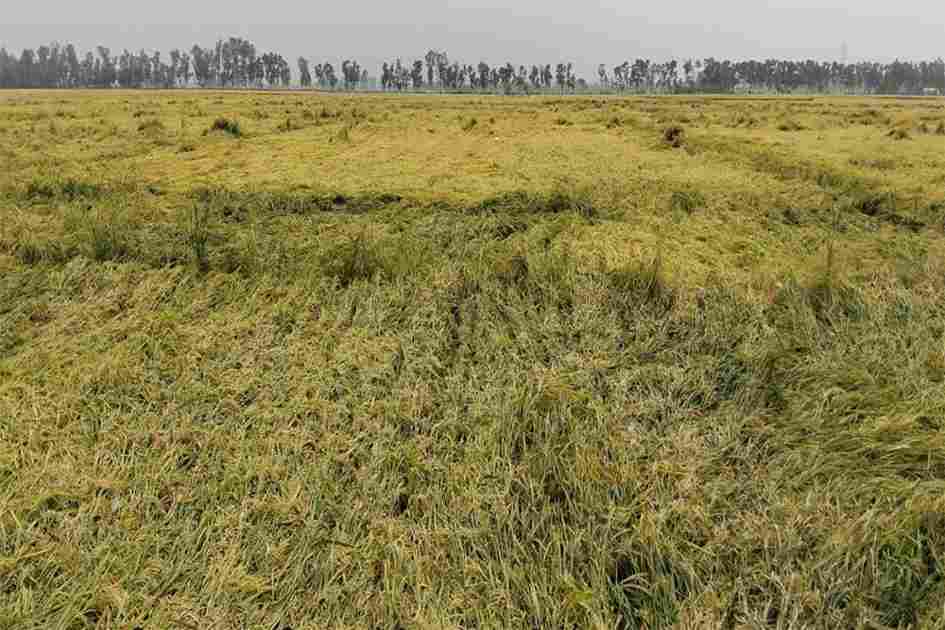



Farmers in Cox’s Bazar begin early boro harvesting as rain, gusty winds and waterlogging fears threaten crops just weeks before harvest, raising concerns over potential losses and disrupted production targets.
Farmers in Bangladesh‘s Cox’s Bazar district have started harvesting boro paddy early after several days of rain and gusty winds raised fears of waterlogging and further crop losses just weeks before the main harvest.
The early harvesting was visible on Monday noon in the Khurushkul union area of Cox’s Bazar Sadar upazila, where hundreds of acres of boro fields stretch along both sides of a paved road near the wind power project site. Some of the paddy had already turned golden while other plots remained green and half-ripe. In some fields, the stalks had bent over in the wind as farmers cut the fallen plants under a clear sky, even though rainwater from the past few days was still standing in the fields.
Farmers said they were only 15 to 20 days away from bringing the crop home when heavy rain hit. They feared that if more rain triggers deeper waterlogging, the paddy standing in the fields will be soaked and ruined. To avoid that risk, they have begun cutting early.
M Abdul Hannan, assistant meteorologist at the Cox’s Bazar office of the Bangladesh Meteorological Department, said 48 millimetres of rainfall was recorded in Cox’s Bazar in the 24 hours until 6:00 am on Sunday. He said the sky had remained cloudy on Sunday and warned that even if Monday appeared clear, heavy rain, thunderstorms and lightning could strike at any time. Heavy rainfall could also cause waterlogging in some places and landslides in hilly areas, he said.
Local farmer Mozaher Mia cultivated boro on two acres of land this season in Fakir Para of Khurushkul. After several days of rain and strong winds, paddy on about 30 decimals of his land had fallen over. He cut part of the damaged crop on Saturday afternoon and knee-deep rainwater still stood in his field.
The 52-year-old said the wind had bent the plants and submerged paddy would be damaged in the water. He said there was little he could do except pray that there would be no rain for a few more days, warning that if flood-like waterlogging develops the paddy in the field will rot away.
Fallen paddy plants were also seen in several fields in nearby Noa Para, Tetaia, Pal Para and Fakir Para.
According to the district Department of Agricultural Extension, boro cultivation is under way on 55,700 hectares across Teknaf, Ukhiya, Ramu, Eidgaon, Chakaria, Pekua, Cox’s Bazar Sadar, Maheshkhali and Kutubdia upazilas this season. Officials said hybrid, high-yielding and local varieties have all produced bumper crops, but some farmers are now facing losses at the final stage because of gusty winds and heavy rainfall.
Ashish Kumar, a sub-assistant agriculture officer at the Cox’s Bazar agricultural extension office, said early harvesting had started in different upazilas of the district because of fears that floods and runoff from the hills could damage paddy. He said 51 percent of the standing crop had already been harvested and the remainder would likely be cut within the next 15 to 20 days.
He said around 20 acres of paddy had been damaged in the district after several rounds of rain and gusty winds. More than 30 acres of plants had fallen over, though that had not caused major grain loss so far. But he warned that if heavy rainfall leads to flooding or waterlogging, the paddy still standing in the fields could be destroyed.
The district has 237,000 farmers, of whom 115,000 grow boro paddy. Last year, fields in the district produced 235,265 metric tons of rice. Farmers said continued heavy rainfall and runoff from the hills could damage the remaining crop and disrupt this season’s production target.
In the Madrasa Gate area of Chakmarkul in Ramu, local farmer Chhaber Ahmad cultivated boro on nine kani of land, with one kani equal to 40 decimals. He said he could not yet harvest because his paddy was still half-ripe. Rain had been falling on and off for the past few days, but runoff from the hills remained limited and water was draining into canals, preventing waterlogging in his fields. Although some plants had bent in the wind, the crop had not suffered serious damage, he said, adding that the shifting mix of sunshine and rain in the sky was still causing anxiety.
Farmers Zainal Abedin and Nawab Ali from Cox’s Bazar Sadar said they still needed to wait a few more days before bringing their paddy home. But dark clouds, loud thunder and intermittent rain were making them fearful. They said waterlogging from heavy rain and runoff from the hills could seriously damage ripe paddy.
A nor’wester on April 26 damaged several hundred houses in Teknaf and Ramu and toppled hundreds of trees. The storm also damaged 10 to 15 acres of boro paddy during that period.
Early harvesting also began in areas including Khunkar Para and Maheshkhaliya Para in Teknaf Sadar union. Union council chairman Ziaur Rahman said around 40 percent of the paddy was still standing in the fields there. He said farmers in his union had produced a bumper boro crop this season because weather conditions had remained favourable and they would be able to bring in the full harvest if heavy rainfall and waterlogging do not occur.
Several farmers alleged that production costs had risen sharply this season, with higher labour charges, irrigation costs, fuel shortages, expensive fuel purchases and rising prices of fertiliser and pesticides all adding to the burden. They said the market price of paddy remained weak and warned that if storms and rain destroy the crop in the fields, hundreds of thousands of farmers could be pushed into ruin.
Bimal Kumar Pramanik, deputy director of the district Department of Agricultural Extension, said recent rainfall had not caused major damage to farmers. He said the month before the rain had been intensely hot and the soil in the fields had cracked, allowing the land to absorb much of the rainfall. That had benefited farmers by reducing irrigation costs, he said. But he added that several consecutive days of heavy rain would have damaged the crop and farmers were being encouraged to cut their paddy quickly before any heavier rainfall arrives.




