




Bangladesh’s new climate finance committee faces calls for transparent funding, stronger community participation, independent oversight and greater focus on grants for adaptation and loss and damage.
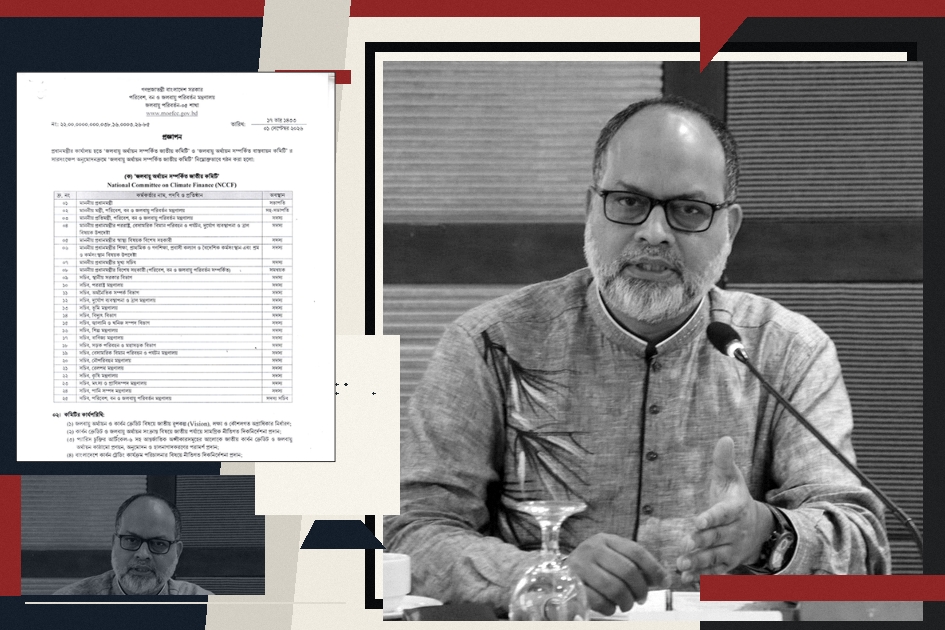
Bangladesh’s National Committee on Climate Finance (NCCF) must prove its worth through the money it delivers to vulnerable communities and the protection it provides, says M Zakir Hossain Khan, co-founder and managing director of Change Initiative and a civil society observer at the Climate Investment Funds. In this interview with The Climate Watch, he discusses the committee’s powers, funding priorities, and accountability.
The Climate Watch: Why did Bangladesh need the National Committee on Climate Finance? What gaps should it address?
M Zakir Hossain Khan: Bangladesh’s climate finance system suffers from fragmented institutions, poor coordination, insufficient international financing, weak monitoring, and serious integrity risks. The environment ministry, Economic Relations Division, finance and planning authorities, sector ministries, Bangladesh Climate Change Trust and development partners are all involved, alongside carbon market actors. There has been no sufficiently strong body to coordinate their work.
The NCCF must address three challenges: mobilising finance, improving coordination and ensuring integrity. Its mandate covers national strategy and policy, policy reform, international financing, monitoring, carbon markets and the resolution of disputes between ministries.
Bangladesh needs one place where climate finance ambition, authority, accountability and delivery finally meet.
The Climate Watch: What role did you play in the committee’s formation, and which recommendations were adopted or left out?
M Zakir Hossain Khan: My contribution has come through almost two decades of research, advocacy, international climate finance engagement and policy advice. I have long advocated a high-level institution bringing government agencies together, with stronger community participation, tracking of finance, transparency and accountability.
More recently, Change Initiative recommended a single coordination structure for climate finance and carbon markets, supported by public dashboards, project registries, audits, community oversight and projects ready for financing.
The NCCF incorporates several of these principles, including high-level coordination, policy reform, international resource mobilisation and oversight. But the notification does not establish mandatory public disclosure, guaranteed expert and community representation, allocation criteria based on vulnerability or independent performance audits. It also lacks explicit safeguards against debt risks, targets for expanding direct access to funds and a grievance mechanism.
The Climate Watch: What powers will the committee have, and what difference does the prime minister’s leadership make?
M Zakir Hossain Khan: The NCCF has considerable policy and coordination authority. It can shape national climate finance policies, strategies and guidelines, propose reforms, guide resource mobilisation, engage international funds, monitor activities and resolve policy disputes between ministries.
That authority should not be confused with the power to allocate money. Public finance, procurement and statutory procedures must still apply.
The prime minister’s leadership can help overcome institutional barriers and delays because climate finance involves almost every economic ministry. That leadership should remove bottlenecks without concentrating decisions on individual project selection.
The prime minister can give the committee political clout; only transparency and independent accountability can give it credibility.
The Climate Watch: How can it secure more finance, and what would be a realistic first-year target?
M Zakir Hossain Khan: Bangladesh needs a single pipeline of projects ready for financing, linking its national climate commitments and adaptation plan with loss and damage, biodiversity, renewable energy and community resilience. Each proposal needs to be matched with suitable funding sources.
Opportunities include the Green Climate Fund, Climate Investment Funds, Fund for responding to Loss and Damage, multilateral development banks, the Adaptation Fund and bilateral partners.
I consider securing an additional $500 million to $1 billion by mid-2027 an ambitious but defensible target if the project pipeline is developed quickly. This is my suggested benchmark, not an official forecast. Commitments must be reported separately from actual disbursements.
The terms matter as much as the amount. Adaptation and loss and damage finance should mainly take the form of grants. Public sector financing should be grants or highly concessional loans. Commercial debt should not finance unavoidable climate losses.
The Climate Watch: How can adaptation and loss and damage avoid being overshadowed by carbon markets?
M Zakir Hossain Khan: This is one of my main concerns. Carbon finance is a tool; it cannot become the organising principle of Bangladesh’s climate finance system.
Bangladesh’s National Adaptation Plan requires about $230 billion for 2023-2050, equivalent to more than $8 billion a year. International adaptation finance has fallen far short of that need.
Carbon markets may offer longer-term opportunities, but these depend on credible measurement, reporting and verification, a strong project pipeline and buyers. Potential revenue must never be treated as guaranteed first-year financing or as a substitute for grants and the responsibility of historical emitters.
Carbon credits reflect verified emissions reductions. They cannot adequately compensate for the loss of a home, saltwater contamination of drinking water, displacement, cultural loss, or irreversible ecosystem damage.
We need separate financing windows for adaptation, loss and damage, ecosystem restoration and mitigation, including carbon markets.
The Climate Watch: How can finance reach the communities most exposed to climate risks?
M Zakir Hossain Khan: Project selection should be based on vulnerability and measurable results. Political preferences and lobbying by ministries should not determine allocations.
Proposals should be assessed publicly against climate hazard exposure, dependence on ecosystems, environmental degradation, poverty, gender-related vulnerability, displacement, capacity to adapt and priorities identified by communities.
Citizens should be able to see which union, upazila or community has received funding, how much it received, what the money was intended to achieve, who implemented the project and what results followed.
Climate finance should follow vulnerability, not political visibility.
The Climate Watch: How can affected communities influence a committee made up mainly of government officials?
M Zakir Hossain Khan: This is a clear gap in the current structure. The 25-member NCCF consists essentially of government officeholders. But the notification allows it to co-opt additional members, creating an immediate opportunity to bring in people with relevant expertise and experience.

I recommend formal participation, either on the committee or through an advisory body, for climate-vulnerable communities, women, young people, local government, Indigenous and traditional communities, civil society, and independent climate finance and integrity experts.
Vulnerable people must have a role as rights holders and decision-makers. They should help shape the projects that affect their lives and have direct, faster access to finance for community-led adaptation.
Consultation after project design is not participation. Communities should participate in setting priorities, designing projects, monitoring, and evaluation.
The Climate Watch: What information should the committee make public?
M Zakir Hossain Khan: The notification sets out monitoring and oversight responsibilities, but it does not provide a sufficiently explicit system of mandatory public disclosure. That should be corrected immediately.
Public disclosure should start with the first NCCF meeting, not after the first scandal.
The committee should publish its decisions, implementation progress, project selection criteria, full project pipeline and funding sources. It should identify whether financing involves grants, loans, equity or guarantees, along with interest rates and repayment terms.
Other disclosures should include implementing agencies, contractors, disbursements, the geographical distribution of benefits, results, independent assessments, grievances and corrective action.
For carbon markets, a public registry should disclose authorisations, credits issued and transferred, buyers, prices where possible, accounting adjustments to prevent double counting, benefit-sharing arrangements and safeguards.
If climate finance is received in the name of vulnerable people, vulnerable people have a right to know where every taka or dollar goes.
The Climate Watch: Who should hold the NCCF accountable?
M Zakir Hossain Khan: No committee should be allowed to conduct self-audits.
The Comptroller and Auditor General, Implementation Monitoring and Evaluation Division, Anti-Corruption Commission, parliament and other statutory oversight bodies must retain their mandates. Climate finance also requires independent technical assessment and field verification. An expenditure can be properly recorded yet produce environmentally or socially harmful results.
I recommend an annual Climate Finance Performance and Integrity Review covering financial audits, procurement, field and geographical verification where needed, checks on beneficiaries and verification of ecological outcomes. Findings and corrective action should be public.
There should also be a protected grievance and whistleblowing mechanism, with suspected corruption referred to the Anti-Corruption Commission.
Accountability must examine the results: have people’s lives been protected? Has nature been restored? Have vulnerable communities become safer?
The Climate Watch: What should the public expect in the first 100 days and the first year?
M Zakir Hossain Khan: Within 100 days, the NCCF should publish a national baseline showing existing projects, funding sources, financing instruments, disbursements and the geographical distribution of benefits.
It should establish project selection and vulnerability criteria, build a project pipeline, introduce real-time monitoring and integrity systems, set disclosure and grievance rules, bring in independent and community experts, and fast-track high-quality proposals to international funds.
In the first year, I would use my proposed $500 million to $1 billion in additional finance as a performance target. Other benchmarks include a larger share of grants for adaptation and loss and damage, faster movement from project submission to disbursement, greater direct and local access, a functioning public dashboard and independent audits.
The decisive measures are people protected from floods and storms, households receiving safe water, displaced people assisted, wetlands and forests restored, resilient livelihoods created, economic losses avoided and access to renewable energy expanded.
Climate finance must move from pledges to protection. The committee should be judged by how much additional, grant-based and accountable finance it mobilises, how quickly that money reaches vulnerable people and what measurable resilience it creates.
If it mobilises billions but increases debt, remains opaque or fails to reach Satkhira, Kurigram, coastal and haor wetland communities and other climate frontlines, it will have failed.




