

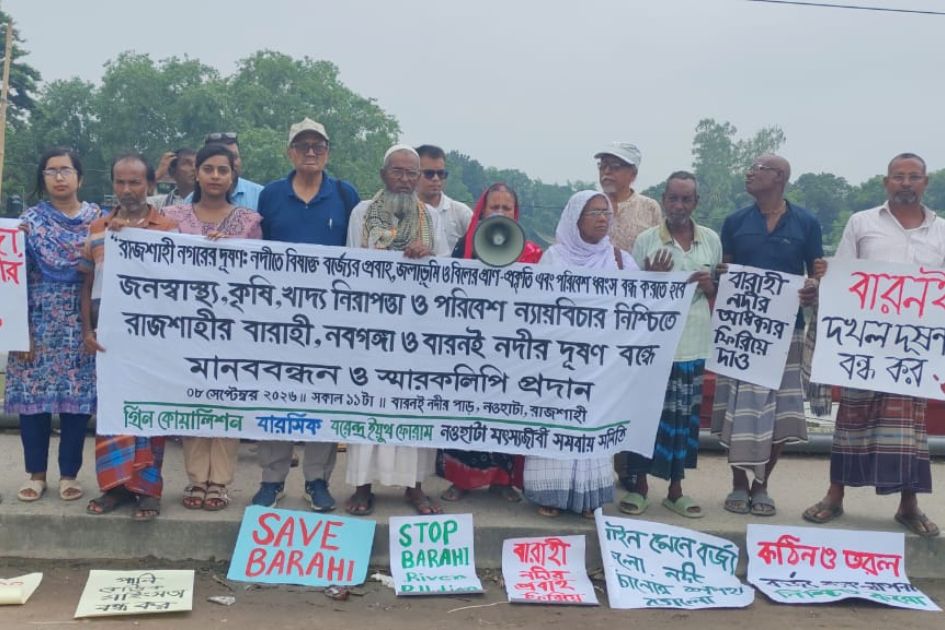



Activists urged waste treatment, river demarcation and stronger monitoring after polluted water was linked to damaged wetlands, falling fish stocks, farmland risks and local health concerns.
Residents, fishers and environmental activists in Bangladesh’s northwestern Rajshahi region formed a human chain on Tuesday demanding action to stop encroachment and pollution in the Noboganga, Barahi, Swaromongola and Barnai rivers, warning that toxic waste is threatening public health, agriculture, food security and environmental justice.
The protest was held at 11:00am on September 8, 2026, on the bank of the Barnai River near Nowhata Bridge in Rajshahi. People living along the Noboganga, Barahi and Barnai rivers, fishers, fishing community members, river researchers, social activists and leaders of environmental organisations joined the event.
The programme was organised jointly by Barendra Youth Forum, a broad alliance of youth, environmental, voluntary, social and cultural organisations in the Barind region, Green Coalition, Nowhata Fishermen’s Cooperative Society and Bangladesh Resource Center for Indigenous Knowledge, a development research organisation known as BARCIK.
Speakers said large quantities of toxic liquid and solid waste, including medical waste, were flowing every day through drains and canals from Rajshahi city into the Swaromongola, Barahi and Noboganga rivers before reaching the Barnai River.
They said toxic liquid and solid waste from the city was accumulating in low-lying areas and damaging Sapmara Beel, Bokmari Beel, Bhugroil Beel, Paikorer Beel, Borobaria Beel and Kornhar Beel. The wetlands, covering thousands of hectares, had long been important for agriculture, fisheries and natural ecosystems, they said.
Polluted water is now creating permanent waterlogging, reducing aquatic plants and fish production and entering farmland, the speakers said. They warned that continued cultivation with polluted water was damaging soil quality and creating the risk that heavy metals and other harmful substances could accumulate in crops.
They said agricultural production had been put at risk and concern was growing over safe food production. The pollution was having a long-term negative impact on food security and public health, they added.
Local riverside communities have reported growing risks of skin diseases, waterborne diseases and breathing difficulties caused by bad odours, speakers said, adding that children, women and elderly people were most at risk.
They said low-income groups, including fishers and farmers, were directly bearing the impact of the pollution, raising questions of environmental justice.
“This situation is not only an environmental problem; it is a question of public health, agriculture, food security and a safe life for future generations,” speakers said.
They also expressed concern that polluted downstream water was reaching Chalan Beel in Natore district through the Atrai River, posing a serious threat to the wider regional ecosystem.
River researcher Mahbub Siddiqui said the rivers originating from the Ganges, or Padma, had once been rich in natural flow and biodiversity.
“The water in these rivers has now turned blackish and foul-smelling, silt and plastic have accumulated on the riverbeds, natural flow has been disrupted and the presence of fish and other aquatic life has declined significantly,” he said.
Local fishers were losing income and the natural ecological character of the rivers was being destroyed, he said, calling for immediate solid and liquid waste management in Rajshahi.
Subhadra Rani Haldar, a riverside resident, said contact with the river water caused different types of skin disease.
Showing wounds on her hand, she said, “I developed sores on my hand after entering this water. It has been a long time but they are not healing. Medicine gives some relief, otherwise it burns.”
Abu Sama, general secretary of Nowhata Fishermen’s Cooperative Society and a fisherman, said: “We have long been speaking about this polluted water from the city but no effective action has yet been taken. We are riverside people and we want this problem to be solved.”
Md Atikur Rahman, president of Barendra Youth Forum, said liquid polluted waste, medical waste and industrial waste from the city were flowing through different drains into the Barnai River via the Barahi and Noboganga rivers without any waste treatment.
“As a result, environmental disaster is continuing in these rivers. Fish and aquatic ecosystems here are being destroyed. This polluted water is entering farmland in different beels, putting agricultural production and safe food production under serious threat,” he said, demanding immediate waste management in Rajshahi.
Kazi Shahidul Islam, president of Paba Upazila Press Club, said waste from Nowhata municipality was being dumped directly into the river.
“Similarly, waste from different municipalities of Rajshahi is being dumped directly into rivers. These practices must be stopped. Monitoring must be improved further and community-based monitoring systems must be developed,” he said.
Deben Haldar of Nowhata said: “We want our livelihood back. We live by fishing but because of this pollution there are no fish in the river today.”
Rahima Khatun, president of Green Coalition in Paba upazila, presented six demands from the human chain.
The demands called for immediate demarcation of the boundaries of the Swaromongola, Barahi, Noboganga and Barnai rivers originating from the Padma and freeing them from encroachment and pollution.
They also demanded proper management of liquid and solid waste from Rajshahi city and the immediate installation and operation of modern sewage treatment plants and effluent treatment plants.
The demands called for mandatory effluent treatment plants at all industries, hospitals, clinics, diagnostic centres and commercial establishments, along with strict community-based monitoring. They also called for identifying polluters and taking strict punitive action against them.
The protesters demanded an end to direct connections of untreated waste-carrying drains, encroachment and pollution in the Barnai, Barahi and Noboganga rivers and other rivers and connected wetlands originating from the Padma. They called for an independent investigation committee to identify the sources of encroachment and pollution and publish its report. They also demanded that poultry farms be brought under waste management.
They called for testing the water and soil quality of Sapmara Beel, Bokmari Beel, Bhugroil Beel, Paikorer Beel, Borobaria Beel and all related wetlands and rivers, publishing the results and taking necessary steps.
The final demand called for stopping encroachment and filling of rivers, beels, ponds, wetlands and waterbodies, and preparing and implementing an integrated restoration master plan with local communities, young people, environmental organisations and experts.
After the human chain, a memorandum addressed to Prime Minister Tarique Rahman was sent through the Rajshahi district administration. Additional Deputy Commissioner (General) Mohammad Sabur Ali received the memorandum on behalf of the district administration, while Additional Divisional Commissioner (Education and ICT) Dr Chitralekha Nazneen received it on behalf of the divisional commissioner.
Copies of the memorandum were sent to ministers and secretaries of the Ministry of Environment, Forest and Climate Change, the Ministry of Water Resources, the Ministry of Local Government, Rural Development and Cooperatives and the Ministry of Health and Family Welfare.
Copies were also sent to the Rajshahi divisional commissioner, the director general and executive engineer of the Bangladesh Water Development Board, the chairman of the National River Conservation Commission, the administrator of Rajshahi City Corporation, the chairman of Rajshahi Development Authority and other relevant authorities.
Other speakers at the human chain included social activist Mahmud Jamal Quaderi, Social Welfare Organisation Executive Director Samrat Raihan, Mahir Uddin, a fisherman from Duari Haldar Para, Intaj Ali, a fisherman from Bagdhani Haldar Para, and Poli Rani, general secretary of Barendra Youth Forum.
Speakers at the event demanded immediate effective steps to implement the public demands raised for protecting the environment, agriculture, food security and biodiversity of climate-stressed Rajshahi.




