

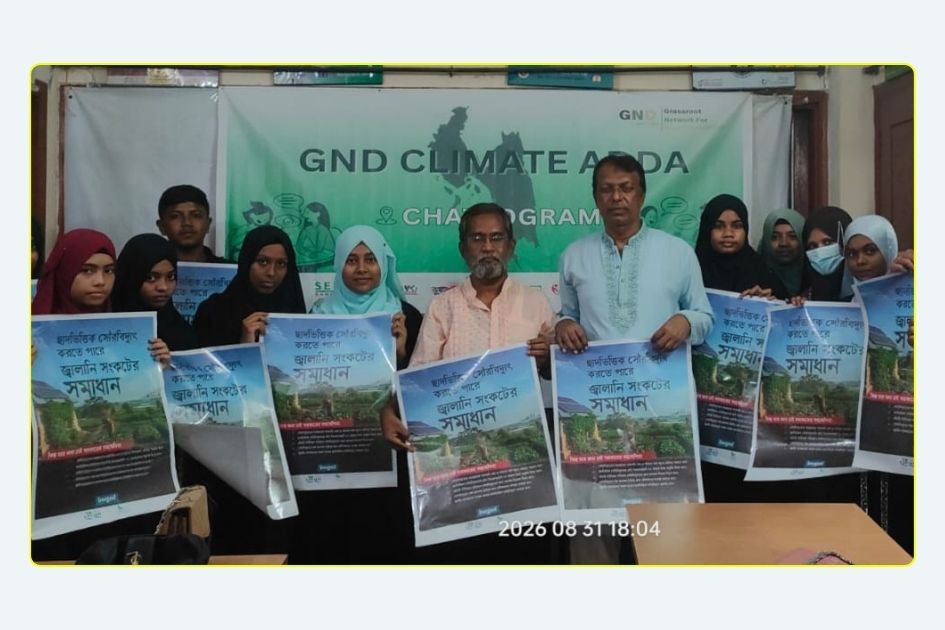



Youth groups and civil society representatives discussed Chattogram’s climate and social crises, including waterlogging, floods, hill destruction, coastal risks and child marriage.
Bangladesh must move beyond traditional technology and knowledge-based approaches to tackle climate change and place greater reliance on talent and wisdom, Consumers Association of Bangladesh Vice President S M Nazer Hossain told a climate discussion in Chattogram.
Speaking on August 31, 2026, at the Grassroots Network for Decarbonization climate adda at the ISDE Bangladesh auditorium in Chandgaon, he said the geography and surface-level weather of the entire world were becoming warmer and changing continuously because of climate change, forcing people to pay the price, particularly in third-world countries such as Bangladesh.
“The Earth is gradually becoming unfit for human habitation,” Nazer said, adding that natural disasters were also becoming increasingly severe.
He said the government’s initiatives to address climate change were visible, but they remained dependent on conventional knowledge and technology. Instead of involving truly talented people and genuine change-makers, he said, the benefits were going into the hands of some opportunists.
“As a result, it will be difficult for Bangladesh to move forward in this sector in line with the rest of the world,” he said. “Therefore, dependence on traditional technology and knowledge must be abandoned, and reliance on talent and wisdom must be increased.”
The event was organised in Chattogram by Sikto Bangladesh, with support from BRAC C3ER and ISDE Bangladesh. Youth Voice for Change, Youth Innovation for Action and Ushar Alo Youth Association took part in the discussion.
The climate adda was moderated by ISDE Associate Admin Officer Abdul Mannan Jihad. Mohammad Selim Jahangir, joint secretary of CAB Chattogram Metropolitan, also spoke at the event.
Representatives and members of different youth organisations presented their activities, goals and social roles. During an open discussion later, participants raised various climate and social crises affecting Chattogram and other parts of Bangladesh.
The discussion particularly focused on waterlogging, floods and disasters, hill destruction, coastal risks and the impact of child marriage, while participants also presented recommendations.
Speakers urged patrons to expand such youth initiatives on environment and climate issues further at the grassroots level.




