

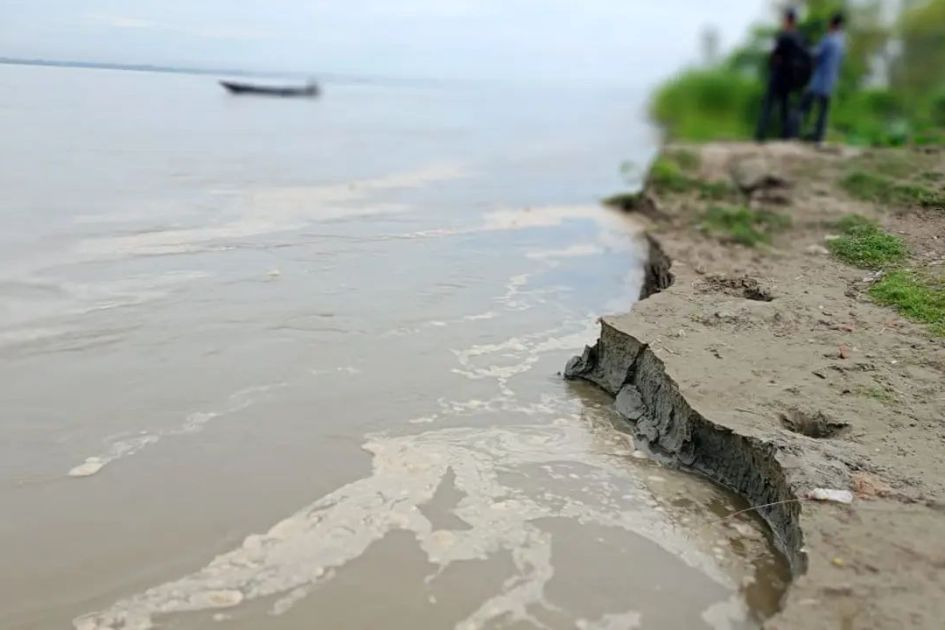



Relentless Brahmaputra erosion in northern Bangladesh is displacing thousands, destroying homes and farmland as climate change intensifies risks and delayed protection projects leave vulnerable char communities facing repeated loss again.
Climate change is accelerating erosion along the Brahmaputra River, displacing thousands and worsening a decades-old humanitarian crisis in northern Bangladesh.
Across Kurigram district, the river has been steadily devouring its banks for generations, forcing families to rebuild their homes multiple times only to lose them again. A roughly 70-kilometre stretch of the river has remained highly erosion-prone since the 1950s, reshaping landscapes and uprooting entire communities.
Low-lying char areas, including Char YouthNet village in Jatrapur union, have been among the hardest hit, with homes, cropland, schools and community infrastructure repeatedly washed away, leaving thousands trapped in cycles of displacement and poverty.
“I have built my house five times in my life and each time it was taken by the river. I don’t know where to go now,” said Sharafat Ali, 56, from Ulipur.
Rahila Khatun, another resident, now lives on borrowed land after losing everything. “I fear the monsoon every year,” she said.
Protection project awaits approval
To address the growing crisis, the Bangladesh Water Development Board has proposed a riverbank protection project worth Tk850 crore, approximately $78 million.
The project aims to protect 16.3 kilometres of vulnerable riverbanks across Ulipur, Roumari and Rajibpur upazilas, including erosion hotspots such as Saheber Alga, Phulua Charghat and Kodalkati. Planned for implementation from January 2026 to June 2029, the proposal has been submitted to the Ministry of Water Resources and forwarded to the Planning Commission, but final approval is still pending.
Officials said work will begin once approval is secured.
Experts warn of worsening climate impacts
Experts say the Brahmaputra’s highly dynamic nature, combined with climate change, is intensifying the crisis.
“The Brahmaputra is an extremely unstable river. On average, it erodes about 50 metres of its banks each year, destroying homes, farmland and infrastructure,” said Prof Shafiqul Islam Bebu, a river expert in Kurigram.
They link the worsening erosion to erratic rainfall, upstream flow changes and increased sediment instability driven by climate change, all of which accelerate bank collapse and channel shifting.
Local representatives warn that delays in protective measures could trigger a major humanitarian disaster, as repeated displacement continues to erode livelihoods and social stability.
A global climate injustice
Although Bangladesh contributes less than 0.5 percent of global carbon emissions, it remains among the countries most vulnerable to climate change.
According to the World Bank, climate-related disasters could displace one in seven people in the country by 2050.
For communities living along the river, the crisis is no longer abstract. It is immediate and deeply personal, measured in lost homes, vanished land and uncertain futures.
For many in Kurigram’s fragile char areas, the question is no longer if they will lose everything again but when.
Sohanur Rahman, Executive Coordinator of YouthNet Global, said, “Communities in the char areas are facing increasing loss and damage from riverbank erosion. Locally led adaptation initiatives and nature-based solutions are urgently needed to protect livelihoods and build resilience against climate impacts.”




