

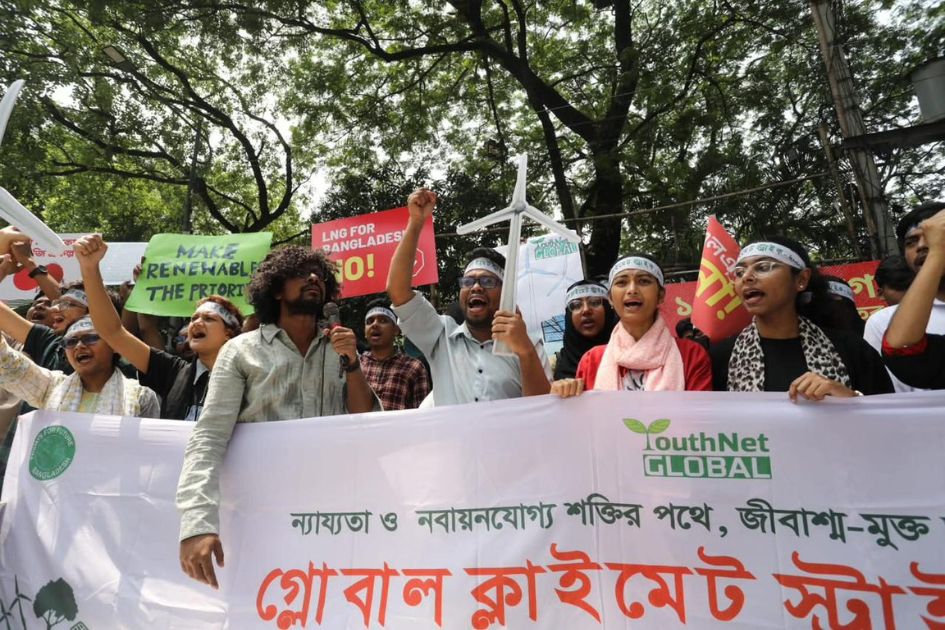

Youth climate activists across Bangladesh urged the government to adopt a time-bound 10,000MW solar roadmap by 2030, warning fossil fuel dependence threatens economic stability, energy security and climate resilience.
Young climate activists in Bangladesh on Thursday demanded a clear, time-bound roadmap for generating 10,000MW of solar power by 2030, warning that continued dependence on imported fossil fuels is threatening the country’s economy, energy security and climate resilience.
More than 200 young people gathered in front of the National Press Club in Dhaka as part of the Global Climate Strike, carrying banners and placards reading “Solar for Survival” and “No Future in Fossil Fuels.”
The programme was organised by YouthNet Global and Youth for NDCs, while similar demonstrations were held simultaneously in 50 districts across the country.
Chanting slogans calling for “10,000MW solar by 2030,” the protesters urged the government to include a significantly higher share of renewable energy in the upcoming Energy and Power Sector Master Plan (EPSMP).
The protests reflect growing anxiety across climate-vulnerable developing nations over how global conflicts, fuel market shocks and geopolitical instability are worsening domestic energy crises.
Speakers at the rally said Bangladesh’s growing reliance on imported LNG, oil and coal is increasing electricity costs and placing additional pressure on ordinary citizens already struggling with inflation and economic uncertainty.
Addressing the gathering, Sohanur Rahman said Bangladesh cannot achieve climate justice while remaining dependent on imported fossil fuels.
“Every new LNG import deal deepens Bangladesh’s vulnerability,” he said.
He added that young people are demanding a just transition powered by affordable, locally generated and sustainable renewable energy.
“The upcoming EPSMP must include a clear roadmap for at least 10,000MW of solar power by 2030,” he said.
Amanullah Porag, founder and executive director of Youth4NDC, said ordinary people are already paying the price of global energy instability.
“Our economy is suffering from rising fuel and electricity costs. We need affordable energy and an immediate shift toward renewables,” he said.
The protesters warned that Bangladesh’s LNG-heavy energy model is undermining long-term economic stability and energy sovereignty.
They also criticised delays in implementing earlier renewable energy commitments, including the government’s previous target of generating 3,300MW of rooftop solar power from public buildings by December 2025.
Activists said implementation gaps, policy uncertainty, high taxes on solar equipment and slow project approvals continue to hinder renewable energy expansion.
They demanded the immediate removal of tax barriers on solar technology, faster project approvals and stronger coordination among government agencies.
Expressing solidarity with the youth movement, Shafiqul Alam said renewable energy is essential for both climate resilience and national energy security.
He welcomed government plans to expand renewable energy development but stressed the need for clear implementation mechanisms and monitoring systems.
Meanwhile, Sharif Jamil said renewable energy development has become an urgent national priority amid ongoing global unrest and disruptions in fuel supply chains.
“We must expand solar and wind power as quickly as possible,” he said.
He also urged the government to utilise unused land allocated for coal- and gas-based power plants for large-scale solar projects.
The activists said Bangladesh, as one of the countries most vulnerable to climate change, must accelerate its transition away from fossil fuels in line with international climate commitments.
They also called on developed countries to honour climate finance pledges and support renewable energy transitions in vulnerable nations through funding and technology transfer.
As the rally ended, protesters continued chanting for “10,000MW solar by 2030,” signalling a growing youth movement pushing Bangladesh toward a renewable energy-driven future.




