




Rising temperatures, shrinking pastures and economic pressures are pushing Nepal’s yak herding into decline, endangering livelihoods while increasing disease risks and threatening the survival and genetic integrity of wild yaks.
In the remote highlands of western Nepal, a way of life built around yaks is steadily eroding under the combined pressure of climate change, economic hardship and social change.
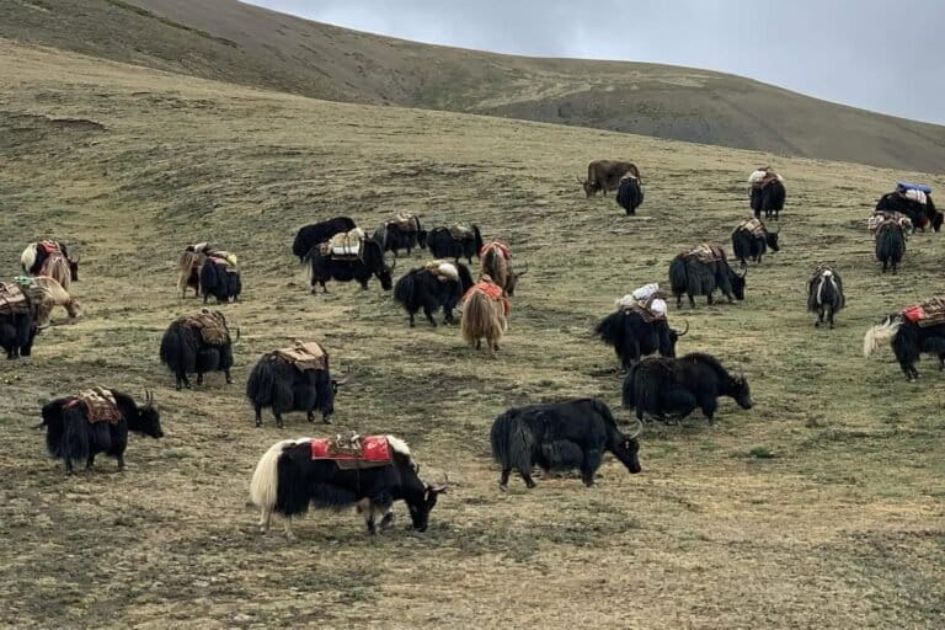
In Dolpa district, one of the country’s largest and most isolated regions, 24-year-old Youngdung Jhama Lama recalls a childhood spent herding nagton, or domesticated yaks, across wide alpine pastures. Today, her family owns just four.
“We only have four yaks left now,” she said, reflecting a broader decline in traditional herding across Himalayan rangelands.
Yaks (Bos grunniens) have long been central to mountain livelihoods, valued for transport, meat and wool. But herders say rising costs, shrinking grazing land, disease outbreaks and weak market access are making yak rearing increasingly difficult. These pressures are also affecting wild yaks (Bos mutus), their rare high-altitude relatives.
“My family sold dozens of them in the neighboring Mustang district last fall because it was more labor-intensive and costly to rear them, and we had limited kharka to graze them,” Lama said, referring to pastureland.
Migration is compounding the crisis. Young people are leaving mountain communities in search of work in cities or abroad, reducing the available labor force. According to Nepal’s 2021 census on internal migration, in-migration to mountain regions rose from 9,698 people, or 2.2 percent, in 1971 to 75,542, or 2.4 percent, in 2021. However, out-migration far exceeded arrivals, resulting in a net loss of 543,966 people.
Scientists say climate change is transforming the fragile ecosystems that sustain yak herding. The International Centre for Integrated Mountain Development (ICIMOD) reports that warming temperatures are altering water cycles in high-altitude landscapes, shifting the timing and availability of moisture.
These changes are affecting vegetation growth, soil carbon storage and the rate at which organic matter decomposes. At the same time, drying wetlands and peatlands are raising fire risks, while glacial changes threaten to submerge some grazing areas.
Herders are also reporting an increase in disease among yaks.
“The infections are lethal. We have to walk for days to fetch a veterinarian, and in case the yak dies, the insurance amount is too low for herders to reach the rural municipality office to claim it,” Lama said.
While the direct link between climate change and disease spread remains unclear, researchers warn that rising temperatures and shifting climatic patterns may disrupt traditional fodder sources, negatively affecting animal health, productivity and disease resistance.
Cross-border grazing routes have also been disrupted. Since the closure of the Morimla and Kato crossings on the Nepal-China border following the COVID-19 pandemic, herders have lost access to seasonal pastures and markets.
“After the closure, herders could not graze their yaks across the border, leading some of them to sell their yaks and raise cattle and goats instead. Unlike yaks, they graze all season, increasing the risk of overgrazing,” Lama said.
Limited demand for yak products has further weakened the sector.
“There are no local markets to sell the cheese and wool, and it’s costly to get them to big markets in Kathmandu or other districts,” she added.
Experts warn that these pressures are also threatening wild yak populations, which are already scarce. Although exact numbers are unknown, estimates suggest fewer than 10,000 remain in the wild. Occasional sightings in Nepal’s Upper Humla region indicate that small populations may persist in remote districts such as Dolpa.


Krishna Prasad Acharya, a veterinarian at the Department of Livestock Services, said shrinking and degrading rangelands could force wild and domestic yaks into closer contact.
“As grazing grounds overlap, crossbreeding becomes more likely,” he said. “Because wild yaks are rare and carry a unique genetic makeup, the exchange through crossbreeding could threaten the genetic purity of wild yak populations.”
Research shows that crossbreeding can alter adaptive traits needed for survival in extreme high-altitude environments, increasing conservation risks.
Some herders, however, have experimented with crossbreeding in the hope of producing stronger animals. Lama’s father, Karma Rikjin Lama, said wild yaks, known locally as dong, have long been present in the landscape but are now rarely seen.
“The calves are physically stronger and resistant to diseases, unlike the domestic ones. But chances are that these calves get along with the wild herds and don’t prefer to be domesticated. It’s only beneficial for us if they choose to stay back,” he said.
Researchers caution against the practice. Naresh Kusi, a PhD scholar at the University of Inland Norway who has studied wild yaks in Upper Humla, said crossbreeding has created challenges for herders.
“The calves are physically bigger and tougher for female yaks to birth,” he said, noting that some herders in the Limi Valley avoided crossbreeding for fear of losing their animals. “Given their genetic differences, the calves are more aggressive and difficult to tame.”
Meanwhile, competition from other livestock is increasing. Sheep and goats, which are easier to manage, are becoming more common in some areas.
Human activity is adding further strain. Overharvesting of yartsa gunbu, a highly valued fungus also known as Ophiocordyceps sinensis, is reducing a key food source for wild yaks.
Despite these challenges, Lama said traditional knowledge still plays a crucial role.
“We allow the yaks to graze based on our knowledge of rotational grazing and keep track of every change around our pasture and overall environment,” she said.

But as herding declines due to degraded rangelands, disease-related calf deaths and rising costs, this knowledge is at risk of disappearing.
Acharya stressed that conservation efforts must involve local communities.
“Conservation does not exist in isolation,” he said, adding that herders’ knowledge is essential for protecting both ecosystems and wildlife.
Kusi called for stronger measures to safeguard the species, including the creation of protected habitats where wild yaks can roam freely without interference from livestock.
“This could be one key solution in sight for wild yak conservation, given multiple threats for both the species,” he said.




