

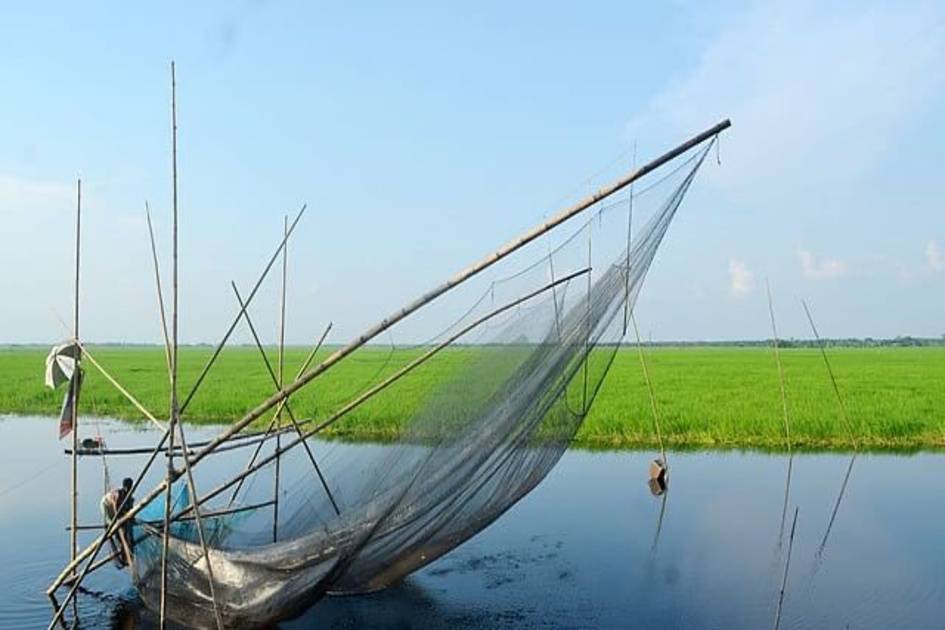



Bangladesh’s largest wetland, Chalan Beel, has shrunk by 85% over a century due to infrastructure and encroachment, threatening biodiversity, disrupting farming livelihoods and exposing urgent water management challenges.
Once a thriving natural wonder, Chalan Beel in Bangladesh was a vast water expanse where fishermen thrived, kingfishers hunted and life flowed with the rhythms of the monsoon. Today, that vibrant ecosystem is a shadow of its former self as decades of human intervention, encroachment and infrastructure development have disrupted its delicate balance.
Historical Decline
Over the past century, Chalan Beel’s area has shrunk dramatically. A recent survey by the Center for Environmental and Geographic Information Services (CEGIS) found that the wetland has contracted by 85 percent, from around 1,085 square kilometres in 1914 to just 168 square kilometres during the monsoon and 52–78 square kilometres in winter. Historically, the wetland spanned 41 upazilas across six districts, connecting 163 smaller water bodies through 47 rivers and more than 90 canals. Today, it covers only nine upazilas in Pabna, Natore and Sirajganj.
Early infrastructure projects such as the Ishwardi–Sirajganj railway line built in 1914 began fragmenting the wetland. In the 1980s, sluice gates and embankments disrupted the Boral River, Chalan Beel’s main lifeline. Between 1995 and 2010, roads, culverts and the Hatikumrul–Bonpara highway further choked water flow while unplanned encroachment continues to threaten key water channels.
Farmers Struggle
Local farmers bear the brunt of Chalan Beel’s decline. Abdus Salam, 60, from Sarara village in Pabna said monsoon water no longer drains naturally, leaving cropland waterlogged. “Mustard cultivation was impossible this year,” he said.
In Singra upazila, Ashraful Islam noted that clearing one bigha of land now costs 10–12 labourers and Tk 6,000–7,000 due to waterlogging and rampant water hyacinth growth. Saidur Rahman from Chatmohar explained that diesel-powered pumps have replaced free surface irrigation, increasing costs by Tk 3,000–4,000 per bigha while falling water tables require deeper pumps each year.
Farmers say restoring canals or providing electricity for irrigation could halve costs, underscoring the importance of coordinated intervention.
Biodiversity Loss
Chalan Beel was once home to 81 fish species. Today only 27 remain with 10 endangered and five critically vulnerable. Annual natural fish production fell from more than 25,000 tonnes before 1982 to 12,217 tonnes in 2007.
Despite these losses, the region contributes significantly to national food security, producing 1.98 million tonnes of paddy annually. This meets about 5 percent of national rice demand, 29 percent of garlic, 14 percent of mustard and 8 percent of lentils. Annual agricultural output in Chalan Beel is valued at more than Tk 15,000 crore.
SM Mizanur Rahman, founder of the “Save Chalan Beel Movement,” warned: “No financial gain can compensate for the environmental damage. We are deliberately killing this natural wetland for short-term convenience.”
Government Response
The government has launched a feasibility study to save Chalan Beel led by the Department of Bangladesh Haor and Wetland Development. The study is expected to conclude in February 2027. Project director Md Tanvirul Haque said: “We aim to identify the real problems and find solutions to restore the wetland.”
BWDB’s Rajshahi divisional engineer Md Mokhlesur Rahman added: “Different authorities often work on separate projects without coordination. This leads to destruction. We must dredge rivers and canals collectively to save Chalan Beel.”
Looking Ahead
Chalan Beel’s decline is a stark reminder that development without environmental foresight comes at a heavy cost. With coordinated policy, restored waterways and responsible conservation initiatives, Bangladesh still has a chance to protect this wetland while preserving biodiversity and supporting livelihoods.
The story of Chalan Beel is more than a local crisis. It is a warning about the challenge of balancing development, water management and ecosystem protection.




