

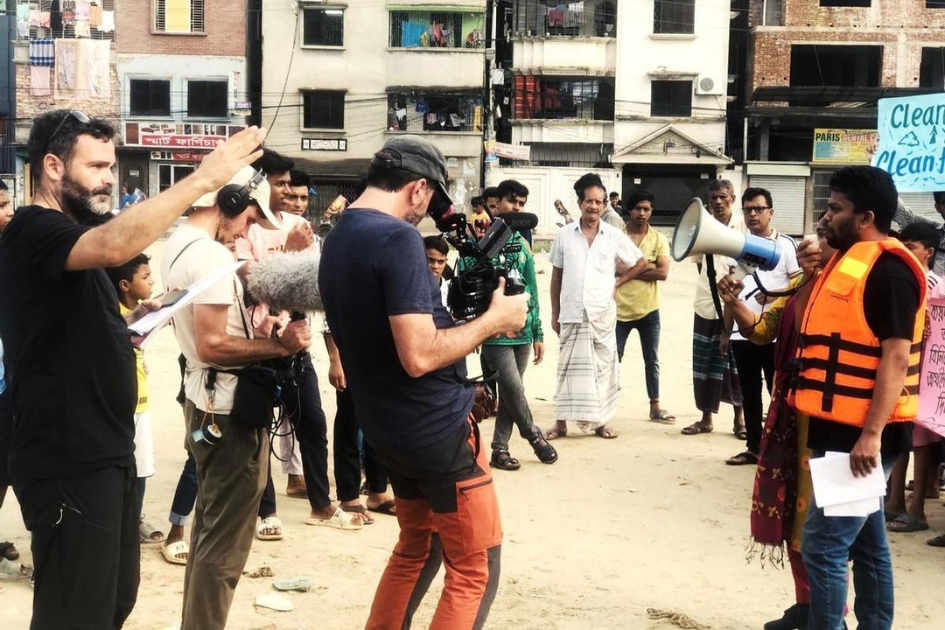



The documentary Black Water screened at Geneva’s FIFDH spotlights climate displacement in Bangladesh and youth-led climate justice movements bringing global attention to communities forced to migrate by storms and erosion.
The documentary Black Water has captured international attention and widespread praise after being screened at the International Film Festival and Forum on Human Rights (FIFDH) in Geneva, Switzerland. The festival, taking place from March 6 to 15, brings together films, debates and discussions on global human rights issues. Directed by Spanish filmmaker Natxo Leuza, the film was presented in both the public and schools programmes in Geneva, engaging audiences of all ages in conversations about the human impact of climate change.
The film also highlights Bangladesh’s youth-led climate justice movement, including the efforts of YouthNet Global, showing young people organizing climate strikes, raising awareness and advocating for policy change amid the escalating climate crisis. This focus on youth activism demonstrates how communities are taking action to address the climate emergency while enduring its immediate impacts.
Black Water follows a woman, Lokhi, and her family in southern Bangladesh as they prepare to flee their rural home. They head to Dhaka, one of the fastest-growing megacities in the world, as storms, cyclones and river erosion force thousands of people every day to seek refuge in the capital. Her journey reflects not just one family’s struggle but a broader pattern affecting millions in Bangladesh who are repeatedly displaced by the country’s increasingly extreme climate.
The documentary unfolds almost like a thriller, moving from the intimate struggles of one family to the broader climate-driven transformation of landscapes and cities. While Lokhi’s journey is deeply personal, it mirrors a wider national and global crisis, showing what the future may hold for many regions around the world.
Bangladesh sits in the world’s largest river delta, formed by the Ganges, Brahmaputra and Meghna rivers. Generations of people have adapted to seasonal floods and monsoon cycles, but climate change is intensifying these natural processes, bringing stronger storms, rising waters and increased displacement.
The film warns of a looming “climate apartheid,” where the rich can pay to escape the worst effects of global warming, famine and conflict while the poorest suffer most. By 2050, Bangladesh’s population could reach 220 million, with large parts of its low-lying territory permanently submerged. Between 10 and 30 million people could be forced from the southern coastline alone. Globally, climate refugees are expected to reach 250 million by mid-century, representing the largest mass migration in human history. This highlights the urgent challenge for cities like Dhaka to accommodate such large-scale displacement and find solutions for those who are forced to leave their homes.
Black Water also highlights the human resilience behind these statistics. Scenes show a mother hurriedly tying her daughter’s hair before a storm, saying “in case we have to run,” and families salvaging tin and wood to rebuild their homes while the ground is still wet. Cyclone warnings are delivered by loudspeakers as communities scramble to reach safe shelters, illustrating the daily reality of life in flood-prone areas.
Speaking about the film, director Natxo Leuza said the most striking moment was seeing how entire lives are repeatedly disrupted by environmental disasters beyond what data and scientific predictions can show.
Sohanur Rahman, Executive Coordinator of YouthNet Global, said the documentary reflects the lived reality of many communities while highlighting the growing role of Bangladeshi youth in climate justice. “Climate change is not a distant threat here. It is a daily struggle,” he said. “Documentaries like Black Water help people around the world understand the human stories behind the crisis. Storytelling bridges the gap between science, policy and public awareness, giving affected communities a global voice.”
By combining personal stories with the realities of climate change, Black Water reminds international audiences that the crisis is already reshaping lives today, particularly in vulnerable countries like Bangladesh, while also showing the determination of youth and local communities to fight for climate justice.




