

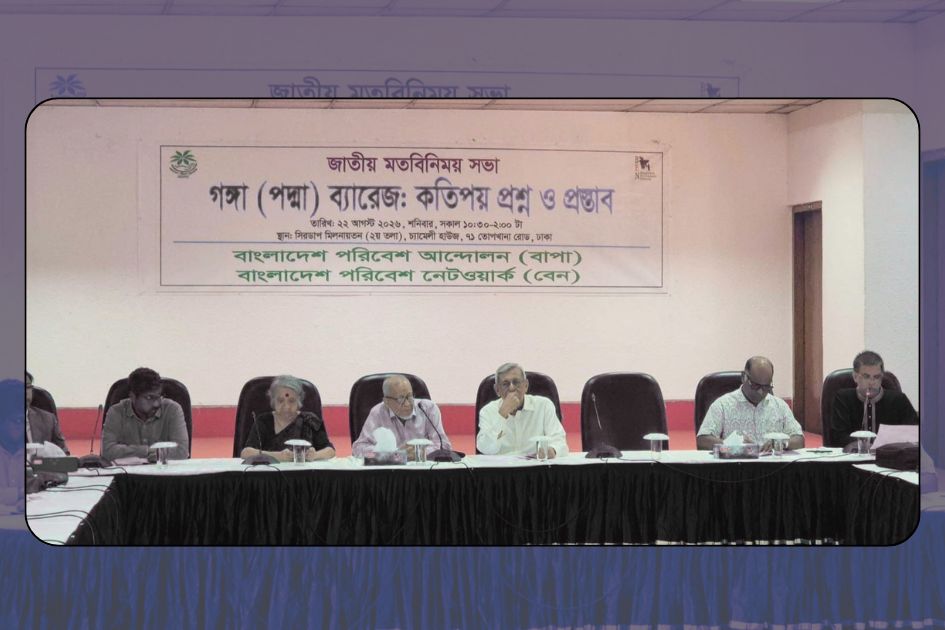



Experts at a Dhaka discussion debated whether the 2.1-kilometre barrage can secure dry-season water without worsening floods, erosion, sedimentation and downstream stress.
Bangladesh Poribesh Andolon (BAPA) has raised 10 questions over the proposed Ganges, or Padma, Barrage project, questioning the age of data used in its feasibility study, the availability of dry-season water, possible upstream and downstream impacts and the justification for an expensive project under the country’s current economic conditions.
The questions were raised at a national discussion titled “Ganges (Padma) Barrage: Some Questions and Proposals,” jointly organised by BAPA and the Bangladesh Environment Network (BEN) at the CIRDAP auditorium in Dhaka at 10:30 am on Saturday, August 22, 2026.
BAPA President Professor Nur Mohammad Talukder chaired the event and General Secretary Md Alamgir Kabir conducted it. Professor M Firoz Ahmed delivered the welcome remarks.
The main paper was jointly presented by Dr Nazrul Islam, vice-president of BAPA, professor at the Asian Growth Institute and former head of the United Nations Development Research Division and Dr Md Khalekuzzaman, vice-president of BAPA and professor in the Department of Geology and Marine Science at Commonwealth University of Pennsylvania in the United States.
Talukder said countries and areas upstream were always in a favourable position and questioned the secrecy surrounding the project.
“They are undertaking the project, but why is there so much secrecy?” he said, demanding that information about the project be made public.
In his welcome remarks, Firoz Ahmed said water was particularly scarce in the western region because of upstream barriers. He said the proposal for a Ganges barrage had been made decades ago to counter India and described the project as extremely expensive.
He said the government should disclose all information about the project to the public in everyone’s interest.
Presenting the main paper, Nazrul Islam said information available so far showed the proposed barrage would be 2.1 kilometres long and include 78 spillways, or water-release gates, each measuring 18 metres by 12 metres, and 18 undersluices, each measuring 18 metres by 14.5 metres.
The proposal envisages maintaining the water level of the Ganges in Bangladesh at 12.5 metres from Pankha, the border point through which the Ganges enters Bangladesh from India, to Pangsha. This would result in 289.1 crore cubic metres of water being stored in the Ganges channel, according to the presentation.
The feasibility report also says the barrage would have wide-ranging positive environmental impacts in the Ganges-dependent region. Increased flows in rivers would generally improve the environment, while intrusion of saline seawater would decline and many areas now classified as “highly saline” would gradually become “limited saline areas.”
It says freshwater flows into the Sundarbans would increase, helping prevent degradation of the mangrove forest. About 33 percent of the Sundarbans would fall within a “low or tolerable low” salinity zone, while 11,000 hectares would be included in a “very low salinity” zone of less than 0.5 ppt.
According to the presentation, the barrage would allow 7.7 Mm3 of timber and 1.25 Mm3 of crown to be obtained from sundari trees. For gewa, the corresponding figures would be 6.4 Mm3 and 1.1 Mm3. The feasibility report says productivity and biodiversity in the Sundarbans would increase.
Nazrul Islam said the government’s first task should be to sign the 1997 United Nations convention relating to the use of international rivers.
He also said the 30-year term of the Bangladesh-India agreement on sharing Ganges water, signed on December 12, 1996, would soon expire and Bangladesh should begin preparing immediately for negotiations with India over its renewal.
He called on the government to quickly disclose to the public the information and data it holds on the barrage project.
Khalekuzzaman said the fundamental principle of surface-water flow and management should be integrated, basin-based management that takes water, sediment and geomorphological changes into account and shares long-term benefits and adverse effects across the basin, rather than focusing only on the dry season.
Although only 4 percent of the Ganges basin lies in Bangladesh, the basin covers 37 percent of the country’s area and is home to 33 percent of its population, he said.
Bangladesh, as the downstream country, bears the greatest impact of natural and human activities upstream, he said.
Khalekuzzaman said the Ganges water-sharing treaty did not take basin-wide realities into account, including Nepal, while around 300 structures in addition to the Farakka Barrage disrupt the natural flow of water. Climate change and future upstream infrastructure would further disrupt those flows, he said.
According to documents prepared for the Padma Barrage and reports published in the media, the feasibility study was based on water-flow data available up to 2010 and did not incorporate data up to 2026.
The presentation said the study showed that the average April flow during 1997-2020 was 934 cumecs, or 32,970 cusecs, while the minimum flow was 11,649 cusecs and in March it was only 7,483 cusecs.
“Then where will the proposed 28,240 cusecs of water come from?” the paper asked, adding that the Ganges water-sharing treaty contained no guarantee clause.
Khalekuzzaman also said there was serious concern in India over future Ganges flows at Farakka. In 1992-93, he said, flows at Farakka fell below 40,000 cusecs for 20 consecutive days.
Under the treaty, he said, after 35,000 cusecs was diverted to the Hooghly-Bhagirathi, Bangladesh could receive 5,000 cusecs during the critical period from March to May.
He cited Indian environmentalist Kalyan Rudra as saying West Bengal faced a 59 percent supply shortfall against demand in 2025.
The presentation warned that during periods of excessive flow in the Padma, the barrage’s limited storage capacity could cause severe flooding and sediment accumulation over 20 to 30 kilometres upstream. Downstream, strong currents of 4.76 metres per second could cause extensive riverbank erosion.
It also questioned the design for dry-season water shortages, saying it would take 36 days just to store the required 2.9 BCM of water during drought conditions. It argued that the barrage had therefore been designed to deprive downstream areas of water rather than simply storing monsoon flows.
Agricultural economist Professor Dr Jahangir Alam Khan said one argument was that a barrage was needed to collect water for the dry season, while the opposing argument was that the amount collected would not be sufficient.
He said the existing problems should be taken into consideration and that increasing food production and improving farmers’ conditions were more urgent priorities.
Steps should be taken after considering all sides and choosing what would be best for the country, he said.
Dr Md Shahjahan Kabir, former director-general of the Bangladesh Rice Research Institute, said decades of upstream water withdrawal, declining river navigability, climate change and expanding salinity had pushed southwestern Bangladesh into a deep environmental and economic crisis.
Rivers that once flowed throughout the year were now nearly dead during the dry season, he said.
Reduced water flow in the Gorai River had rapidly increased salinity in Khulna, Satkhira and Bagerhat, causing agricultural production to fall alarmingly, reducing freshwater fish and threatening biodiversity in the Sundarbans.
Kabir said many studies and government documents had identified such changes as impacts following the Farakka Barrage.
He said the government had recently approved the Padma Barrage project, triggering extensive discussion and debate at the national level.
Some people viewed the project as a possible “game changer” for protecting Bangladesh’s future water, agriculture and food security, while others considered it extremely expensive, environmentally complex and geopolitically risky, he said.
The project’s main objective is to store water during the monsoon and supply it in a controlled manner during the dry season. The plan includes construction of a roughly 2.1-kilometre barrage at Pangsha in Rajbari, with a planned storage capacity of about 2,900 million cubic metres of water.
Dr Md Sirajul Islam, a professor at North South University, said there were more than 100,000 barrages around the world and that barrages had a definite role.
Bangladesh needed to increase food production and could no longer depend on rainwater for agriculture as it had in the past, he said.
He said the proposed barrage would have uses beyond agriculture, while noting that unnecessary barrages were being removed in many places around the world.
According to Islam, only two locations in Bangladesh were suitable for such barrages, the Padma and the Teesta. Although environmentalists opposed a barrage on the Padma, he said it also had economic importance.
“If not a barrage, what is our alternative?” he said, adding that the question needed to be considered.
Geologist Professor Dr Ahad Chowdhury said the Padma Barrage should be considered part of national development.
He said Bangladesh would fall behind without engineering development, but projects should be undertaken in ways that ensured rivers remained alive and flowing rather than being killed.
Writer and researcher Sheikh Rokon said the government did not publish river-related papers because of a lack of accurate information.
He said people were branded as agents of India when they spoke about the Ganges and argued that the Padma Barrage should instead be called the Ganges Barrage.
The main Ganges River should not be excluded simply because of its connection with the Padma, he said. He also referred to agreements being cancelled for political reasons involving China and India.
Water management expert Malik Fida A Khan said the Padma Barrage would not remain open throughout the year, with the main barrage remaining open only from July 19 to October 10.
He questioned what alternative Bangladesh would have if the barrage was not built, saying the other available options were extremely expensive.
SM Mahbubur Rahman, a former executive director of the Institute of Water Modelling and a senior official involved with the project, responded to the 10 questions raised by Nazrul Islam.
Rahman said the project had been sent to the government for implementation only after sufficient research and that China and India had been taken into consideration in developing it.
Asked why there was so much secrecy surrounding the Ganges project, he said he did not know the answer.
He said the barrage gates would be closed in October, creating reservoirs upstream, and water would be supplied from those reservoirs during the dry season when water was otherwise unavailable.
Rahman said the issue of the barrage’s downstream impacts was covered in a separate chapter detailing the environmental effects downstream.
He expressed support for implementing the project.
BAPA General Secretary Alamgir Kabir expressed disappointment that when the organisation asked the chairman of Bangladesh’s Water Development Board to send an appropriate discussant, the chairman replied that he had no suitable person for the issue.
Others attending the discussion included BAPA Vice-President Mahidul Haque Khan, Professor Dr M Shahidul Islam, organisational secretary Zakir Hossain, joint secretary Mihir Biswas, executive member Humayun Kabir Suman, Advocate Parveen Akhtar, Gaus Peary, Ashraf Amirullah and leaders of BAPA’s central and national committees.
Nazrul Islam’s 10 questions to the relevant government institutions asked why there was so much secrecy surrounding the project; whether the barrage would use only monsoon water during winter; where the discussion of the barrage’s impacts on downstream areas was; why monsoon flows of the Ganges no longer entered its distributaries; where discussion and solutions for waterlogging in southwestern Bangladesh were; how confident the barrage’s advocates could be about sedimentation, flooding and riverbank erosion upstream; how reliable estimates of the various benefits upstream of Pangsha were; whether the barrage would further weaken Bangladesh’s position over Ganges water sharing; why the project was being formulated using such old data and information; and how suitable such an expensive and controversial barrage project was under the country’s current fragile economic conditions.




