

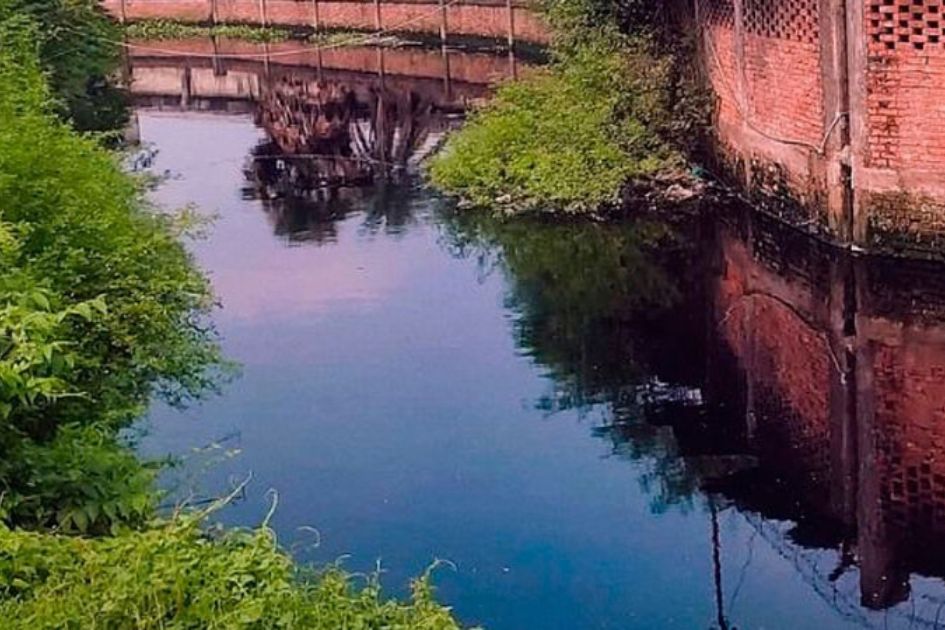

A nationwide study of 56 rivers identifies Lobondoh, Haridhoya and Sutang as Bangladesh’s most polluted waterways, highlighting widespread industrial waste, plastic contamination and worsening water quality across the country.
Industrial waste and microplastic contamination have been detected in nearly all of Bangladesh’s rivers, with studies identifying the Lobondoh River in Gazipur, the Haridhoya River in Narsingdi and the Sutang River in Habiganj as the country’s three most polluted waterways.
Environmental experts say that alongside industrial pollution, plastic contamination has emerged as a growing concern, while municipal waste is adding a new dimension to river degradation across the country.
In 2023, the River and Delta Research Centre (RDRC) conducted a year-long study on pollution in 56 major rivers across Bangladesh. The research assessed water quality in all 56 rivers and found that pollution from plastics and industrial waste has spread not only to rivers near cities and towns but also to waterways in remote areas. Since rivers are interconnected and flowing systems, pollution is carried from one river to another through water currents.
Researchers collected and analysed data using four key pollution indicators commonly employed to assess river health and aquatic characteristics. These included the oxidation properties of water, dissolved oxygen, biological oxygen demand (BOD) and chemical oxygen demand (COD). Samples were collected from different sections of the rivers during the dry season. The study did not take river encroachment or several other environmental parameters into account.
Members of the research team said concern had previously centred on rivers adjacent to urban and industrial areas because factories are concentrated there. However, the latest findings showed that no river in the country remains free from pollution.
“Industries are now being established even in remote regions. As a result, pollution has also been detected in rivers surrounding the Sundarbans. River currents carry contaminants downstream, meaning even rivers flowing through rural communities are affected. Significant levels of plastic pollution from various sources were also found in every river,” the researchers said.
According to the study, the three most polluted rivers recorded almost identical water-quality conditions. The pH levels of Lobondoh, Haridhoya and Sutang were measured at 5, 4.1 and 4 respectively. Water scientists say the pH level of clean water should range between 6 and 7. Water with lower values is considered acidic while higher values indicate alkalinity. Both excessively low and high pH levels can pose serious risks to human health.
The concentration of dissolved oxygen in the three rivers was found to be alarmingly low. Lobondoh recorded a dissolved oxygen level of 0.21, Haridhoya 0.6 and Sutang 0.4. Dissolved oxygen is essential for the survival of aquatic life. Water experts say levels must remain between 4.5 and 8 for fish and other aquatic organisms to survive. Below that threshold, aquatic life cannot be sustained.
A review of the rivers’ histories shows that all three once played important roles in supporting prosperous settlements and local economies.
The Lobondoh River originates at the confluence with the Kshiru River in Bhaluka upazila of Mymensingh district, along the southern boundary of Sreepur upazila in Gazipur district. After winding through a long course, it joins the Turag River near Mirzapur. Once a powerful river, Lobondoh is now facing a severe existence crisis and is increasingly referred to as the “Lobondoh Canal”. It has largely lost its riverine character and is also locally known as Lobolong Khal or Lobolong Nala.
The fast-flowing Haridhoya River, which runs alongside Narsingdi town, was once regarded as a blessing for local residents. The river played a major role in trade, commerce and improving livelihoods. Fertile farmland lined its banks and its waters supported abundant native fish species. Years of encroachment and the discharge of toxic industrial waste have transformed the river into what many residents now consider a curse. Originating from a branch of the Shitalakkhya River between the southwestern part of Monohardi upazila and the northwestern section of Shibpur upazila, the river winds for about 60 to 70 kilometres before meeting the Meghna River at the southeastern edge of Narsingdi town. Fish have virtually disappeared from the river and its water is now considered unsuitable even for animals and birds.
The Sutang River is a transboundary river shared by Bangladesh and India. In Bangladesh’s northeastern Habiganj district, the river stretches 82 kilometres, has an average width of 36 metres and follows a meandering course. Once a swift-flowing river running along the foothills, Sutang has gradually lost much of its historical character over time.
This post is republished from Daily Bonik Barta.




