

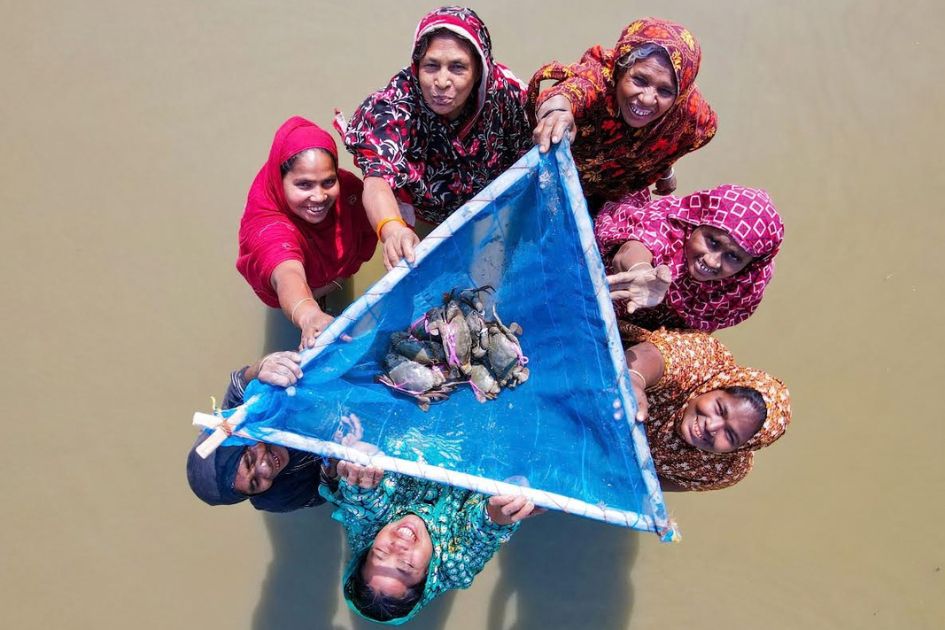



Women in Bangladesh’s climate-vulnerable southwest are building new livelihoods through crab farming, gardening and aquaculture, overcoming salinity, cyclones and social barriers while adapting to an increasingly uncertain future.
In the coastal village of Godara, near the Sundarbans mangrove forest in southwestern Bangladesh, Nurjahan and other women from a crab-farming cooperative abandoned their Eid morning meals and ran toward a collapsing embankment as tidal water rushed into their pond.
“It was Eid day. We couldn’t even cook semai,” Nurjahan recalled. “We just rushed to repair the embankments.”
For the women of the Joba Women’s Livelihood Group, the pond was more than water and mud. It was a fragile attempt to survive on one of the world’s most climate-vulnerable coastlines, where rising salinity, stronger cyclones and erratic weather are steadily reshaping rural life.
Bangladesh is widely considered one of the countries most exposed to climate change. Much of the nation is low-lying, while the southwest coastal region bordering the Bay of Bengal faces overlapping threats from cyclones, tidal surges, sea-level rise, river erosion and salinity intrusion.
In coastal districts such as Khulna and Satkhira, saltwater increasingly enters rivers, ponds and agricultural land, damaging crops and reducing access to freshwater. For many farming families, climate change is no longer a distant environmental issue discussed at international conferences. It is visible in failed rice harvests, saline drinking water, broken embankments and shrinking income opportunities.
Repeated cyclones such as Sidr, Aila and Amphan have left lasting scars across the region. Cyclone Aila alone flooded large parts of southwestern Bangladesh in 2009, contaminating freshwater ponds with saltwater and leaving some agricultural land unusable for years.
Traditional farming has become increasingly uncertain as rising salinity reduces crop choices and extreme weather disrupts agricultural cycles. In response, many women are turning to climate-adaptive livelihoods such as crab farming, hydroponics, fish-feed processing and rainwater-based homestead gardening in an effort to continue earning from the land without abandoning their communities.
Some of those efforts are supported through the “Enhancing Adaptive Capacities of Coastal Communities, Especially Women, to Cope with Climate Change-Induced Salinity” project, also known as the Gender-responsive Coastal Adaptation (GCA) project.
Led by Bangladesh’s Ministry of Women and Children Affairs, the initiative was launched in 2019 with financial support from the Green Climate Fund and co-financing from the Government of Bangladesh. With technical assistance from the United Nations Development Programme (UNDP), the project operates across five upazilas in Khulna and Satkhira: Dacope, Koyra and Paikgacha in Khulna, and Assasuni and Shyamnagar in Satkhira.
According to Ministry of Women and Children Affairs project data, the initiative covers 39 unions and 101 wards with nearly $33 million in committed funding. The project says it has formed more than 1,000 Women Livelihood Groups and installed over 13,000 water facilities in climate-vulnerable communities.
Located on the western bank of the Jhorjhoriya River near the Sundarbans, the group began crab farming after receiving training and support through the GCA project. Members leased land, stocked ponds and hoped crab cultivation would offer a better income than increasingly unreliable traditional farming.
Their first attempt nearly collapsed. Wild crabs and burrowing snakes weakened the pond embankments, causing water to leak continuously. Under intense heat, water temperatures rose sharply and many crabs died. After months of work, the group managed to sell only a few surviving crabs for 740 taka, less than many rural laborers earn in a week.
Instead of giving up, the women leased another pond, rebuilt the embankments and reinvested their earnings.
Then came another setback. Heavy rainfall and tidal surges damaged the embankment during Eid celebrations. Group members rushed from their homes to save the pond before the crabs escaped into floodwater.
“It was Eid morning. We couldn’t even cook semai,” Nurjahan said. “We just rushed to repair the embankments around the pond.”
In Bangladesh, semai is especially associated with Eid celebrations. Families commonly cook semai on Eid morning and serve it to guests.
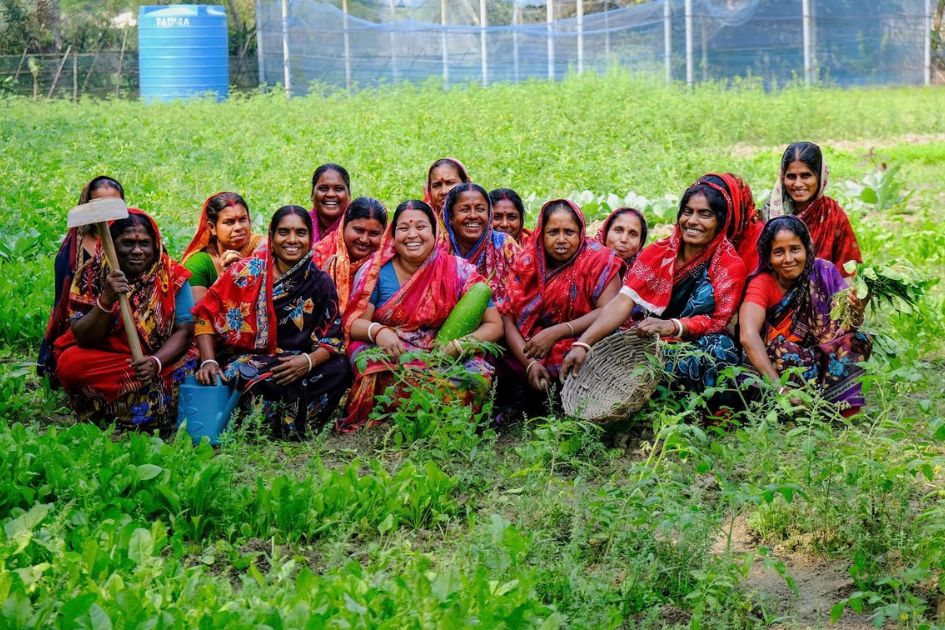
The group has since sold around 30,000 taka worth of crabs and hopes earnings will rise further this year. Still, members acknowledge that one powerful cyclone or embankment failure could erase months of work almost overnight.
Elsewhere in Khulna’s Dacope upazila, 35-year-old Kanaklata Mondol is also trying to adapt to the region’s changing climate.
Her village, Gunari, remains highly vulnerable to salinity and natural disasters more than a decade after Cyclone Aila devastated large parts of Bangladesh’s southwest coast. Traditional vegetable farming often produced too little even for household consumption.
After joining a Women Livelihood Group under the GCA project, Kanaklata received training in homestead gardening, aquageoponics and sesame cultivation. She began using small areas around her home to grow vegetables while also raising fish in a pond adapted for saline conditions.
But the biggest change was social, not agricultural.
In her conservative village, women rarely sold products directly in markets. When Kanaklata first started taking vegetables and fish to nearby markets twice a week, some people mocked and criticized her.
“At first it was very challenging,” she said. “People taunted me.”
She continued anyway.
Today, Kanaklata independently markets her produce in nearby village markets, earning income for her family while challenging local gender norms that once limited women’s movement and economic participation.
“Through this work, I gained confidence,” she said. “Now I can make my own decisions.”
In neighboring Paikgacha, Lipi Akter’s story reflects another side of climate adaptation through diversification.
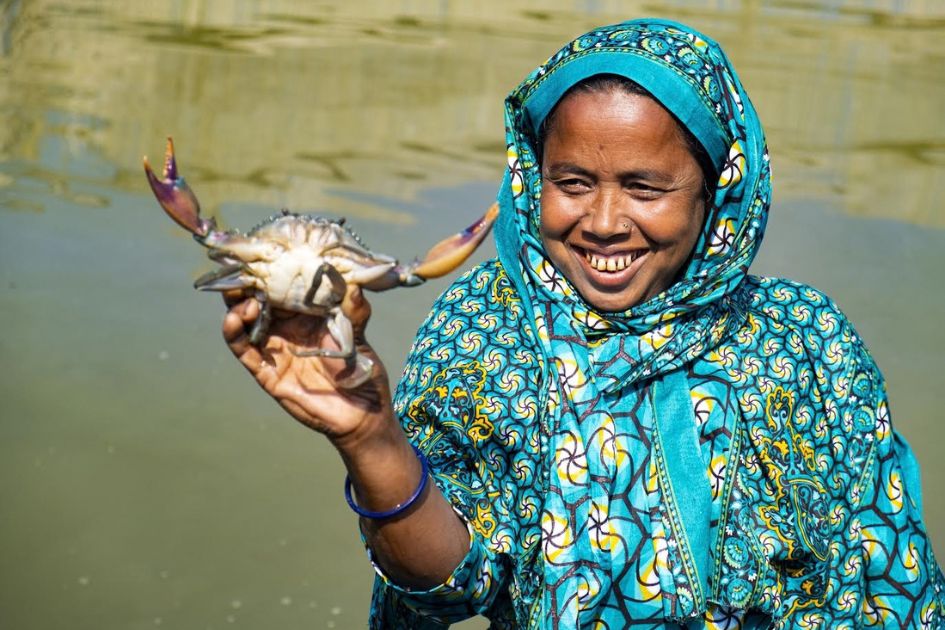
After years of economic hardship and domestic instability, Lipi joined a women-led fish-feed processing business supported by the GCA project. Her group produced fish feed for local farmers while learning business planning and market coordination.
Income from the enterprise later helped Lipi support her injured husband, continue her children’s education and expand into fish cultivation, duck farming and poultry rearing.
“With the increase in my income, my voice has also grown stronger across all levels of society,” Lipi said.
Kholilullah Jibon, a Bangladesh-based climate change researcher, said the southwest coastal belt is facing “compound climate stress” from salinity, freshwater scarcity, heatwaves, tidal flooding and increasingly unpredictable weather.
“These adaptation efforts are important because people cannot simply stop living in these areas,” he said. “But the reality is that one cyclone, one embankment collapse, or one season of failed markets can still destroy months of progress.”
Dr. Md. Romij Uddin, a professor of agronomy at the Faculty of Agriculture, said government initiatives backed by UNDP are increasingly important for women living in coastal and salinity-affected areas where agriculture is becoming more vulnerable.
“This is the high time to adapt,” Uddin said. “Women’s participation can strengthen the fight against extreme salinity and also empower them economically and socially. These initiatives are a good example of how adaptation can work at the community level.”
Even so, many questions remain about whether small-scale climate-adaptive businesses can survive without long-term technical and financial support.
In villages across Khulna and Satkhira, uncertainty still hangs over everyday life: whether embankments will survive the next storm surge, whether freshwater will remain available during dry months, whether crops can withstand rising salinity and whether local markets can provide enough income to justify the risk.
For women like Nurjahan, Kanaklata and Lipi, climate adaptation is no longer an abstract policy discussion. It is daily survival measured through ponds, vegetable beds, rainwater tanks and damaged embankments.
“We still fear the storms,” Kanaklata said softly. “But now, at least, we have something to hope for.”




