

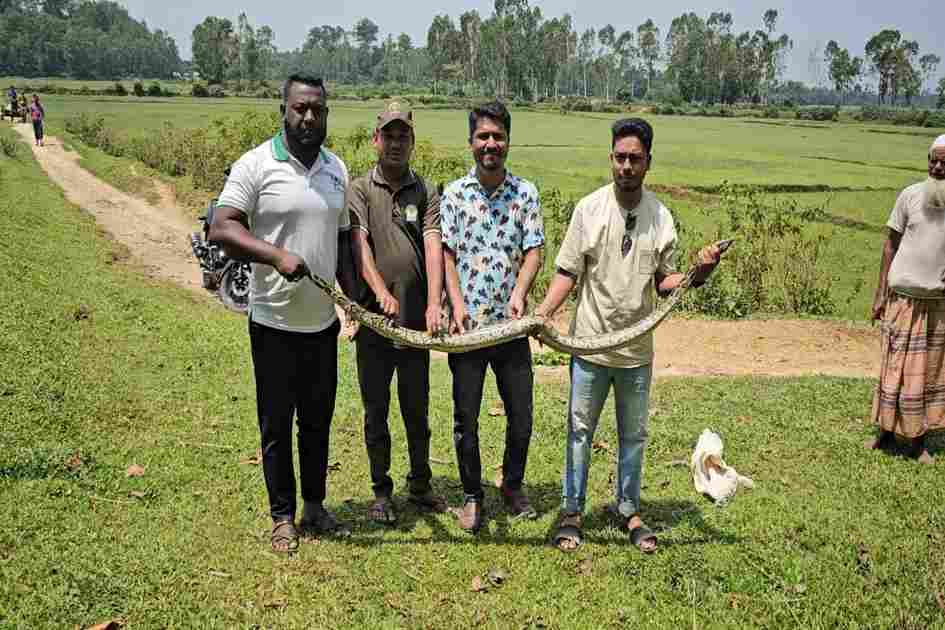

Local volunteers say habitat loss and food shortages are pushing wildlife into border hill villages, where rescue work helps prevent rare animals from being killed or confined.
A group of young volunteers in Bangladesh’s Netrokona district has rescued and released 112 wild animals, including rare and endangered species, between 2020 and June 2026, as part of an effort to protect wildlife straying from forests into human settlements.
The organisation, Save the Animals of Susang, was formed in Durgapur upazila, a sub-district of Netrokona, by 20 young people to rescue pythons, monkeys, pangolins, owls, barking deer and other wild animals that enter local areas from nearby forests.
Rifat Ahmed Rasel, the founding president of the group, said its members carry out rescue operations in different parts of the upazila and release the animals into forests through the relevant authorities.
“We started the organisation with 20 young people. The number of members is still 20. But 10 of them are currently working actively,” Rasel said.
“So far, we have been able to rescue 112 wild animals and release them into the forest with the help of the relevant forest department. These include 29 pythons, 17 slow lorises, one barking deer, one critically endangered pangolin, six civet kittens, one Asian leaf turtle, one ferret-badger, eight egrets, two green pit vipers, five fishing cats and one lizard,” he said.
Rasel said indiscriminate deforestation was destroying forests and depriving wildlife of safe habitats.
“Wild animals are losing their safe shelters. Because of the lack of safe habitats, many species of wild animals are disappearing day by day,” he said.
He said various wild animals are often seen in the border region as they move into human settlements because of forest destruction and food shortages.
“Everyone needs to be more aware to protect the balance of the environment and wildlife. Otherwise, people themselves will have to face the adverse consequences,” Russell said.
Anisul Haque Sumon, joint general secretary of Save the Animals of Susang, said the group often learns through social media that critically endangered and rare wild animals have been captured in border hill villages.
“We then rescue them and take necessary steps after talking to the relevant authorities,” Sumon said.
“Sometimes we have to use different techniques to rescue wild animals and, when necessary, seek help from the local upazila and police administration,” he added.
A forest official said wild animals are often rescued in the hilly border areas of Durgapur and Kalmakanda.
“The volunteers of Save the Animals of Susang, a voluntary organisation working to protect the environment and wildlife, rescue various rare species of wild animals and bring them to us. After talking to higher authorities, we release them into the forest on the advice of officials of the Wildlife Crime Control Unit,” the official said.
Kamrul Islam, a junior wildlife scout at the Wildlife Crime Control Unit, thanked the volunteers for handing over rare, endangered and nearly extinct wild animals after rescuing them.
“At different times, wild animals come from India into the localities of Durgapur and Kalmakanda in Netrokona. Ordinary people kill them. Some keep them confined. That is not right,” Islam said.
The private research organisation BARCIK and the Rajshahi Green Coalition Committee have awarded Save the Animals a biodiversity honour for its special contribution to wildlife and environmental protection.




