


Bangladesh is developing an implementation framework for its Third Nationally Determined Contribution that places decent work, social protection and inclusive economic transformation alongside climate mitigation and adaptation priorities.
Bangladesh has begun integrating Just Transition principles into its national commitment, named the NDC 3.0 implementation plan, through a high-level inter-ministerial consultation, aiming to ensure that climate action protects workers, creates decent green jobs and strengthens resilience for climate-vulnerable communities already facing rising temperatures, floods, river erosion, coastal salinity and other climate impacts.
Among the countries most vulnerable to climate change, Bangladesh is reshaping its climate pathway to ensure that the transition towards a low-carbon and climate-resilient future delivers not only greenhouse gas emission reductions but also decent employment, social protection, equity and opportunities for all.
The country has taken a significant step towards embedding the principles of Just Transition into the implementation framework of its Third Nationally Determined Contribution (NDC 3.0), recognising that climate action must protect livelihoods while creating pathways for sustainable economic transformation.
A Just Transition refers to moving towards a climate-friendly economy while ensuring that workers, communities and vulnerable groups affected by environmental and economic changes receive protection, skills development, social security and access to new livelihood opportunities.
Speakers at the consultation stressed that, for Bangladesh, Just Transition cannot be limited only to mitigation or energy transition. As a climate-vulnerable developing country, Bangladesh’s climate pathway must also address adaptation, climate-induced displacement, loss and damage, livelihood protection and resilience-building for communities already experiencing climate impacts.
Unlike economies where Just Transition discussions often focus mainly on moving away from fossil fuel industries, Bangladesh’s transition is shaped by climate vulnerability, adaptation challenges, livelihood insecurity and the need to create opportunities for a young and growing workforce.
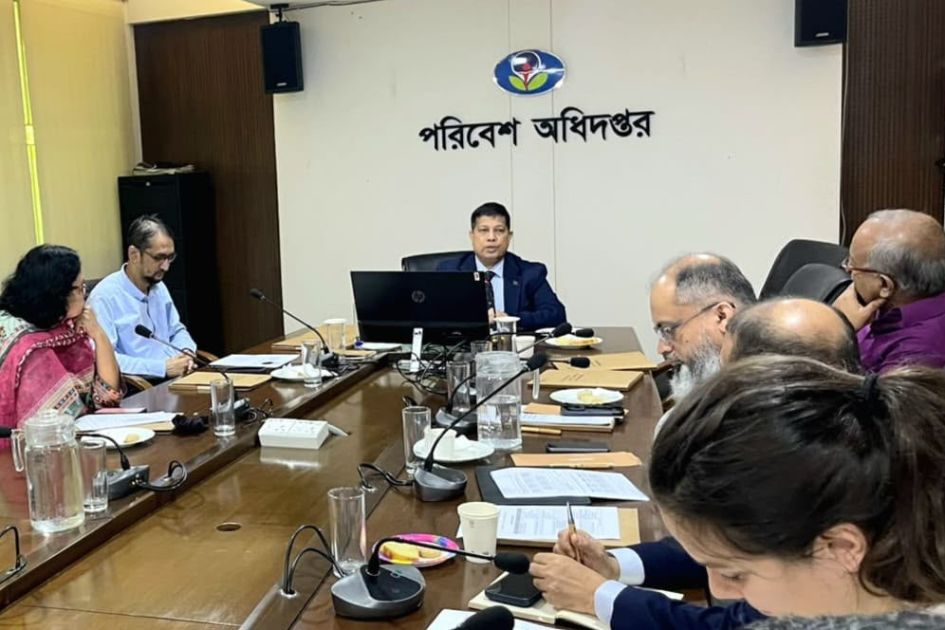
The Department of Environment (DoE), under Bangladesh’s Ministry of Environment, Forest and Climate Change, organised the high-level inter-ministerial consultation on July 26 at its seminar hall in Agargaon, Dhaka, to discuss the integration of Just Transition into Bangladesh’s NDC 3.0 Implementation Plan.
The consultation, titled “Building Bangladesh’s Just Transition Pathway,” was jointly convened by the Department of Environment, the International Labour Organization (ILO) Bangladesh, the South Asian Network on Economic Modeling (SANEM) and Sida, Sweden.
The dialogue brought together senior government officials, trade union leaders, employers’ organisations, financial institutions, researchers, youth representatives and development partners to develop a participatory framework for implementing Bangladesh’s climate commitments.
While Bangladesh has already submitted its NDC 3.0 to the United Nations Framework Convention on Climate Change (UNFCCC), the country is now preparing a comprehensive implementation plan with technical support from the ILO.
Bangladesh’s climate transition comes at a critical moment as the country faces multiple challenges, including its upcoming graduation from Least Developed Country status, increasing global climate-related trade requirements such as the European Union’s Carbon Border Adjustment Mechanism, rapid technological automation and the need to create employment opportunities for millions of young people.
Home to one of the world’s largest youth populations, Bangladesh faces the challenge of creating millions of decent employment opportunities while preparing its workforce for a changing climate and economy.
Participants noted that Just Transition will require investment not only in clean technologies but also in new industries, green entrepreneurship, skills development and innovation to ensure that climate action becomes an opportunity for economic transformation.
The transition must address the needs of workers in vulnerable sectors, including agriculture, ready-made garments, transport, construction, waste management and emerging gig economy jobs.
Agriculture remains particularly important because millions of rural households depend on climate-sensitive livelihoods that are increasingly affected by floods, droughts, salinity intrusion, changing rainfall patterns and rising temperatures.
The ready-made garment sector, which employs millions of workers and remains central to Bangladesh’s export economy, will require support for cleaner production, worker reskilling, energy efficiency and climate-resilient industrial practices.
Informal workers, who represent a significant share of Bangladesh’s workforce and often lack social protection, are among those facing the greatest risks from rising temperatures, extreme weather events, livelihood disruption and economic restructuring.
Gig workers, including delivery riders and app-based service workers who spend long hours outdoors, face increasing exposure to extreme heat while often lacking adequate workplace protections and social security.
For millions living in coastal areas, river islands and climate-exposed regions, the success of NDC 3.0 will not only be measured by greenhouse gas emission reductions but also by whether people can protect their homes, livelihoods and future.
Climate-induced migration and displacement will remain a major concern as communities affected by river erosion, flooding, salinity intrusion and extreme weather events increasingly seek new livelihood opportunities in urban areas.
Bangladesh has long advocated for stronger adaptation action, climate finance and international support for vulnerable countries, arguing that communities already experiencing climate impacts need resources to build resilience alongside global efforts to reduce emissions.
Bangladesh’s climate strategy is also aligned with broader adaptation priorities, including strengthening climate-resilient agriculture, protecting coastal communities, improving urban resilience and supporting communities facing climate-induced displacement.
As Bangladesh advances its climate commitments under the Paris Agreement, policymakers and stakeholders emphasised that the country’s pathway must remain green, fair and resilient, creating opportunities while protecting people and the planet.
Climate action must protect jobs and livelihoods
Speaking as the chief guest, Mohammad Navid Safiullah, Additional Secretary (Climate Change Wing) at Bangladesh’s Ministry of Environment, Forest and Climate Change, said Bangladesh’s NDC 3.0 provides a roadmap for low-carbon, climate-resilient and inclusive development.
“A Just Transition is about advancing climate action in a way that creates decent jobs, protects livelihoods and leaves no one behind. Through strong collaboration across government and active engagement of the private sector, workers’ and employers’ organisations, Bangladesh can translate the commitments of NDC 3.0 into inclusive and effective action,” he said.
He called for a whole-of-government approach, stronger inter-ministerial coordination, regular tripartite dialogue among government, employers and workers, private sector engagement and sector-based action plans with clear timelines.
Md. Abdur Rahim Khan, Additional Secretary at Bangladesh’s Ministry of Labour and Employment, emphasised that workers’ voices must remain central to Bangladesh’s climate transition.
He highlighted the importance of tripartite dialogue, stronger trade union participation, support for small and medium enterprises and the formation of an inter-ministerial task team to accelerate the Just Transition process.
Mesbah Uddin Ahmed, Chairperson of the National Coordination Committee for Workers’ Education (NCCWE), said Bangladesh’s informal workforce must be placed at the centre of the Just Transition discussion.
He said outdoor workers in Bangladesh’s capital are facing longer heat exposure, declining earnings and limited protection as the country debates a fair transition for its informal workforce.
“From gig riders working through heatwaves to rickshaw pullers working under extreme temperatures, the people who keep cities moving are paying the highest price for a warming world,” he said.
Elisa Benistant Fremigacci, Technical Officer for Just Transitions at the International Labour Organization (ILO), and Zubayer Hossen, Programme Director at SANEM, delivered keynote presentations focusing on labour protection, skills development, social dialogue and evidence-based policymaking.
The consultation was chaired by the Director General of the Department of Environment and included representatives from the Ministry of Finance, the Ministry of Agriculture, the Economic Relations Division, the Power Division, the Ministry of Industries, the Bangladesh Garment Manufacturers and Exporters Association, the Bangladesh Employers Federation, the SME Foundation, the National Coordination Committee for Workers’ Education, trade unions, financial institutions and other stakeholders.
Officials said the process represents a shift away from traditional top-down climate policymaking by involving key actors from the beginning of the implementation process.
$116 billion climate roadmap
Dharitri Kumar Sarkar, Joint Secretary (Climate Change-3 Wing) at Bangladesh’s Ministry of Environment, Forest and Climate Change, said Bangladesh’s NDC 3.0 implementation roadmap requires an estimated $116.18 billion through 2035.
The plan aims to achieve an unconditional greenhouse gas reduction target of 6.39 per cent and a conditional reduction target of 13.92 per cent, representing a combined potential reduction of 20.31 per cent from business-as-usual levels.
The roadmap focuses on renewable energy expansion, energy efficiency, industrial transformation, building sector reforms and broader climate resilience measures.
Bangladesh is also preparing its Long-Term Low Emission Development Strategy, outlining a pathway towards resilient and low-carbon development by 2050.
Stakeholders highlighted that the financing requirement demonstrates the scale of investment needed for Bangladesh to simultaneously pursue greenhouse gas emission reductions, climate adaptation, resilience-building and socially inclusive economic transformation.
Bangladesh has repeatedly stressed that climate-vulnerable countries require greater access to predictable international finance because the burden of climate impacts falls disproportionately on communities that have contributed least to global emissions.
Significant international climate finance, technology transfer and capacity-building support will be essential to implement these commitments while ensuring that the transition remains fair and equitable.
Green jobs and worker-centred transition
Director General of the Department of Environment Dr Md. Lutfur Rahman said environmental safeguards and job creation are two major priorities guiding development initiatives.
“The government’s focus is on two key issues in development projects: environmental safeguards and job creation, especially for young people. We will not take any action that creates job losses. Through accelerating Just Transition, we want to create new green jobs and green enterprises,” he said.
Stakeholders stressed that the transition must focus on creating decent, safe and sustainable green jobs with social protection rather than employment opportunities alone.
Businesses will also play a critical role by investing in green technologies, reskilling workers, improving workplace safety and ensuring that competitiveness does not come at the expense of labour rights.
Industries such as garments, textiles, manufacturing and energy will require investment in cleaner technology, renewable energy, resource efficiency and worker skills development to remain competitive in global markets.
A gender-responsive approach will also be essential, as women workers, particularly those engaged in agriculture, informal employment and climate-affected rural economies, often face greater risks from climate change, livelihood insecurity and limited access to emerging green employment opportunities.
Targeted support, including skills development, financial access and safe employment pathways in emerging green sectors, will be important to ensure women benefit from the climate transition.
Youth and communities must not be left behind
Recent studies highlight that a growing green skills gap could threaten Bangladesh’s climate transition. Youth advocates are calling for climate education to be integrated into national curricula, universities to redesign programmes around green skills and greater investment in youth-led climate solutions.
Sohanur Rahman, Executive Coordinator of YouthNet Global, said climate transition must be designed as a people-centred process.
“Just Transition cannot only be an energy transition; it must be a people’s transition. Millions of young people in Bangladesh are seeking decent employment opportunities while climate impacts are threatening traditional livelihoods. NDC 3.0 must ensure that young people, women, informal workers and climate-vulnerable communities are not left behind,” he said.
He added that young people must not only be viewed as beneficiaries of climate action but as partners and decision-makers.
“Dedicated climate finance for youth-led initiatives, capacity building and meaningful youth representation are essential to ensuring that the transition creates opportunities for the next generation,” he said.
Youth representatives also called for institutional mechanisms to ensure meaningful youth participation in climate policy development, implementation monitoring and access to climate finance.
Bangladesh and the global Just Transition agenda
Mirza Shawkat Ali, Director of Climate Change and International Convention at the Department of Environment, highlighted the importance of the emerging global Just Transition framework ahead of COP31, scheduled to be held in Antalya, Türkiye, in November 2026.
He said the Belém-Antalya Mechanism on Just Transition is expected to advance towards operationalisation at COP31 after being established as a milestone under the United Arab Emirates Just Transition Work Programme at COP30 in Belém, Brazil.
The mechanism aims to bridge implementation gaps in the global shift away from fossil fuel dependency by protecting labour rights, strengthening social safeguards and providing international support for frontline communities and workers.
The mechanism is expected to provide a platform for international cooperation on ensuring that climate action is socially fair, particularly for workers and communities affected by economic transformation.
The global Just Transition agenda focuses on protecting workers and livelihoods, ensuring human rights and inclusion in climate decisions and expanding access to finance, technology and capacity-building support for developing countries.
Bangladesh’s experience could provide important lessons for other climate-vulnerable developing countries seeking to balance climate ambition with poverty reduction, employment creation and social equity.
For Bangladesh and other vulnerable countries, progress on the Just Transition Mechanism will be critical to ensuring that global climate commitments are matched with finance, technology support and implementation capacity.
For Bangladesh, the Just Transition debate represents a broader global question: how can climate action protect people, create opportunities and build resilience in countries already facing the impacts of a changing climate?
The success of NDC 3.0 will ultimately be measured not only by tonnes of carbon reduced but by whether Bangladesh can build a future where climate action protects livelihoods, creates decent opportunities and strengthens resilience for millions of people living on the frontline of climate change.




