




DATA-DRIVEN NEWS ANALYSIS
Banks and finance companies disbursed Tk30,369 crore in green finance in 2025, yet renewable energy remained a small part of the outstanding portfolio. Investors blame delayed decisions, short loan tenures and a refinancing process that often starts only after commercial lenders have already funded the project.
Bangladesh’s green lending has expanded more than fourfold in four years, yet renewable energy remains a small corner of the portfolio. The mismatch is becoming harder to defend as conflict in the Middle East exposes the country’s dependence on imported fuel and as the government raises its clean-power ambitions.
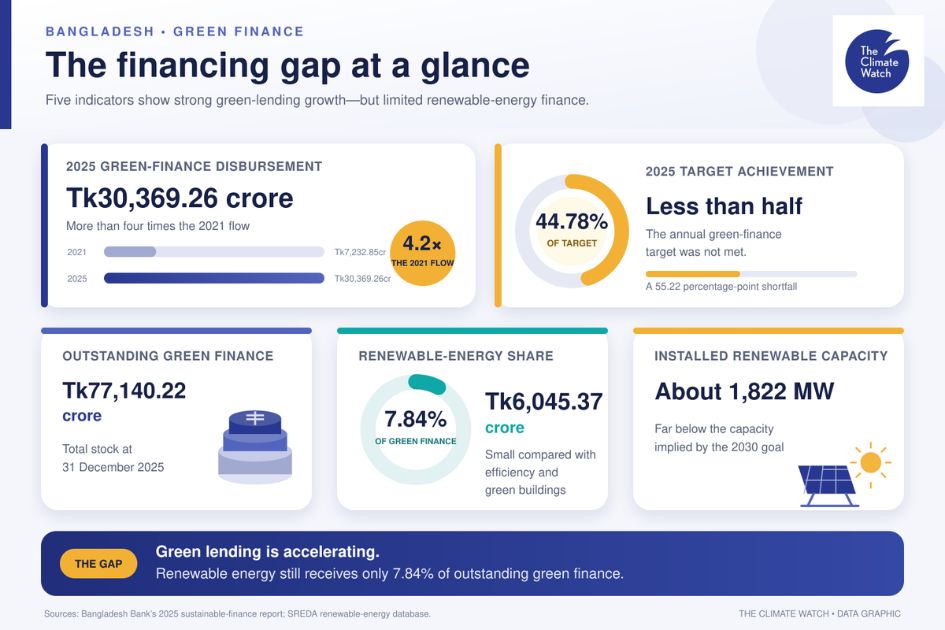
The Bangladesh Bank Quarterly Review Report on Sustainable Finance for October-December 2025 shows that banks and finance companies disbursed Tk30,369.26 crore in green finance in 2025, compared with Tk7,232.85 crore in 2021. Green finance rose from 3.06% of total term-loan disbursement to 13.77% over the same period. The rapid increase suggests that environmental lending has moved closer to the mainstream of the financial system.
But the headline growth conceals where the money is going. At the end of 2025, total outstanding green finance stood at Tk77,140.22 crore. Renewable energy accounted for Tk6,045.37 crore, or 7.84% of that stock. Energy and resource efficiency received Tk31,931.42 crore, equal to 41.4%, while green or environment-friendly establishments received Tk16,529.70 crore, or 21.4%. Together, those two categories absorbed almost two-thirds of all outstanding green finance.
That composition does not mean efficiency upgrades or greener buildings are unimportant. Factories that reduce energy and water use can cut emissions quickly, and efficient industrial equipment often delivers immediate savings. The problem is one of balance: Bangladesh can report rapid growth in green finance while the lending needed to build new clean generation, reduce fossil-fuel imports and strengthen energy security remains comparatively limited.
The distinction between annual disbursement and outstanding loans also matters. The Tk30,369.26 crore figure is the flow of green finance during 2025. The Tk77,140.22 crore figure is the stock outstanding at year-end. Bangladesh Bank set a 2025 green-finance target of Tk67,820.83 crore, calculated from banks’ and finance companies’ net loans and advances. Actual disbursement reached only 44.78% of that target. Sustainable finance, a much broader category that includes agriculture, micro, small and medium enterprises and socially responsible lending, achieved 82.57% of its annual target.
An energy shock sharpens the financing question
The financing gap is no longer an abstract climate-policy problem. Bangladesh raised retail fuel prices by 10% to 15% in April 2026 as the war involving the United States, Israel and Iran drove up crude prices, freight and insurance costs. Reuters reported in April that the government had sought more than $2 billion in external financing to secure energy imports. A second Reuters report in July said renewed fighting had again disrupted flows through the Strait of Hormuz, a route that carried about one-fifth of the world’s oil and liquefied natural gas before the conflict.
The International Monetary Fund has estimated that 25% to 30% of global oil and about 20% of LNG normally pass through the strait. For an import-dependent economy, a disruption can hit the foreign-exchange market, public subsidies, industrial gas supply, transport costs and food prices at the same time. Renewable energy cannot remove those exposures overnight, but every megawatt generated domestically can reduce the volume of fuel that must be bought in volatile international markets.
Bangladesh has also raised its policy ambition. The Renewable Energy Policy 2025 aims to meet 20% of electricity demand from renewable sources by 2030 and 30% by 2040. The country’s third Nationally Determined Contribution, or NDC 3.0, goes further by setting a 25% share of electricity demand by 2035, with 40% of that target designated unconditional and the remaining 60% dependent on international support.
The scale of the task is visible in the capacity numbers. The SREDA national renewable-energy database displayed about 1,822MW of installed renewable capacity in July 2026, including roughly 1,529MW of solar, 230MW of hydropower and 62MW of wind. A 2025 financing study by the Institute for Energy Economics and Financial Analysis, or IEEFA, estimated that meeting the 2030 policy goal could require around 5,851MW, depending on electricity-demand assumptions. On that estimate, the installed base is still less than one-third of the capacity needed by 2030.
A rooftop project lost in the paperwork
The gap between policy and lending is reflected in the experience of Humayun Kabir Salim, managing director of Khantex Composite Textiles Ltd. Two years ago, he planned to install a 1MW rooftop solar system at his Dhaka factory at an estimated cost of Tk6 crore. The technology was available, the factory had a roof and the government was urging industry to become greener. Financing appeared to be the final piece.
Salim approached four or five banks and financial institutions. None rejected the proposal outright, he said, but none approved it. Requests for information and documents continued while a decision remained out of reach. “There was no outright rejection, but the process kept getting delayed with repeated documentation requirements,” he said. “People eventually stop chasing these projects.”
He eventually abandoned the solar plan. Salim believes his experience points to a wider accountability problem. The government announces large renewable-energy goals, he said, but banks are not required to finance a fixed renewable share or explain why a viable proposal has stalled. “The government has set big renewable energy targets, but there is no follow-up or obligation for banks to finance a fixed share or explain why they do not,” he said.
A senior official at one of Bangladesh’s leading conglomerates described a similar experience, speaking on condition of anonymity because the company maintains relationships with several lenders. Banks rarely issue a clear refusal, the official said. Instead, applications can be held up by long checklists and requests for information that borrowers consider unnecessary or duplicative. “After filing an application, they hand you a checklist demanding a lot of unnecessary information – things that take time to compile and may not even be needed at all,” the official said.
For a business, delay has a cost. Equipment prices can change, approvals expire, management attention shifts and the expected savings from a project are postponed. A bank may never formally say no, yet the outcome for the investor is the same.
Why broad green targets can leave renewables behind
Bangladesh Bank’s sustainable-finance framework covers a wide range of activities. Green finance includes renewable energy, energy and resource efficiency, alternative energy, waste management, circular-economy projects, cleaner brick production, green establishments, agriculture, green small businesses, socially responsible projects, blue-economy finance and information technology. Sustainable finance is broader still.
The broad taxonomy gives lenders many ways to meet a sustainability target. That flexibility can be useful, but it also allows banks to favour projects that fit their existing credit models. An energy-efficient machine inside a profitable factory can generate quick, measurable savings and may be secured by the borrower’s established balance sheet. A solar plant, by contrast, may need a longer loan, depend on grid connection or a power-purchase agreement, and expose the lender to unfamiliar technical and performance questions.
“While green finance is expanding in Bangladesh, renewable energy still accounts for around 8% of the portfolio, which suggests the transition is yet to gain real momentum,” said Shafiqul Alam, lead analyst for Bangladesh at the Institute for Energy Economics and Financial Analysis.”Energy-efficiency projects dominate because they recover costs quickly. Renewable-energy projects require longer tenures and carry higher perceived risks,” Alam said.
A financing study by IEEFA illustrates the maturity mismatch. Utility-scale renewable projects may require around 20 years to recover their initial investment, while local commercial-bank lending is commonly far shorter. For smaller projects, the institute found that ordinary local financial institutions generally offered loans of about five years, compared with up to 10 years under concessional green-refinance arrangements. Short maturities raise annual repayments and can make an otherwise profitable solar project difficult to finance.
Collateral creates another barrier. IEEFA reported that IDCOL required a 100% bank guarantee for rooftop-solar lending, while other lenders commonly sought land as full security. Engineering, procurement and construction companies trying to install systems under an operating-expenditure model can struggle because their balance sheets may not satisfy traditional collateral tests, even when contracted electricity savings could support repayment.
Cheap refinance exists, but access remains slow
Bangladesh is not short of green-finance mechanisms on paper. According to Bangladesh Bank’s latest sustainable-finance review, its revolving refinance scheme for environment-friendly products, projects and initiatives was expanded to Tk1,000 crore in 2023. Its list covers 70 products and projects, including rooftop solar, solar-home systems, biogas and other clean technologies. Under the central bank’s participation agreement for the scheme, Bangladesh Bank charges participating financial institutions 1% on the refinanced amount and permits them to add a margin of up to four percentage points, producing a customer rate of up to 5%.
The structure is attractive, but the route to the money is not direct. The Bangladesh Bank participation agreement requires a borrower first to obtain and receive a loan from a bank or finance company. The lender then applies to Bangladesh Bank for refinancing and submits prescribed documents. IEEFA’s financing analysis describes how this two-stage process leaves the participating institution to assess and fund the project initially at its own rate and risk. For projects requiring a trial run, the bank can apply for refinance only after the trial is complete.
The utilisation figures show how small the channel remains compared with the country’s ambition. During the final quarter of 2025, the environment-friendly refinance scheme disbursed only Tk9.66 crore across 42 projects. Net-metered rooftop solar received Tk0.99 crore and solar-home systems Tk0.03 crore in that quarter. The scheme had disbursed Tk1,792.20 crore cumulatively since its creation in 2009, a total that can exceed the fund’s current size because the money revolves as loans are repaid and lent again.
Bangladesh Bank also operates larger windows. Its local-currency Green Transformation Fund had disbursed Tk2,267.49 crore to 82 clients of 24 banks by the end of 2025, while its Technology Development and Up-gradation Fund had disbursed Tk1,088.75 crore. Those funds support a range of industrial improvements, not renewable generation alone. Their scale therefore should not be read as a measure of solar or wind finance.
M Zakir Hossain Khan, chief executive of Change Initiative, said the central problem is the failure to align policy declarations with financial execution. “Bangladesh’s renewable-energy transition is not being held back by a lack of funds; it is being constrained by a lack of alignment between policy declarations and financial execution,” Khan said.
He said policies are often announced without adequate preparation by the institutions expected to implement them. Banks then face ambitious targets without standardized project documents, clear risk-sharing arrangements or dedicated staff able to appraise new technologies. Net-metering approvals, import duties and the two-stage refinance process add to the delay.”Expecting banks to lend at 4% while their operating structure runs at 10% to 12% is unrealistic. Incentive alignment is key,” Khan said.
The formal refinance agreement now permits an end-borrower rate of up to 5%, rather than 4%, but the underlying incentive problem remains: the lender receives the refinance only after it has originated the loan and completed the required application. A February 2026 IEEFA policy analysis argues that a dedicated facility able to pre-finance or approve eligible projects in a single stage would reduce that timing and balance-sheet burden.
Banks remain unevenly engaged
The latest Bangladesh Bank sustainable-finance report provides the clearest current picture of lender participation. In the October-December quarter of 2025, 40 of Bangladesh’s 61 scheduled banks and 10 of 34 finance companies recorded green-finance exposure. For the broader sustainable-finance category, 56 banks and 12 finance companies reported exposure.
The difference is important. Most banks now participate in sustainable finance, but one-third of scheduled banks recorded no green-finance exposure in the quarter. Participation among finance companies was even thinner. All banks and finance companies are required to maintain sustainable-finance units and policies, yet institutional compliance has not produced uniform lending activity.
Bangladesh Bank’s own figures also show that renewable energy is not merely losing to non-green lending; it is losing within the green category. In 2025, 41.4% of outstanding green finance went to energy and resource efficiency, while renewable energy received 7.84%. A bank can therefore expand its green portfolio substantially without developing the capacity to assess a power-purchase agreement, forecast solar output, evaluate an engineering contractor or price grid and offtaker risk.
Risk is real, but the evidence is not entirely negative
Chowdhury Liakat Ali, director of Sustainable Finance at Bangladesh Bank, said low disbursement partly reflects investor hesitation as well as lender behaviour. Investors may be reluctant to expand when they are uncertain about demand, approvals and the route to market for the electricity they produce.”If investors are not assured that their generated electricity can be purchased, they remain hesitant about where they will sell it,” Ali said.
Those concerns are valid for utility-scale projects. A detailed IEEFA review of renewable-energy financing barriers identifies policy changes, off-taker risk, currency depreciation, land acquisition, weaker sovereign credit, technology performance and thin project pipelines as barriers to private capital. Large solar and wind projects need bankable contracts and confidence that the buyer will pay over a long period. Foreign loans also create exchange-rate exposure when project revenues are earned in taka.
Yet recent evidence suggests that carefully structured renewable lending can perform. The World Bank’s implementation-completion report for the Bangladesh Scaling-up Renewable Energy Project says the project supported 338.15MW of capacity, exceeding its 310MW target. Its renewable-energy financing facility backed 44 rooftop-solar projects and two utility-scale solar plants. By project completion, it had mobilized $101 million in private capital and $181.37 million in total renewable-energy investment. The financing portfolio reported no loans at risk, against a maximum target of 4%.
That record does not eliminate risk, but it challenges the assumption that renewable projects are inherently unbankable. The result points to the value of long-tenor concessional capital, specialist appraisal, technical assistance and a pipeline of standardized projects. It also suggests that banks’ perceived risk can be reduced when an experienced institution shares due diligence and structures financing around the project’s cash flow.
Rooftop solar is growing, but far below its potential
Rooftop solar is one of the most immediate opportunities because it uses existing industrial, commercial and institutional roofs rather than scarce land. The SREDA rooftop-solar database showed 5,023 net-metered systems with a combined capacity of about 334.7MW in July 2026. The Net Metering Guideline 2025 also allows third-party investment under an operating-expenditure model, creating a route for customers that do not want to fund the full installation themselves.
But scale requires finance that follows the asset. A rooftop system can lower a factory’s electricity bill and reduce demand from the grid during daylight hours. Those savings can support repayment, yet lenders often rely mainly on conventional collateral and the sponsor’s balance sheet. A standard contract, accepted performance benchmarks and a partial credit guarantee could allow banks to give more weight to future savings and contracted cash flow.
IEEFA’s renewable-finance study has recommended a dedicated rooftop-solar fund with a single-stage approval process, a credit-risk guarantee and a temporary waiver of import duties on solar accessories. A February 2026 follow-up analysis by IEEFA says Bangladesh will need $933 million to $980 million a year through 2030 to reach the policy goal, compared with average annual renewable investment of about $238 million between 2018 and 2023. The required flow is therefore roughly four times the recent historical level.
A reform agenda that follows the target
The reforms proposed by experts and recent institutional reports point in the same direction. First, Bangladesh needs a financing window dedicated to renewable energy, with project-specific appraisal capacity and authority to provide pre-finance or single-stage approvals. This would prevent eligible projects from becoming trapped between a commercial bank’s initial disbursement and the central bank’s refinance decision.
Second, lenders need risk-sharing tools. Bangladesh’s NDC 3.0 says a green credit-guarantee scheme will support clean brick and block production, industrial rooftop solar, biogas and clean-cooking projects.
Implementation should be transparent: the government and Bangladesh Bank should publish eligibility criteria, guarantee coverage, fees, claims procedures, participating institutions and quarterly results. A guarantee that exists only in policy language will not change credit decisions.
Third, loan tenures must match the economic life of the asset. Short loans force high annual repayments and can make a sound project appear unaffordable. Blended finance from development banks, domestic institutions and climate funds can provide longer maturities, while commercial banks originate and service the loans. Pension and insurance capital could eventually support longer-term instruments if regulation, project quality and disclosure improve.
Fourth, the government should standardise the non-financial side of the market: model power-purchase and rooftop contracts, predictable net-metering timelines, equipment and installer standards, and clear grid-connection procedures. Those steps are consistent with the direction set by the Renewable Energy Policy 2025, NDC 3.0 and Net Metering Guideline 2025. Banks cannot solve delays caused by utilities or inconsistent policy, and investors will not borrow if they are unsure whether a project can connect or sell electricity.
Fifth, Bangladesh Bank should separate the measurement of renewable-energy lending from the broader green-finance headline. A public dashboard could show annual disbursement and outstanding loans by technology, bank type, project size, tenor, rate, district and borrower category. It should also report application-to-approval times and reasons for rejection. Without that transparency, rapid growth in easier categories can continue to obscure weak investment in new clean generation.
Recent thinking inside the central bank supports stronger incentives. A June 2026 working paper by Bangladesh Bank’s Financial Stability Department recommended preferential refinancing, green-credit incentives, possible reductions in risk weights where appropriate, and supervisory recognition for credible green and adaptation finance. The paper represents the authors’ research rather than a binding policy, but it shows that climate-related credit allocation is increasingly being treated as a financial-stability issue.
Khan also proposed using corporate social-responsibility resources to narrow interest-rate gaps, developing carbon-pricing revenue and focusing on the large rooftop opportunity. Alam has called for a dedicated renewable-energy window and instruments that address the specific risks of long-tenor projects. Ali recommended stronger coordination and a high-powered committee to remove obstacles quickly.
The real test is deployment
Bangladesh’s green-finance architecture is more developed than it was a decade ago. It has targets, a taxonomy, sustainable-finance units, disclosure rules, refinance schemes, a green-transformation fund, net-metering guidelines and a new renewable-energy policy. The country is not starting from zero.
But the numbers show the distance between architecture and deployment. The Bangladesh Bank sustainable-finance report records green-finance disbursement of Tk30,369.26 crore in 2025, yet only 7.84% of outstanding green finance was in renewable energy. The annual green-finance target was less than half achieved. Only 40 of 61 banks reported any green exposure in the final quarter, and just Tk0.99 crore from the central bank’s main environment-friendly refinance window went to net-metered rooftop solar during that period.
At the same time, the Renewable Energy Policy 2025 asks renewable energy to meet 20% of electricity demand by 2030, while the SREDA national database shows an installed base of about 1,822MW. IEEFA estimates that annual investment must rise to as much as $980 million before 2030. Those goals cannot be delivered by policy statements alone; they require credit decisions, long-term contracts, grid connections and projects that reach financial close.
As Reuters reported in April and again in July 2026, the energy shock has made the cost of delay visible in fuel prices, subsidies and foreign-exchange pressure. The IMF’s assessment of the energy and trade disruption shows why the next measure of progress should be more demanding than the growth of a broad green-finance total. It should be the number of renewable projects approved, the megawatts installed, the time taken to reach disbursement and the volume of imported fuel those projects displace.
If finance continues to favour the quickest and safest green label, Bangladesh may meet reporting targets while missing the energy transition. If policy, refinancing and risk-sharing are aligned, the same banking system could turn the country’s renewable ambition into assets on factory roofs, irrigation systems and the national grid.
But the numbers show the distance between architecture and deployment. The Bangladesh Bank sustainable-finance report records green-finance disbursement of Tk30,369.26 crore in 2025, yet only 7.84% of outstanding green finance was in renewable energy. The annual green-finance target was less than half achieved. Only 40 of 61 banks reported any green exposure in the final quarter, and just Tk0.99 crore from the central bank’s main environment-friendly refinance window went to net-metered rooftop solar during that period.
At the same time, the Renewable Energy Policy 2025 asks renewable energy to meet 20% of electricity demand by 2030, while the SREDA national database shows an installed base of about 1,822MW. IEEFA estimates that annual investment must rise to as much as $980 million before 2030. Those goals cannot be delivered by policy statements alone; they require credit decisions, long-term contracts, grid connections and projects that reach financial close.
As Reuters reported in April and again in July 2026, the energy shock has made the cost of delay visible in fuel prices, subsidies and foreign-exchange pressure. The IMF’s assessment of the energy and trade disruption shows why the next measure of progress should be more demanding than the growth of a broad green-finance total. It should be the number of renewable projects approved, the megawatts installed, the time taken to reach disbursement and the volume of imported fuel those projects displace.
If finance continues to favour the quickest and safest green label, Bangladesh may meet reporting targets while missing the energy transition. If policy, refinancing and risk-sharing are aligned, the same banking system could turn the country’s renewable ambition into assets on factory roofs, irrigation systems and the national grid.
This story is published as part of the CPRD–TCW Reporting Fellowship 2025




