

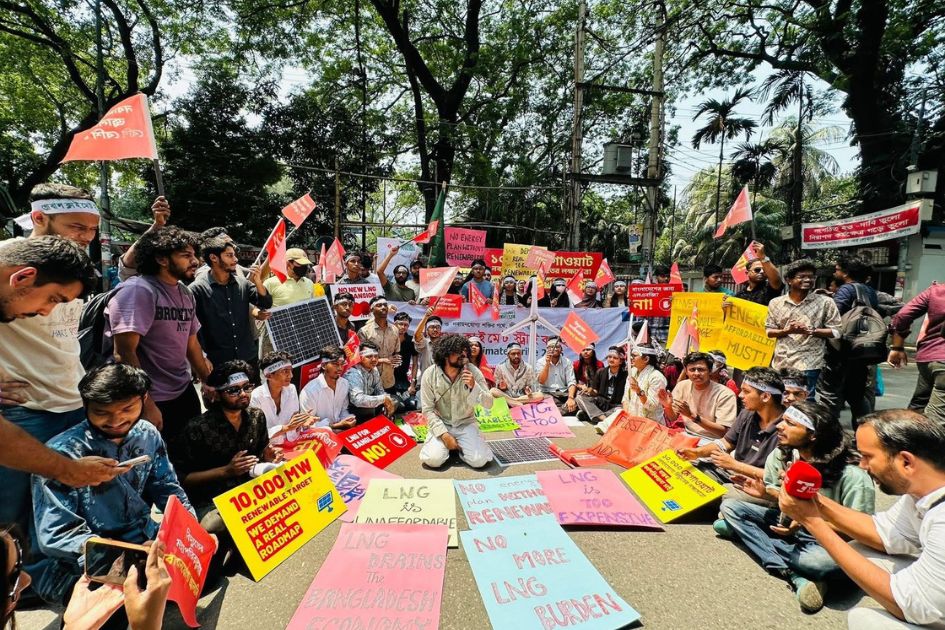

Young climate activists in Bangladesh are demanding accountability from major polluters as worsening floods, salinity, erosion, and heatwaves threaten vulnerable communities, livelihoods, and the future of millions nationwide.
As climate disasters intensify across the globe, young activists in Bangladesh are raising their voices for climate justice, warning that countries least responsible for global warming are paying the highest price for a crisis they did little to create.
In the coastal south, rising salinity is destroying farmland and limiting access to safe drinking water. In northern riverine districts, families continue to lose homes and livelihoods to river erosion. Across the country, recurring floods, cyclones, heatwaves, and extreme weather events are disrupting education, threatening public health and forcing vulnerable communities deeper into poverty.
For millions of Bangladeshis, climate change is no longer a distant environmental concern. It is becoming a daily struggle for survival.
According to the Climate Risk Index 2026 published by German environmental organization Germanwatch, Bangladesh was among the 20 countries most severely affected by climate-related disasters in 2024. At the same time, the Sixth Assessment Report of the Intergovernmental Panel on Climate Change warns that sea levels could rise between 20 and 35 centimeters by 2050, placing nearly one-fifth of Bangladesh’s land area at risk.
Yet Bangladesh contributes only a very small share of global carbon emissions. Climate justice advocates say this stark imbalance lies at the center of the global climate crisis.
Climate justice refers to the demand that wealthy industrialized nations, which built their economies through centuries of fossil fuel consumption and large-scale carbon emissions, take greater responsibility for addressing climate impacts. The demand includes reducing emissions, financing adaptation efforts, compensating vulnerable countries for climate-related losses and damages and ensuring a fair transition toward sustainable development.
Experts say the debate is also deeply connected to intergenerational equity, as today’s young people and future generations are expected to bear the harshest consequences of a crisis they did not create.
Professor Md. Hafizur Rahman from the Department of Environmental Science and Management at Independent University, Bangladesh said the climate crisis cannot be separated from questions of inequality, accountability and historical responsibility.
“Developed countries improved their living standards through decades of large-scale carbon emissions, while countries like Bangladesh are now suffering the consequences,” he said.
He stressed that climate justice is not only about financial assistance but also about empowering communities, investing in youth leadership, building youth capacity and ensuring transparency in how climate funds are distributed and used.
“Climate justice is not charity. It is a matter of rights, fairness and accountability,” he added. “Young people must understand where climate financing goes, how policies are shaped and how they can influence those decisions.”
The issue of climate finance has become increasingly important during recent United Nations Climate Change Conference negotiations, where developing countries have repeatedly demanded stronger commitments from industrialized nations on Loss and Damage financing, adaptation support and carbon emission reductions.
In Bangladesh, many young activists say those negotiations are directly connected to their futures.
Aruba Faruque, who received the Queen’s Commonwealth Award in 2023 for her contribution to climate awareness, said climate change is no longer only an environmental issue.
“Cyclones, floods, salinity, heatwaves and river erosion are affecting people’s health, education, safety and future opportunities,” she said. “Those who contributed the least to the climate crisis are suffering the most. That injustice must be addressed through policy changes, protection of affected communities and global solidarity.”
She warned that future generations will carry the heaviest burden if urgent action is delayed.
“If we do not raise our voices today, future generations will pay the highest price for decisions they never made,” she said.
Youth-led organizations across Bangladesh have become increasingly active in climate campaigns, grassroots mobilization, climate strikes, awareness programs and international advocacy efforts. Activists argue that young people in the Global South are often excluded from decision-making processes despite standing on the frontlines of the climate crisis.
Many campaigners now say young people should not only be treated as beneficiaries of climate policies but also as co-leaders in shaping climate solutions, adaptation planning and sustainable development strategies.
During recent climate strikes in different parts of Bangladesh, students and young campaigners marched through streets carrying banners demanding climate justice, renewable energy investment and accountability from major polluting nations. Many say these demonstrations are not symbolic protests but urgent calls for survival.
Among the organizations leading climate justice campaigns is YouthNet Global, which has been working with young people from climate-affected communities across the country.
Its Executive Coordinator Sohanur Rahman said climate justice is ultimately about survival, dignity and intergenerational responsibility.
“We are strengthening youth leadership, amplifying the voices of climate-affected communities and bringing grassroots realities into national and global policy discussions,” he said.
He added that investing in youth leadership and recognizing young people as co-leaders in climate action are essential for building long-term resilience and equitable climate solutions.
“Young people are no longer waiting silently for decisions to be made on their behalf,” Sohanur Rahman said. “Climate justice is about protecting our future, defending vulnerable communities and ensuring that those most responsible for the crisis are held accountable.”
Climate experts believe Bangladesh’s large youth population could become one of the country’s strongest forces in pushing for stronger global climate commitments, fair climate financing and a just transition toward renewable energy and sustainable development.
As climate impacts intensify across South Asia and beyond, activists warn that climate justice is no longer a distant political slogan discussed only in international conferences. For millions living on the frontlines of climate change, it has become a question of human rights, equality, dignity, intergenerational equity and survival.




