

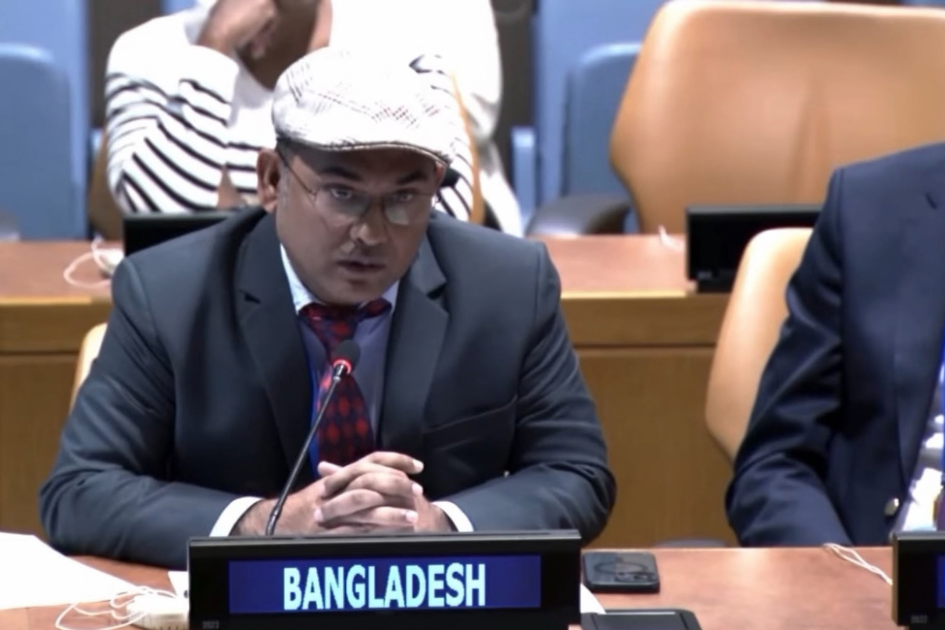



Bangladesh urged stronger public finance, simpler access and faster disbursement from the Loss and Damage Fund as vulnerable countries face growing climate-related losses.
Bangladesh has called for a predictable, sustained and accessible financing base for addressing climate-related Loss and Damage, warning that vulnerable countries should not be pushed deeper into debt to recover from disasters they contributed little to causing.
Dr Md Saimum Parvez, Special Assistant to the Prime Minister on Environment, Forest and Climate Change Affairs, made the call while representing Bangladesh at the high-level side event “Expanding the Finance Base: The Urgent Case for Scaling Up Loss and Damage Finance” on the sidelines of the 81st session of the United Nations General Assembly.
The event, organised by the Government of the Philippines and the Secretariat of the Fund for Responding to Loss and Damage, brought together senior representatives and key stakeholders to discuss how to scale up Loss and Damage finance, broaden the Fund’s resource base and improve access for climate-vulnerable countries.
Dr Parvez said Bangladesh contributes less than 0.5 percent of global greenhouse gas emissions, while climate impacts cost the country an estimated 1 to 2 percent of its gross domestic product each year.
Cyclones, floods, salinity intrusion and river erosion are already creating losses that cannot be fully avoided through adaptation measures alone, he said.
He stressed that climate shocks should not force vulnerable countries to take on additional debt.
Faster and simpler access
Dr Parvez called for direct and simplified access to the Fund, rapid disbursement and small-grant channels capable of delivering resources quickly to affected communities.
He said Loss and Damage finance must address both economic and non-economic losses, including damage to livelihoods and infrastructure as well as impacts on ecosystems, culture, identity and community wellbeing.
Highlighting Bangladesh’s domestic efforts, he referred to the development of the country’s first National Climate Finance Strategy and the establishment of a National Committee on Climate Finance.
He also noted Bangladesh’s formal engagement with the Fund through a community-focused proposal addressing flood-induced Loss and Damage in northern Bangladesh.
The initiatives are intended to strengthen Bangladesh’s ability to access international climate finance and channel resources more effectively to communities facing climate impacts.
Public finance must remain central
Dr Parvez said public finance from developed countries must remain at the core of the Loss and Damage financing architecture.
At the same time, he said complementary sources could also be explored, including blended finance and innovative solidarity mechanisms linked to carbon-intensive activities and international transport.
However, such additional sources should complement, rather than replace, the responsibilities of developed countries under the United Nations Framework Convention on Climate Change and the Paris Agreement, he said.
At the outset of his remarks, Dr Parvez also expressed Bangladesh’s condolences and solidarity with Nepal following recent flash floods that caused loss of life.
COP31 opportunity
Looking ahead, Dr Parvez said COP31 would provide an important opportunity to advance the global Loss and Damage finance agenda.
He called for international efforts to focus on mobilising resources at the scale and speed required, while ensuring predictable financing, simplified access, rapid disbursement and effective delivery to affected countries and communities.
For Bangladesh and other climate-vulnerable nations, these issues are expected to remain central to negotiations over how the Loss and Damage Fund is financed and implemented ahead of COP31.




