

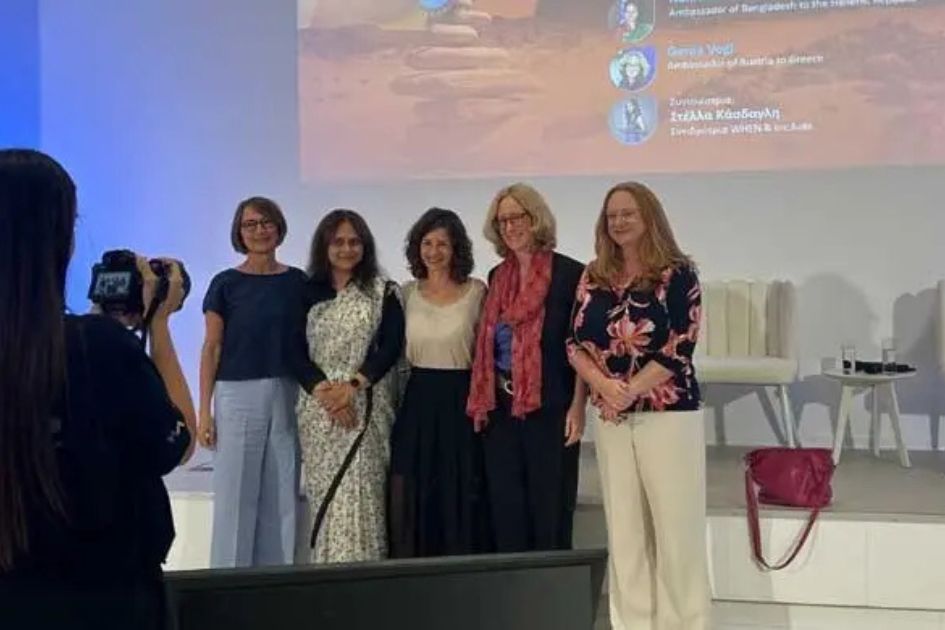



Bangladesh’s ambassador highlighted climate vulnerability, social inclusion and climate finance while discussing diplomacy’s role in addressing interconnected global crises.
Bangladesh Ambassador to Greece Nahida Rahman Sumona participated in a panel discussion titled “Diplomacy for Sustainability” at the fourth “Effective Dialogue” conference held in Athens, the capital of Greece.
The conference was held on Thursday (September 24) at the Stelios Foundation Conference Hall in Athens under the theme “Disruption or Destruction?” Team Sympraxis and Equality Empowerment Change jointly organised the conference.
Four women ambassadors from Australia, Finland, Austria and Bangladesh took part in the panel discussion. They were Australian Ambassador Alison Duncan, Finnish Ambassador Leena Pilvanainen, Austrian Ambassador Gerda Vogel and Bangladesh Ambassador Nahida Rahman Sumona.
At the conference, diplomats, experts and civil society leaders held politically realistic and meaningful discussions on global crises, climate change, inclusion and ways to address various global changes.
The panel discussion focused on how interconnected crises such as climate change, the erosion of democratic values and growing inequality are changing global priorities. Rather than country-specific reports, the discussion highlighted the role of diplomacy in addressing these crises and the capabilities and limitations of different countries in meeting the needs of communities at risk, based on the ambassadors’ diplomatic experiences.
Bangladesh Ambassador Nahida Rahman Sumona said Bangladesh was born in 1971 through a struggle for dignity and self-determination. Her own life, too, has progressed through a struggle for survival and dignity. Drawing on her experience of serving in Canberra, Kolkata, Ottawa, Brasilia and Bandar Seri Begawan, she said modern ambassadors must act as interpreters of interconnected global crises between their respective capitals and host countries.
Highlighting differences in the global concept of sustainable development, the ambassador said that while wealthy democratic countries prioritise the pace of reducing carbon emissions and financing the energy transition, for countries of the Global South such as Bangladesh, sustainable development is inextricably linked to survival, coastal protection, climate-induced displacement and resilient agriculture. She warned that social inclusion and climate finance should not be pushed aside due to geopolitical changes.
Highlighting differences in the risks and resources of different countries, Nahida Rahman Sumona said each country has its own challenges. For some, the pressure of energy transition alongside abundant natural resources is a major issue, while for others, internal diversity and institutional limitations are significant concerns. In Bangladesh’s case, the biggest vulnerability is extreme geographical risk and population density. However, the country’s greatest asset is its people, local resilience and decades of experience in disaster preparedness.
The discussion also highlighted Greece’s position from a comparative perspective. Greece’s position at the intersection of European policymaking, migration, economic recovery and climate risks was compared with many structural challenges in South Asia. The discussion also covered opportunities to learn from Bangladesh’s model of women’s empowerment, the undervalued nature of care work and the need to create long-term opportunities for women to lead in decision-making.
In her closing remarks, the Bangladesh ambassador said the true value of diplomacy in building a fairer and more sustainable future lies in patient, relationship-based cooperation and South-South knowledge exchange. Referring to Bangladesh’s leadership in the Climate Vulnerable Forum, she said diplomacy can play the most effective role in connecting the needs of local communities with international resources and building bridges of joint ownership and cooperation in finding solutions.




