




Bangladesh’s elephant conservation efforts include a new survey by 2027, compensation for conflict victims and 159 local response teams to reduce human-elephant conflict.
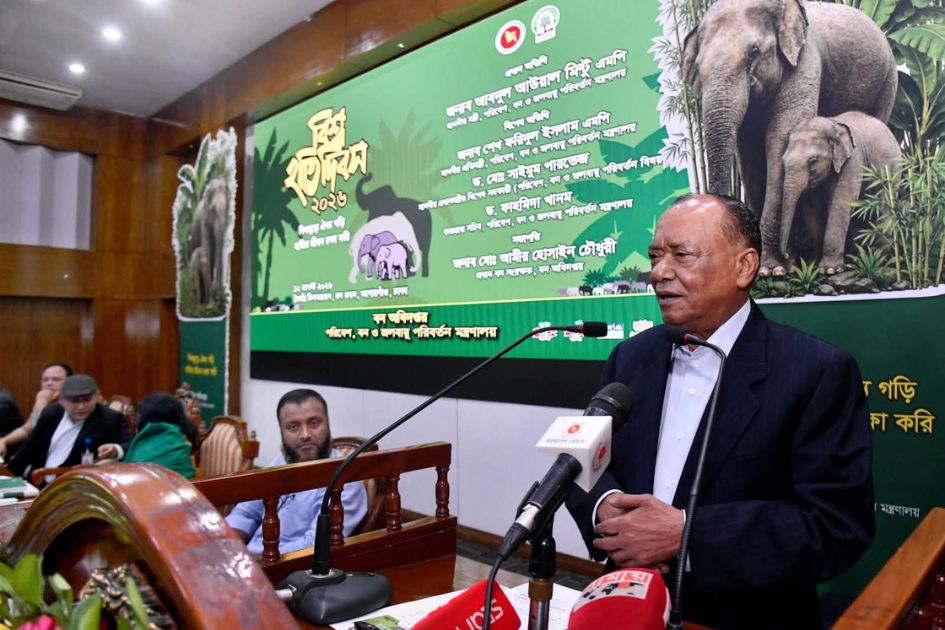
Bangladesh’s Environment Minister Abdul Awal Mintoo on Wednesday called for joint efforts by the government, local communities and wider society to ensure a safe future for the country’s elephants, warning that habitat loss, deforestation, illegal hunting and wildlife crime are threatening their survival.
“Ensuring a safe future for elephants requires a collective effort. Government initiatives alone are not enough. Local communities, field-level forest department staff, non-governmental organisations, students, young people, researchers, media workers and people from all sections of society must be involved,” Mintoo said.
The minister was speaking as the chief guest at a discussion organised to mark World Elephant Day 2026 at the Forest Department’s conference room in Agargaon, in the capital Dhaka.
This year’s international theme for World Elephant Day is “Bringing the world together to help elephants”, while the Bengali theme is “Let us build unity across the world and protect elephants’ lives”. The day aims to raise public awareness about elephant and habitat conservation and ensure a safe future for the species.
Mintoo said the country once had a large elephant population, but their numbers have been declining. Habitat encroachment and destruction, deforestation, illegal hunting and wildlife crime have emerged as major threats to the species, he said.
According to a 2015 survey, Bangladesh had 268 wild elephants that permanently lived in the country, 93 migratory wild elephants and 96 domesticated elephants. The government has taken an initiative to conduct another elephant survey by 2027.
The minister said the government had formulated the Bangladesh Elephant Conservation Action Plan (2018-2027), identifying 40 priority activities. These activities are being implemented through various projects, he said.
The government is also providing compensation to people affected by human-elephant conflict, Mintoo said. Under the Wildlife Attack Compensation Rules, 2021, the family of a person killed receives 300,000 taka, an injured person can receive up to 100,000 taka and compensation of up to 50,000 taka is available for damage to property.
From 2012 to June 2026, the government has paid about 137.7 million taka in compensation to the families of 322 people killed, 169 injured people and 3,215 families whose homes and crops were damaged, according to the minister.
Mintoo instructed the Forest Department to ensure that compensation for people affected by elephants is provided as quickly as possible.
He said local people had been involved in efforts to address human-elephant conflict. A total of 159 Elephant Response Teams have so far been formed in elephant-inhabited areas.
The teams play an important role in issuing early warnings about the arrival of elephants, monitoring their movements and reducing conflict between people and elephants through safe measures, he said.
“Local people’s participation is our greatest strength in elephant conservation. Elephant conservation can never be sustainable without involving local people,” Mintoo said.
Mahmudul Haque Rubel, a member of parliament from Sherpur-3 constituency, spoke as a special guest and presented various information on elephant attacks and compensation in his constituency.
Dr Md Saimum Parvez, the prime minister’s special assistant for environment, forest and climate change, also spoke as a special guest. He said elephants play an important role in protecting life and nature and called on everyone to come forward to protect them.
He also stressed that biodiversity must be protected if human existence is to be sustained.
Dr Fahmida Khanam, acting secretary of the Ministry of Environment, Forest and Climate Change, said elephants are endangered not only in Bangladesh but across the world.
She said the extent of the benefits of protecting elephants is not generally understood, making it difficult to secure approval for new projects. She called on various domestic and international organisations to work with the government alongside public funding.
The event was chaired by Chief Conservator of Forests Md Amir Hossain Chowdhury. Dr Md Abdul Motaleb, acting executive director of Arannyak Foundation, presented various information and data on elephants.
Representatives of organisations working on elephants, officials from the Ministry of Environment, Forest and Climate Change and the Forest Department, as well as journalists from electronic, print and online media, attended the event.




