

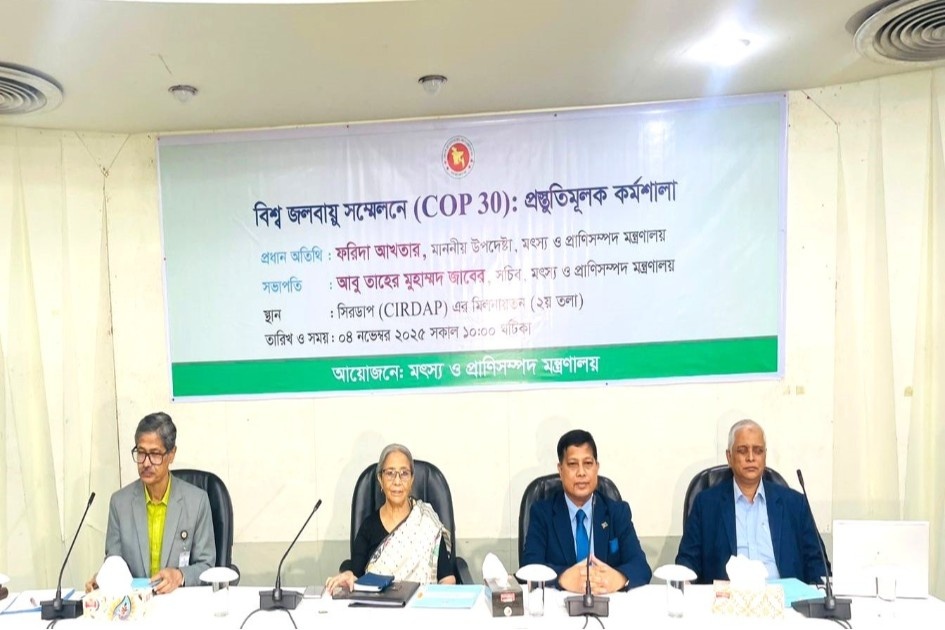



As Bangladesh prepares for COP30 in Brazil, Fisheries Adviser Farida Akhter urges stronger national unity and fair compensation for climate losses, warning that fragmented efforts and weak visibility could undermine the country’s case for justice amid mounting threats to fisheries and food security.
Bangladesh must adopt a stronger and more unified stance at this year’s United Nations Climate Change Conference (COP30) in Brazil to demand fair compensation for climate losses, Fisheries and Livestock Adviser Farida Akhter said Tuesday.
Speaking at a preparatory workshop titled “World Climate Conference COP-30: Preparatory Workshop” in Dhaka, Akhter warned that Bangladesh’s fragmented approach risks weakening its global advocacy on climate justice.
“For too long, people have thought COP is only the responsibility of the Ministry of Environment,” she said. “But climate change affects fisheries, livestock, agriculture, education, disaster management, and women’s affairs as well. It cannot be represented by a single ministry.”
For the first time, the Ministry of Fisheries and Livestock will join Bangladesh’s national delegation to COP30, alongside the Ministry of Environment, Forest and Climate Change, to highlight how warming temperatures and erratic weather patterns are threatening the country’s fisheries and livestock sectors.
Call for unity and visibility
Akhter stressed the need for coordination among ministries and between government and non-government actors. “At this COP, we must forget who comes from the government and who represents NGOs. We are all Bangladesh,” she said.
Participants from environmental groups and NGOs criticized the lack of visibility of Bangladesh’s efforts at past COPs compared to countries such as Bhutan and Indonesia, which host vibrant national pavilions.
Responding to these concerns, Akhter said Bangladesh’s pavilion in Belém this year will showcase exhibits on iconic local species, including the hilsa fish and Black Bengal goat, to illustrate how climate change is disrupting biodiversity, livelihoods, and food security.
LDC graduation, funding fears
Expressing concern over Bangladesh’s graduation from the Least Developed Country (LDC) category, Akhter cautioned that it could affect the nation’s access to international climate finance, including the Loss and Damage Fund.
She urged policymakers to move beyond portraying Bangladesh as a “victim country” and instead demand compensation as a right.
“Asian countries still lack unity in raising collective demands at COP, while African nations have become more organized and effective,” she observed.
Fisheries under threat
Akhter highlighted that climate stress has significantly reduced the contribution of capture fisheries. “Once 60 percent of our fish came from capture fisheries, but that figure has dropped by over 20 percent,” she said. Rising temperatures, salinity intrusion, and excessive use of chemical fertilizers and pesticides are further harming fish productivity and ecosystem health, she added.
Rich nations, Akhter noted, are responsible for nearly 80 percent of global carbon emissions. “They talk about ‘net zero,’ but how can there be ‘net’ before achieving zero? Instead of real emission cuts, they focus on tree planting and technological fixes while continuing business as usual,” she said.
Towards a united front at COP30
Academics, researchers, and climate activists attending the workshop agreed that COP30 will be a critical platform for Bangladesh to press for climate justice and fair compensation.
Akhter concluded that only through stronger coordination and a united voice can Bangladesh ensure that its climate vulnerabilities-from riverbank erosion to declining fish stocks -are reflected in the global agenda.




