

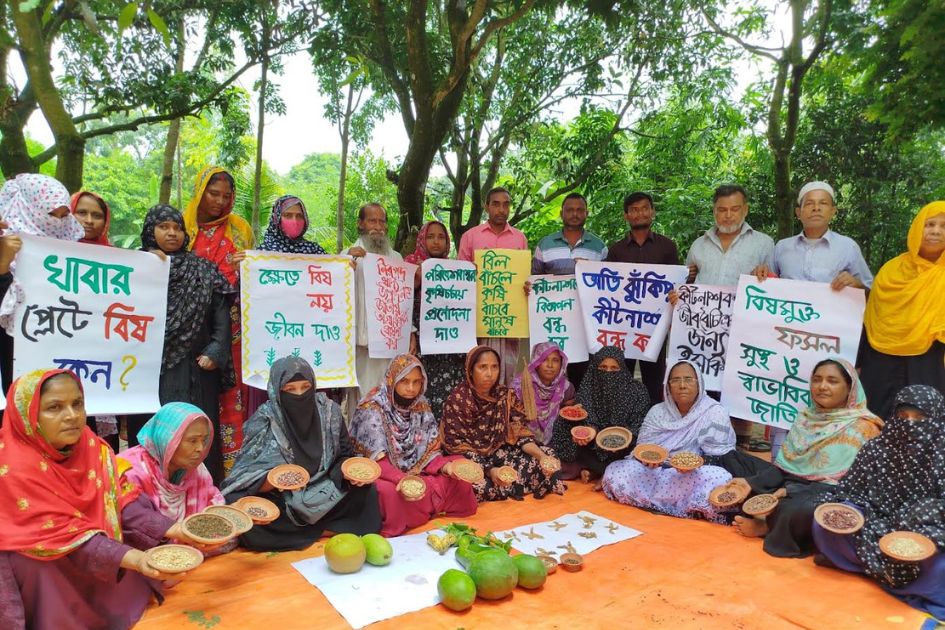



Farmers in Rajshahi are promoting agroecology, local seed systems and natural pest control while urging stronger safeguards against hazardous pesticides.
Farmers in Rajshahi district have called for an end to the use and unrestricted sale of highly hazardous pesticides, displaying chemical-free crops and locally produced seeds as part of a campaign for safer farming and food production.
The demand was made at a community discussion in Bargachhi village in Paba upazila of Rajshahi, where farmers practising agroecology displayed crops produced without chemical fertilisers and pesticides as well as indigenous seeds.
The event, organised by Green Coalition and the Bangladesh Resource Centre for Indigenous Knowledge (BARCIK), was held on Tuesday under an initiative by grassroots women of the Green Coalition focusing on agroecology, food sovereignty and climate adaptation. Thirty women and men farmers practising safer agricultural methods took part.
During the discussion, farmers shared their experiences and said excessive pesticide use had reduced the number of birds in their villages, contributing to an increase in crop pests. They also said water from wetlands and farmland flows into the Barnai River, where the number of native fish has declined.
According to information cited from the Bangladesh Cancer Research Institute, 64 out of every 100 cancer patients in Bangladesh are farmers. The farmers said they had been using chemical fertilisers and pesticides in various ways in agriculture for many years.
Hridoy Hasan, a young farmer practising agroecology in Dadpur Bagichapara of Bargachhi, said pesticide purchases were taking money from farmers’ pockets.
“By buying pesticides, someone else is eating the money from our pockets. We have to save the money in our pockets. For this, we have to practise agroecology. We have to learn how to make and use organic pest control,” he said.
Rubina Begum, a woman farmer from Madhabpur, said farmers were using natural materials to control pests.
“We control pests by extracting organic pest-control substances from neem leaves, ash, Bishkatali, mahogany seeds and the bark and leaves of various plants,” she said.
Farmer Abdul Jabbar said he had been cultivating papaya on 10 kathas of land and had tested organic pest control on some of the plants.
“I did not use organic pest control on some plants for testing, and they developed many spots, but I used neem leaf extract on the others and they did not develop any more spots. Who says crops cannot be grown without poison? If organic fertilisers and organic pest control are used properly, it is possible to produce crops without poison,” he said.
Rahima Begum, a farmer from Paba upazila involved with the Green Coalition, said farmers could make organic pest-control products from resources available around their homes.
“When we can find the agricultural resources we need close to home and can easily make organic pest control from them, why should we buy poison and put it on our fields? The unrestricted advertising and sale of harmful pesticides must be stopped and safe agriculture must be expanded further,” she said.
The meeting was told that Bargachhi Union has 30 model homesteads and two Agroecology Learning Centres and Community Seed Banks. Seeds are produced seasonally at the model homesteads, while surplus seeds are deposited at the learning centres. Other seeds are exchanged among farmers on a seasonal basis.
Farmers also receive training at the learning centres on making and using organic pest-control products and practise the methods themselves.
Women farmers at the meeting displayed seeds they had produced themselves and called for the protection of their seed sovereignty. They also demanded an end to pesticide sales inside villages.
Participants said seeds were farmers’ own resources and the foundation of food sovereignty. They called for the expansion of local seed production, preservation and exchange systems, alongside controls on the use and unrestricted sale of harmful chemical pesticides.
Mohammad Atikur Rahman, president of the Barendra Youth Forum, said people wanted safe food and farmers wanted to produce it safely, but farmers needed training and stronger controls on pesticides.
“We do not want to eat poison anymore, and farmers also want to produce food safely. But farmers need to be trained for this, highly hazardous pesticides must be banned and pesticide use must be controlled. An agroecological transformation programme must be adopted and implemented. The government must take this decision immediately,” he said.
The meeting called for increased government support at the union level for local seed production and preservation, expansion of community seed banks, recognition of farmers’ local knowledge and agroecological practices, and controls on the use and unrestricted sale of harmful chemical pesticides.




