

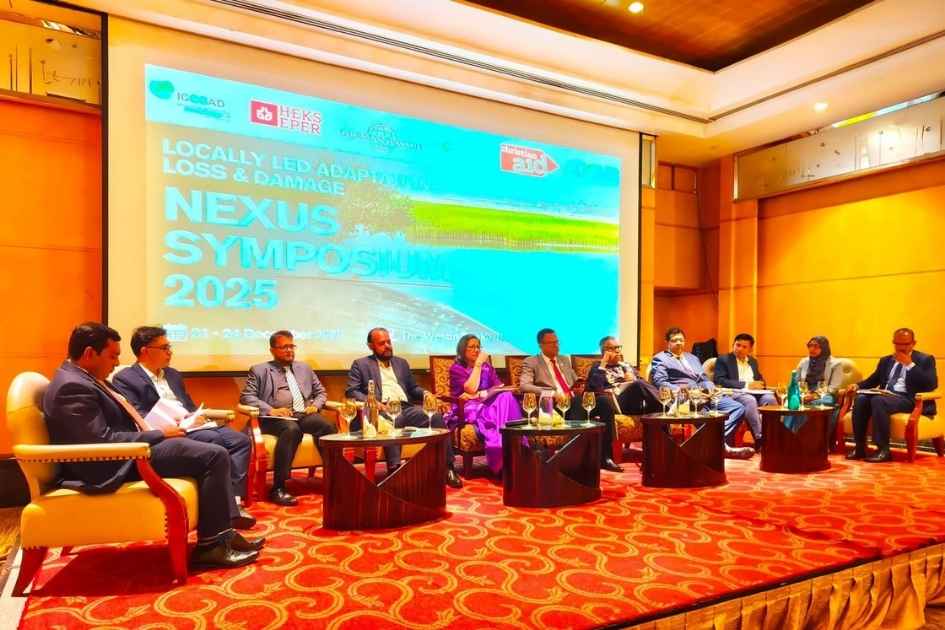



Bangladesh convened policymakers, practitioners, and communities at ICCCAD’s Dhaka symposium to advance locally led adaptation, address climate loss and damage, and demand equitable, community-driven climate finance amid growing climate vulnerability
The International Centre for Climate Change and Development (ICCCAD) successfully hosted the Locally Led Adaptation (LLA) and Loss and Damage (L&D) Nexus Symposium 2025 in Dhaka on December 22 and 23. The two-day event brought together over 50 participants, including local practitioners, policymakers, youth leaders and development partners, to explore inclusive, community-driven approaches to Bangladesh’s escalating climate crisis.
Speakers emphasized that locally led adaptation and equitable climate finance are not just policy choices. They are essential for ensuring that no community is left behind in Bangladesh’s fight against climate change.
Bangladesh, one of the world’s most climate-vulnerable countries, faces rising sea levels, cyclones, floods and salinity intrusion, threatening livelihoods across coastal, haor, hill tract and urban areas. Against this backdrop, the symposium highlighted the urgent need for locally led strategies that not only strengthen resilience but also address the full spectrum of climate-related losses.
The first day focused on building understanding around locally led adaptation and loss and damage. Speakers emphasized that empowering local communities goes beyond participation. It requires shifting decision-making, power and resources to the grassroots level. Shahrin Mannan noted, “LLA is not just participation but a shift of power, resources and decision-making to local actors.” Palash Sarker added that climate-vulnerable communities are often excluded from formal decision-making processes, while Juel Mahmud highlighted the challenges Bangladesh faces in accessing adaptation finance under global frameworks.
Sessions led by Sohanur Rahman and Dr. Rezwana Karim Snigdha underscored the importance of recognizing non-economic losses, including mental health impacts, displacement, cultural erosion and gendered vulnerabilities. “Locally led adaptation is crucial not only to strengthen resilience but also to recognize and address non-economic losses that communities face every day, losses that often go unnoticed in national policies,” Sohanur Rahman emphasized.
The second day showcased practical insights from local organizations across diverse landscapes, from coastal and haor areas to hill tracts and urban centers. Panel discussions focused on aligning locally led adaptation with loss and damage, improving financing mechanisms and strengthening local data systems. Speakers highlighted that many current adaptation efforts fall short in preventing loss and damage and stressed the importance of a decentralized and democratic process in advancing climate adaptation efforts.
Dr. Ainun Nishat, Professor Emeritus at BRAC University, said, “Without bottom-up planning and community ownership, climate actions cannot be just or sustainable.” He added that decentralization and empowering local governments would enable better coordination between central and local authorities, ensuring more inclusive decision-making.
On the financing front, AKM Sohel, Additional Secretary and UN Wing Chief, Economic Relations Division, Ministry of Finance, emphasized Bangladesh’s need for equity-based support over additional debt. Bangladesh is not in a position to take on more loans. Our Climate Finance Strategy is a clear statement that we must rethink how we finance climate action, prioritizing equity-based and guaranteed funding over additional debt, he said.
The symposium concluded with a call for collective and cross-sectoral action to reduce climate impacts and strengthen resilience. Saqib Huq, Managing Director of ICCCAD, said in his closing remarks, “LLA and Loss and Damage must move beyond siloed approaches. Collective action across sectors is essential to reduce climate impacts and strengthen resilience.”




