

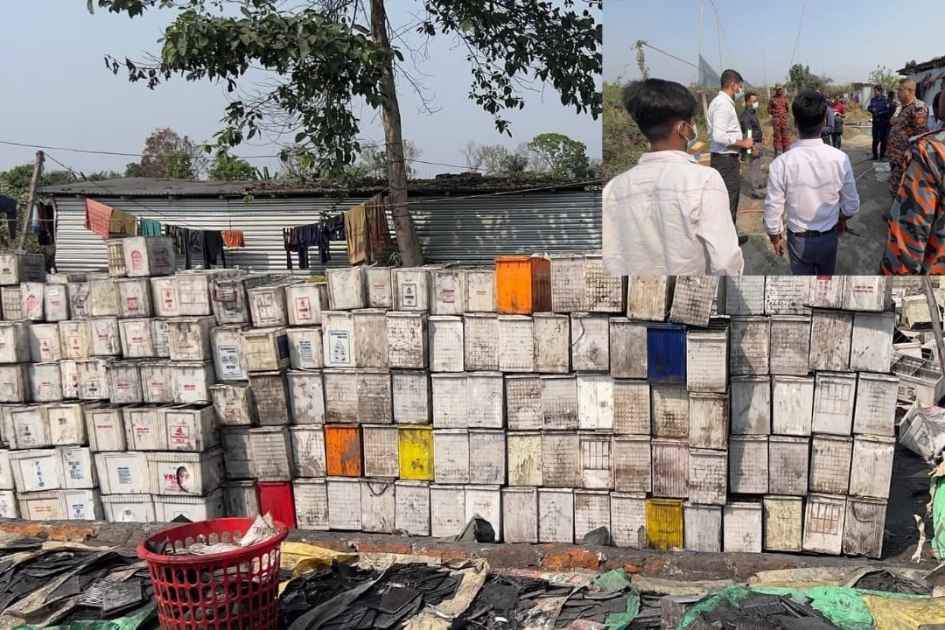



Mobile courts imposed fines, prison terms and shutdown orders after raids on battery-recycling and lead-processing sites in Tangail, Munshiganj and Chapainawabganj amid toxic pollution concerns.
Bangladeshi authorities dismantled, sealed or shut down three unauthorised lead-processing facilities in separate districts after finding they were operating without mandatory environmental approval and posing risks to public health and ecosystems.
The Department of Environment’s Tangail district office demolished an illegal used-battery recycling and lead-extraction facility on Tuesday, August 4, in Madhupur upazila.
The enforcement operation found that the plant had been melting discarded batteries to recover lead without clearance from the environmental regulator.
Md Rezwzan-ul-Islam, an executive magistrate from the Department of Environment’s headquarters, led the mobile court operation.
Officials demolished the facility completely under Bangladesh’s environmental protection laws and fined its owner Tk 50,000. The fine was recovered immediately at the scene.
Tapas Chandra Pal, assistant director of the Department of Environment’s Tangail district office and prosecution officer for the operation, said strict legal action would continue against industries operating without the required environmental approvals.
Department inspector Md Nurul Amin Pradhan and other officials attended the raid. Local police and personnel from the Fire Service and Civil Defence assisted with the demolition.
In a separate operation on Tuesday afternoon, authorities sealed an unauthorised lead-processing plant in the Betka area of Tongibari upazila in Munshiganj after finding that it was operating without environmental approval and posing pollution risks to nearby communities.
Tongibari Upazila Nirbahi Officer Tahmina Akter led the mobile court operation following reports that the facility was carrying out unregulated lead-melting activities and contributing to environmental pollution.
Authorities sealed the plant and fined its owner, local resident Md Moktar Hossain, Tk 100,000.
Officials said the facility lacked the environmental authorisation required for hazardous industrial operations. Bangladesh’s environmental regulations require industries posing significant pollution risks to secure approval before beginning operations.
The plant was involved in unregulated lead processing, which can release toxic substances and contaminate the air, soil and water when proper safety measures are not followed. Such contamination poses serious risks to workers, children and people living near the facilities.
“We received information that the facility was operating without approval and causing environmental pollution. Following verification, we sealed the plant and fined the owner Tk 100,000,” Akter said.
Environmental campaigners welcomed the action and called for stronger oversight to prevent hazardous pollution from unregulated industrial activities.
Lead exposure is widely recognised as a major public health concern because of its potential long-term effects on children’s development and vulnerable populations. Unsafe recycling of used batteries and materials containing lead remains a challenge in many developing regions because of inadequate waste-management systems.
Authorities said similar operations against unauthorised and environmentally harmful industries would continue in Munshiganj and other parts of Bangladesh to strengthen pollution control and environmental compliance.
In Chapainawabganj district, a mobile court took action against another illegal battery-recycling facility for extracting lead through the hazardous burning of used batteries without regulatory approval.
The district Department of Environment led a late-night raid on the unauthorised factory in the Salla Fultola area of Chapainawabganj Sadar upazila from 9:00 pm on Tuesday, August 4, until 1:30 am on Wednesday, August 5.
Eight people involved in the illegal lead-production process were sentenced to prison and fined under Bangladesh’s environmental laws.
The court handed down prison terms ranging from one to three months and imposed fines of between Tk 10,000 and Tk 100,000. The factory’s electricity connection was also disconnected with assistance from the local power department.
Two teams from Chapainawabganj Sadar Police provided security during the operation.
Mobile court judge Ekramul Haque Nahid, who is also assistant commissioner for land in Sadar upazila, said after the raid that the offenders had been punished under Section 15 of the Bangladesh Environment Conservation Act, 1995, for operating an environmentally hazardous facility without approval from the relevant authorities.
Abu Sayeed, assistant director of the district Department of Environment, was also present.
Md Ibrahim of the Gonka area in Chapainawabganj town was sentenced to three months in prison and fined Tk 100,000. Md Mahbub of the Alinagar Bhutpukur area received a one-month jail term and a Tk 30,000 fine.
Mostafizur Rahman of Putratali village in Gobindaganj upazila of Gaibandha district was sentenced to one month in prison and fined Tk 10,000. Hazrat Ali of Ulipur village in the same upazila received a one-month jail term and a Tk 20,000 fine.
Ariful Islam of Kuradaha village in Gobindaganj was also sentenced to one month in prison and fined Tk 20,000.
Abdur Rashid of Balua village in Saghata upazila of Gaibandha was sentenced to one month in prison and fined Tk 30,000. Md Shakil and Md Jamil, both from the same village, each received a one-month jail term and a Tk 20,000 fine.
Environmental experts have repeatedly warned that informal battery-recycling and lead-extraction facilities can release toxic substances into the air, soil and water, creating severe risks for workers and surrounding communities. Lead exposure is associated with serious health effects, particularly neurological and developmental problems among children.
The Department of Environment has recently intensified monitoring and legal action against unauthorised industrial operations as Bangladesh seeks to strengthen hazardous-waste management, pollution control and environmental compliance.
Authorities said enforcement drives against unauthorised industrial operations would continue to protect public health and environmental safety.




