

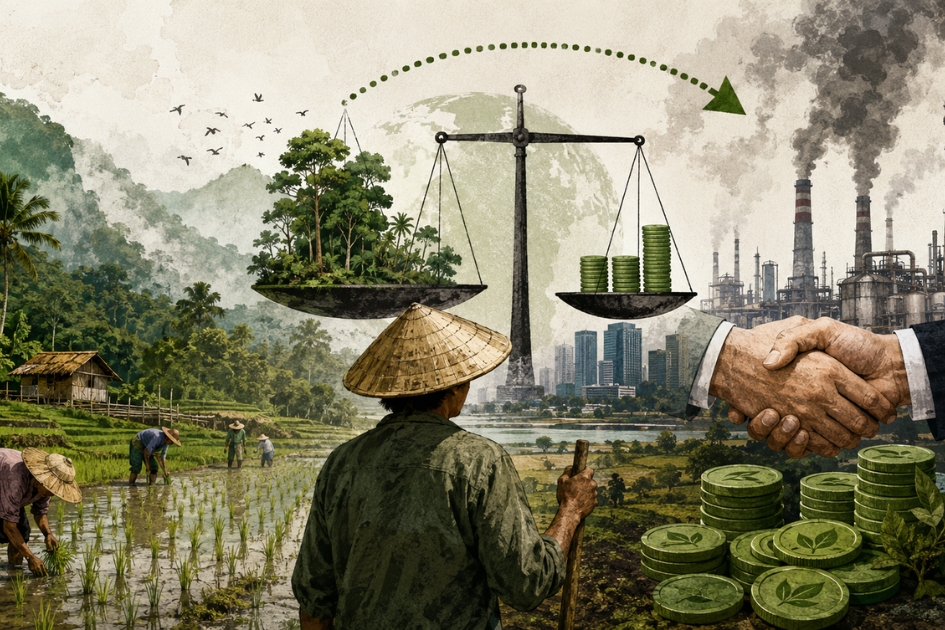



A new GRAIN report warns Asia’s fast-growing carbon credit market is exposing small farmers to land loss, weak incomes and corporate control while allowing major polluters to avoid meaningful emissions cuts.
Asia’s rapidly expanding carbon credit market is exposing millions of small farmers to land loss, corporate control and uncertain incomes as governments and multinational companies race to profit from climate offset schemes, according to a new report released by international non-profit organisation GRAIN.
The report, The Carbon Credit Trap: A New Danger for Farmers in Asia, warns that carbon credit projects promoted as climate solutions are increasingly targeting agricultural lands and forests across the region while allowing major polluting corporations to avoid cutting their own emissions.
Carbon credit projects are expanding rapidly across Asia as governments develop regional carbon markets and international trading mechanisms that allow companies and countries to purchase credits generated abroad and count them toward emissions reductions. The report says Asia already produces more than half of the world’s carbon credits and the market is projected to generate nearly US$10 billion annually by 2030.
East Asia accounts for 50 percent of carbon credits produced in the region while South Asia contributes 31 percent and Southeast Asia 12 percent, according to the report.
GRAIN said companies, government agencies and NGOs are travelling across rural Asia encouraging farmers to enrol in carbon schemes by promising climate benefits and new income opportunities. In reality, the organisation argues, many of the projects place long-term restrictions on farming practices, transfer control over land and carbon resources to corporations and expose farmers to legal and financial risks.
The report says farming can both contribute to greenhouse gas emissions and help remove carbon dioxide from the atmosphere through soil conservation and agroecological practices. However, it argues that carbon markets are using these practices to justify continued emissions by major fossil fuel and industrial corporations.
Under carbon credit systems, corporations purchase credits generated through projects that claim to reduce emissions or store carbon in soils, forests and farmlands. Companies buying the credits can then claim reductions in their own carbon footprint despite continuing to burn fossil fuels.
The report identifies several categories of projects spreading across Asia, including REDD+ forest conservation schemes, mangrove carbon projects, tree plantations, soil carbon farming programmes, pasture management systems and methane reduction projects linked to rice cultivation.
Forest protection projects operating under REDD+ programmes have been accused of restricting traditional land use by Indigenous and rural communities. In Cambodia, the Southern Cardamom REDD+ project allegedly forced Indigenous Chong villagers from ancestral territories and criminalised farming and foraging activities. More than 28.6 million carbon credits had already been sold before protests led to a temporary suspension of new issuances in 2023.
Mangrove carbon projects are also expanding in coastal regions across Asia. The report says Thailand has registered more than 34,000 hectares of mangrove forests for carbon credits since 2023. Some communities reportedly discovered their forests had been added to national carbon registries without consultation, sparking fears of future land conflicts and restricted access to fishing, gathering and timber resources.
Tree plantation projects promoted as carbon removal solutions often involve large-scale monoculture plantations or long-term contracts requiring farmers to maintain tree cover for decades. GRAIN said such projects can undermine biodiversity, reduce water availability and replace diverse ecosystems with commercial plantations vulnerable to pests and disease.
The report also highlights the growing role of agribusiness and technology companies in soil carbon projects. Corporations including Bayer, Cargill and Syngenta are promoting programmes that require farmers to adopt specific farming techniques such as no tillage, cover cropping and fertiliser optimisation while using digital platforms to monitor compliance.
Farmers participating in the projects are often required to register through smartphone applications and share farm data collected through satellites, sensors and digital monitoring systems. The report says these systems allow corporations to influence decisions about seeds, chemicals and crop sales while integrating farmers more deeply into industrial supply chains.
Rice cultivation has become one of the largest agricultural carbon markets in Asia. According to data compiled by GRAIN from the CarbonPlan offsets database, rice-related projects account for 309 registered agricultural carbon projects in the region, representing 53 percent of issued agricultural carbon credits.
The projects aim to reduce methane emissions by replacing continuous flooding of rice paddies with alternate wetting and drying systems. The report warns these techniques can increase weed growth and dependence on herbicides while encouraging farmers to adopt hybrid rice varieties that cannot be replanted the following season.
Major corporations including Shell have purchased carbon credits from rice farming projects in Asia, according to the report, which describes the projects as “greenwashing tactics” allowing polluting industries to market themselves as climate leaders without reducing fossil fuel use.
GRAIN said financial returns for farmers are often far lower than advertised. Project contracts usually allow companies to deduct large shares of carbon revenue along with certification fees, staff salaries, administrative costs and other expenses before farmers receive payments. The report estimates farmers may receive only around 10 percent of total project revenue.
In one carbon farming project in India’s Haryana and Madhya Pradesh states, 99 percent of farmers reportedly received no financial benefits from carbon credit sales and many participants reported falling crop yields. More than one-quarter of the farmers later withdrew from the project.
The report further warns that farmers may bear responsibility for “reversals”, situations where stored carbon is released back into the atmosphere because of fires, droughts, land-use changes or natural disasters. Many projects require farmers to maintain carbon storage commitments for between 40 and 100 years and may require repayment if emissions targets are not met.
In China’s Yunnan province, the report says local authorities partnered with companies on an afforestation carbon project covering more than 11,000 hectares. Village committees signed agreements transferring decision-making authority over community lands to government agencies and private firms for 60 years.
GRAIN said resistance to carbon projects is growing globally. In Kenya, court rulings and local protests led to the suspension of major soil carbon projects linked to rangeland conservation schemes. In Madagascar, communities filed complaints against a multinational company accused of seizing land for carbon tree plantations. Farmer groups in India have also criticised carbon markets for turning nature into a commodity controlled by corporations.
The report argues that genuine climate solutions already exist in traditional farming systems practised by small-scale farmers across Asia. It cites agroforestry, rotational farming, duck-rice-fish cultivation and the preservation of traditional seed varieties as examples of low-emission agricultural systems rooted in local knowledge and biodiversity.
Rather than expanding carbon markets, GRAIN says governments should support agroecological farming and direct climate assistance for communities already protecting forests, soils and biodiversity.




