

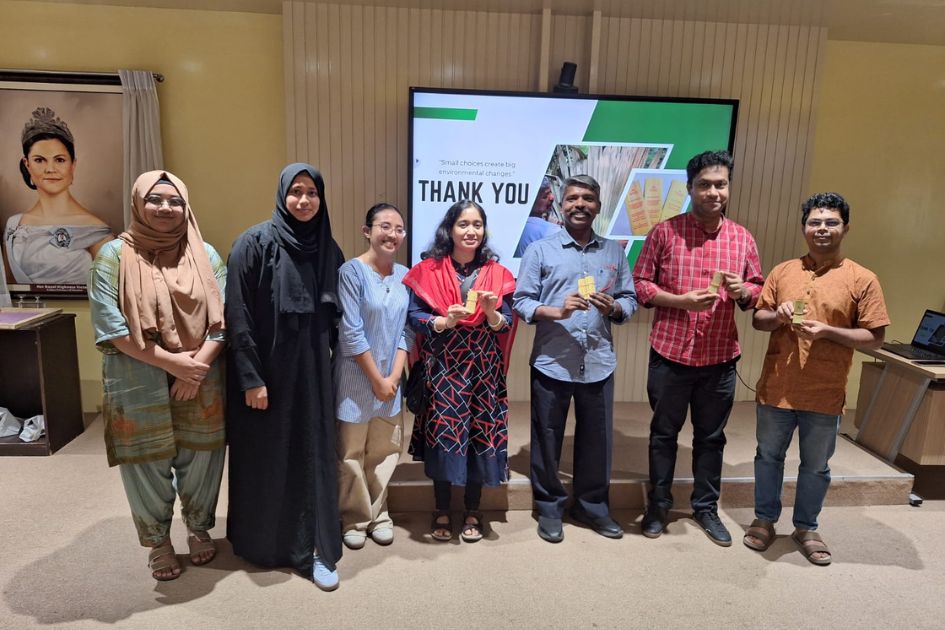



Around 100 AUW students learned to transform palmyrah leaves into biodegradable business cards, advancing women-led entrepreneurship while exploring future applications in sustainable printing.
The Asian University for Women (AUW), an independent international university in Chattogram, Bangladesh, has trained about 100 students to turn natural palmyrah leaves into eco-friendly business cards as part of a project exploring sustainable entrepreneurship.
The university held a hands-on Palmyrah Leaf Eco-Preneurship Workshop to share knowledge developed through a one-year startup research project funded by AUW’s Research and Ethics Committee.
The project was led by Dr. Mosae Selvakumar Paulraj, director of AUW’s Environmental Sciences Program and a palmyrah researcher, and combines the historical use of palm leaves with sustainable product design.
Speaking at the event, Mosae said palm leaves had historically been used across Asia to write manuscripts and transfer literary knowledge across generations.
He said the palmyrah tree is revered as a celestial tree in Tamil culture, while the classical text Tala Vilasam details more than 801 distinct uses for it.
Mosae said every part of the tree, from shoot to root, serves a purpose and described transforming its leaves into premium business cards as a “waste-to-wealth” approach that could attract corporate markets.
He said printing on palmyrah leaves was a first-of-its-kind initiative in Bangladesh and expressed hope that the model could eventually expand into sustainable wedding card production and broader printing enterprises.
The initiative is also linked to Mosae’s Green Bangle Movement, which is based on principles of eco-feminism and women-driven eco-preneurship and seeks to involve young women in developing practical environmental solutions.
Technical development of the project was co-led by lead research assistants Tawsia Ajrin and Denazia Da Silva Pires, with support from 10 student volunteers from AUW’s Environmental Sciences Program and the Green Bangle Movement.
During the workshop, Denazia and Tawsia explained the established protocol for preparing the leaves and demonstrated the printing process using devices. They also said research was under way to develop a natural dye for the printing process.
Participating students received hands-on instruction in transforming locally abundant natural resources into durable and fully biodegradable alternatives to conventional paper and plastic visiting cards.
The event was coordinated by Shaika Mohammad Chowdhury, assistant project manager of the Green Bangle project and Mithila Jahan, student coordinator of the Environmental Sciences Program. University leaders, faculty members, staff and students attended the session.
Customized sample palmyrah business cards were presented to senior university officials, including Research and Ethics Committee Chair Dr. Tuhin Biswas, Deputy Registrar Amena Begum, Finance Officer Naznin Sultana, Head of Maintenance Prithwiraj Nandy, Assistant Professor Dr. Shanta Dutta and Dr. Ahmedul Kabir, director of MS. Apparel Science.
AUW Vice Chancellor Prof. Sangita Rayamajhi and Associate Dean of Academic Affairs Dr. Mokiuddin Ahsanul Kabir Chowdhury congratulated the team on the initiative.
The event concluded with an award ceremony in which project assistants received Certificates of Appreciation and all workshop participants were awarded e-certificates.
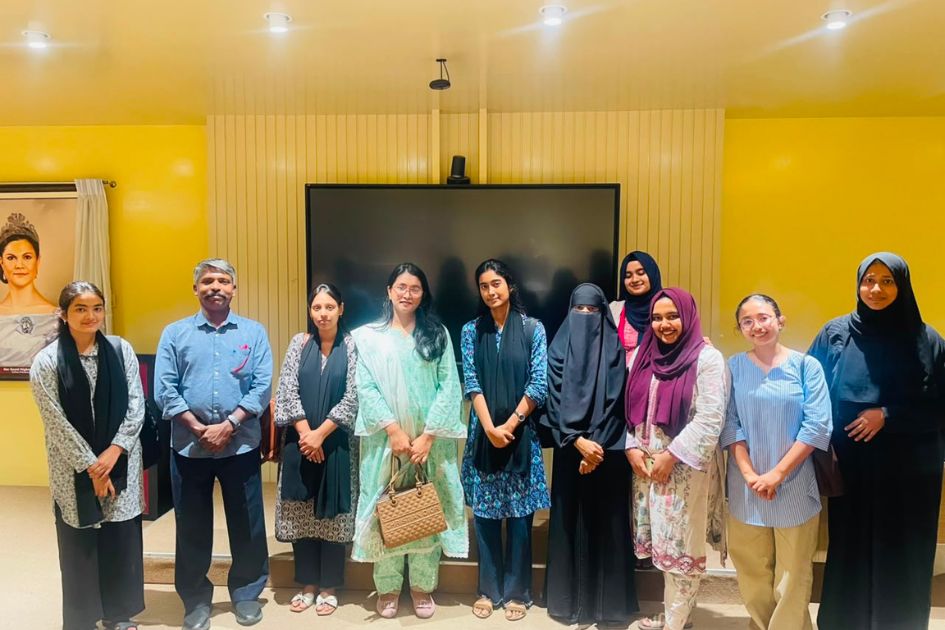
The workshop was organized in partnership with The Climate Watch, which expressed interest in adopting the technology to develop a large-scale eco-preneurship venture in direct collaboration with the Green Bangle Movement and the Asian University for Women.




