

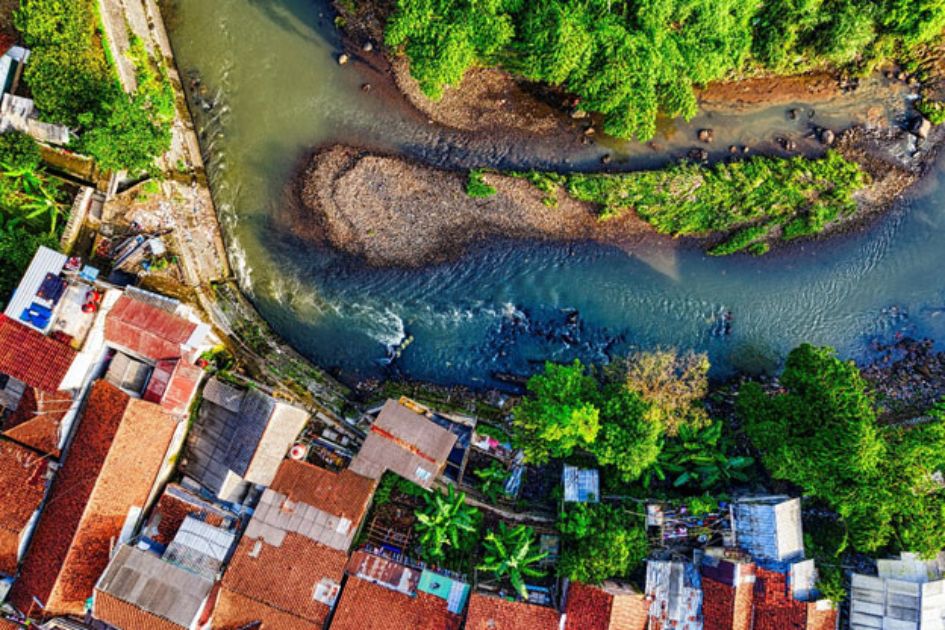



New geospatial and AI tools in Asia integrate satellite and data to guide water infrastructure, monitor ecosystems and strengthen governance, countries tackle data gaps and accelerate progress toward SDG 6.
Across Asia, governments and researchers are turning to satellite data and artificial intelligence to tackle a persistent lack of reliable water information, a gap that has long hindered effective policymaking and infrastructure planning.
Only about 3 percent of global water quality measurements, roughly 60,000 out of 2 million, come from the world’s poorest regions, according to the United Nations. Even where data exist, they are often fragmented across multiple agencies, with sparse monitoring stations and datasets rarely analysed together.
New initiatives are showing how satellite Earth observation and AI-powered technologies can unify these scattered sources into a single analytical pipeline, transforming raw environmental data into timely insights for policymakers and local authorities. Experts say such integration can strengthen water governance and accelerate progress toward Sustainable Development Goal 6 on clean water and sanitation.
In Indonesia’s Cimanuk–Cisanggarung River Basin in West Java, rapid urban growth, land-use changes and climate variability have intensified flooding during the rainy season while worsening water shortages in dry months. Retention ponds, small reservoirs designed to capture excess rainwater, are widely seen as an effective solution, helping to manage runoff and supply water for irrigation and communities.
However, identifying optimal sites for these ponds has traditionally relied on field surveys and fragmented datasets, making the process slow, costly and difficult to scale.
An AI-powered tool developed by Indonesia’s National Research and Innovation Agency and the West Java Department of Water Resources is now changing that. The system integrates satellite data such as digital elevation maps, land cover information and rainfall patterns with georeferenced drainage networks and soil data to pinpoint locations where retention ponds would deliver the greatest benefits.
It also applies socio-environmental filters to exclude protected areas or sites that could trigger social or legal conflicts. The results have been validated through field assessments and consultations with local stakeholders, while a mobile application is being developed to allow field technicians to access the data directly on site.
Officials say the tool replaces subjective decision-making with a more transparent and evidence-based approach, enabling governments to allocate resources more efficiently and strengthen long-term water resilience. Capacity-building efforts for local institutions are also supporting its adoption.
Similar innovations are reshaping how water ecosystems are monitored elsewhere in the region. In Thailand’s Songkhla Lake, the country’s largest lagoon system and a vital resource for fisheries and aquaculture, water quality monitoring has traditionally depended on periodic sampling at fixed stations.
A project led by Prince of Songkla University, in collaboration with local authorities, is now combining multi-source satellite data, historical records and machine learning models to estimate key indicators such as turbidity and biochemical oxygen demand. The approach enables near-monthly water quality mapping instead of relying on quarterly point measurements, improving early warning capabilities for ecosystem management.
The initiative builds on more than a decade of experience from China’s Poyang Lake, the country’s largest freshwater lake. There, Jiangxi Normal University has developed a comprehensive monitoring and early warning platform that integrates satellite, drone, ground and lake-surface data with ecological modelling.
The system tracks dynamic ecological conditions and overall lake health while supporting conservation efforts for migratory birds and the Yangtze finless porpoise.
These pilot projects highlight a broader trend, experts say, that many of the technologies needed to address water data gaps are already available. Satellite-derived data can expand environmental monitoring, while cognitive digital tools can convert complex datasets into actionable insights.
Yet scaling these solutions remains a challenge. According to the UN Economic and Social Commission for Asia and the Pacific report Seizing the Opportunity: Digital Innovation for a Sustainable Future, digital transformation is not only about technology but also about building the skills, institutions and partnerships needed to embed these tools into governance systems.
Experiences from Indonesia and Thailand show how integrating satellite data, geospatial analysis and AI can strengthen climate resilience, support livelihoods and improve water management. With supportive policies, stronger digital capacity and sustained regional cooperation, such approaches could be adapted across the region.
These efforts are supported under the Asia-Pacific Plan of Action on Space Applications for Sustainable Development for 2018 to 2030, which promotes knowledge sharing and technical exchange, including lessons from the Poyang Lake system.
The Asia-Pacific SDG Progress Report 2026 warns that progress on many development goals remains off track, with persistent data gaps continuing to constrain effective policymaking. Experts say closing those gaps will require not only new infrastructure but also stronger data systems and analytical capacity to guide decisions.
Kareff Rafisura, an Economic Affairs Officer for space applications at ESCAP, Orbita Roswintiarti, a senior scientist at Indonesia’s BRIN and Huang Qi, an associate research fellow at Jiangxi Normal University and director of the Nanji Wetland Field Research Station, contributed to the analysis. Chaoyang Fang, a distinguished professor and chief engineer at the Key Laboratory of Poyang Lake Wetland and Watershed Research, also provided insights.
They say scaling proven digital innovations could help transform fragmented water data into actionable intelligence, supporting progress toward SDG 6 and the broader 2030 Agenda for Sustainable Development.
This post is republished from IPS (Inter Press Service) UN Bureau Report.




