

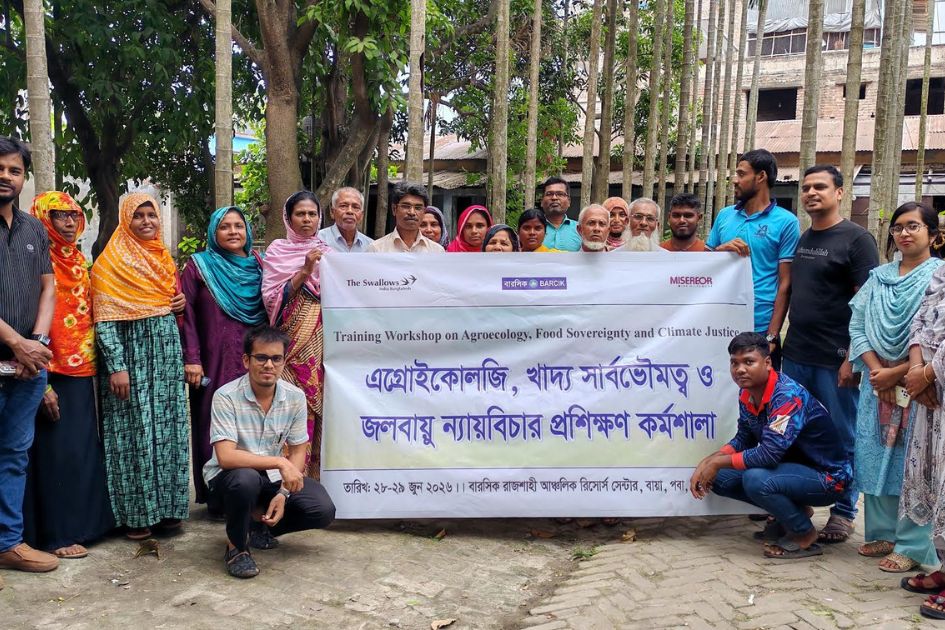

A two-day Rajshahi workshop trained farmers, women and youth on agroecology, food sovereignty, biodiversity conservation and climate-resilient farming, promoting indigenous knowledge, safe food production and sustainable agricultural practices.
A two-day training workshop on agroecology, food sovereignty and climate justice has concluded in Rajshahi, a metropolitan city in northwestern Bangladesh, bringing together farmers, women farmers, youth representatives, organizers and practitioners to promote environmentally sustainable agriculture, biodiversity conservation and climate-resilient farming.
The workshop was organized by the Rajshahi Resource Centre of Bangladesh Resource Center for Indigenous Knowledge (BARCIK), a non-governmental and non-profit research and development organization.
The training covered a wide range of topics, including agroecology and environmentally friendly farming practices, safe food production, food sovereignty, agricultural adaptation to climate change and the conservation of agricultural biodiversity.
Participants received practical training on the preparation and use of biopesticides, vermicompost production and application, indigenous seed preservation techniques, the differences between indigenous and hybrid seeds, reducing plastic use, establishing safe agricultural markets, existing challenges and opportunities in agricultural marketing and different forms of government support for agroecological practices.
The workshop also discussed the “Shatbari Initiative” and the Agroecology Learning Centre (ALC), focusing on village-based learning, experience sharing and effective strategies for expanding agroecology at the local level. Speakers also emphasized the importance of engaging young people in the agroecology movement.
One of the key attractions of the workshop was a group exercise titled “Food Diversity: Then and Now,” in which participating farmers and women farmers compared food consumption patterns from 20 years ago with those of the present day.
The discussion found that rural communities once relied heavily on indigenous rice varieties, diverse leafy vegetables, pulses, native fish, seasonal fruits and other locally available foods. Participants observed that this diversity has declined significantly over time as dependence on market-based and processed foods has increased, posing threats to indigenous food culture, nutritional security and agricultural biodiversity.
Speakers said agroecology is not merely an agricultural technology but a comprehensive approach to building a farmer-centered, environmentally sustainable and equitable food system. They stressed that agroecology-based farming has no viable alternative for preserving indigenous seeds, producing safe food, protecting biodiversity and addressing the impacts of climate change.
At the end of the workshop, participants pledged to expand agroecological practices in their respective communities, increase the production of safe food, promote indigenous knowledge and technologies among farmers and encourage the younger generation to become actively involved in environmentally friendly agricultural initiatives.




