

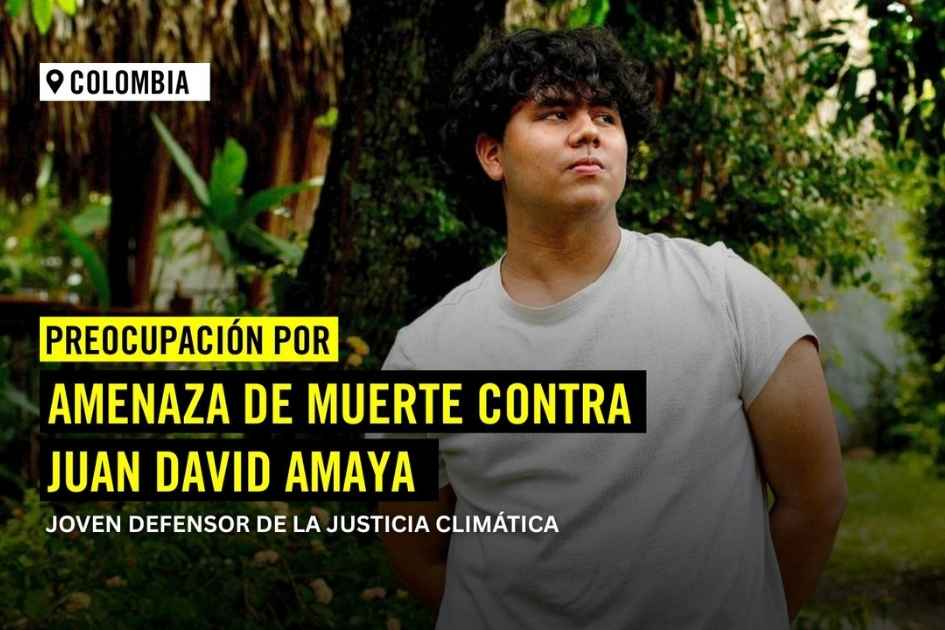



Teen climate defender Juan David Amaya receives death threats in Colombia, prompting Amnesty International to demand urgent investigations and protection amid rising violence against environmental and human rights activists globally.
Juan David Amaya, a 19-year-old human rights defender and climate justice activist, received a death threat near his residence on January 12, 2026. The incident, directly linked to his activism work, has been formally reported to the authorities.
Several days have passed since the report was filed, but Amaya has yet to receive any response from the Attorney General’s Office of Colombia. The delay raises serious concerns about the safety of human rights defenders who continue to face real and persistent risks.
“This is not an isolated case,” Amaya, CEO of Life of Pachamama, said. “It reflects a broader, structural pattern of violence and intimidation against those who defend human rights and the environment. Such acts seek to silence voices and discourage civic participation and the defense of life, territory and dignity.”
Amaya is calling for urgent protection mechanisms to ensure the safety of himself and his family. He emphasized, “Defending human rights should never put lives at risk.” Authorities must act swiftly before more defenders are threatened or killed.
Amnesty International Calls for Protection
Human rights organisation Amnesty International has also expressed concern over the threats against Juan David Amaya. In a public statement, the organization said, “We express our concern over the threats against the young human rights and climate justice defender Juan David Amaya. We call on the Attorney General’s Office of Colombia to conduct a prompt investigation and on the Ministry of the Interior and the Mayor’s Office of Villavicencio to provide effective protection measures.”
Global Context of Risks
The threats against Amaya reflect a broader global pattern of violence against environmental defenders, according to recent data. A report by the international NGO Global Witness found that at least 146 people were killed or disappeared last year for environmental activism. The countries with the highest death tolls were Colombia (48), Guatemala (20), Mexico (19), Brazil (12) and the Philippines (8). Of those counted, 33 percent were Indigenous Peoples. Experts note these figures likely underestimate the true scale due to underreporting, often caused by threats to journalists or families refraining from seeking justice for fear of retaliation.
Global Witness has been documenting these killings since 2012. Over this period, at least 2,253 defenders have been killed or disappeared. Latin America consistently sees the highest numbers, with Colombia being the deadliest country, where 509 people were killed or disappeared in just over a decade, followed by Brazil with 413. In Asia, 485 defenders were killed or disappeared between 2012 and 2024, mainly in the Philippines (306), India (87), Indonesia (25) and Thailand (13).
Industries and Conflict Zones
Mining and extractive industries were the most dangerous sectors for defenders last year, with at least 29 reported cases, followed by logging (8) and agribusinesses (4). Almost a third of cases were linked to organized crime, while states, including armed forces and police, were responsible for killings in 17 cases. Conflict zones also increase risks for defenders, though violence and displacement make documentation difficult.
Global Witness urges governments to systematically document attacks on environmental defenders, establish legally binding frameworks for corporate accountability and guarantee protection for communities defending land, forests and natural resources. Hundreds of environmentalists are killed annually worldwide by illegal miners, loggers, corporations or corrupt officials, highlighting a severe and ongoing human rights crisis. Over 1,000 environmental activists have been killed in the 21st century, with numbers rising to over 200 in both 2019 and 2020 alone.
Sohanur Rahman, Executive Coordinator of YouthNet Global, said, “Protecting defenders is not optional. When activists are silenced through threats or violence, it’s not just one life at risk, it’s the future of communities, the environment and democracy itself.”




