

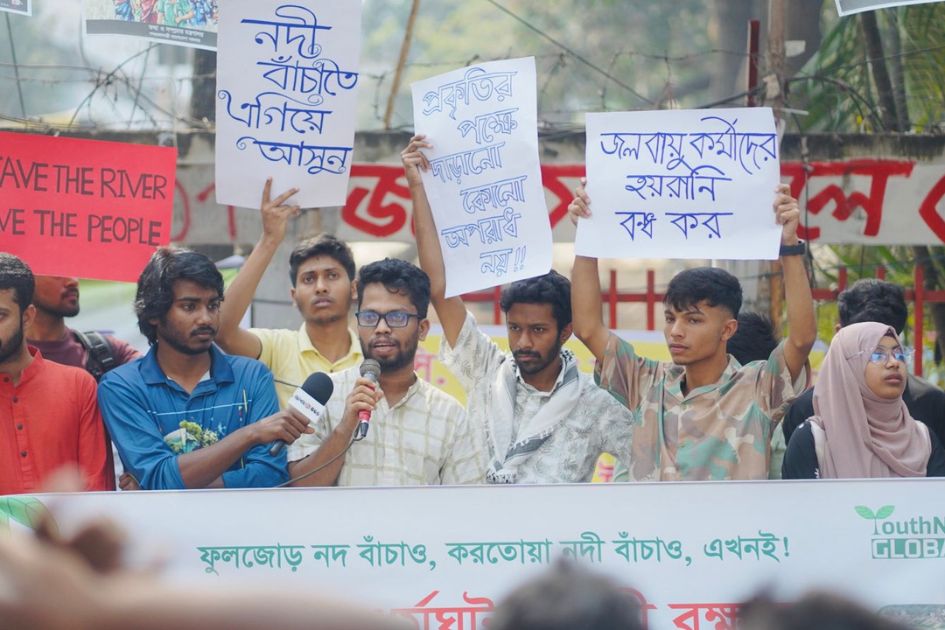



Youth activists rallied in Dhaka demanding investigation into alleged industrial waste polluting the Phuljor River, warning of ecological damage, fish deaths and threats to livelihoods in Bogura and Sirajganj districts.
Youth climate activists and environmental defenders called on authorities to urgently investigate alleged industrial pollution, enforce environmental regulations, protect environmental defenders from harassment and take immediate action to prevent further damage to the Phuljor River ecosystem.
The 55-kilometre Phuljor River supports fisheries, agriculture and daily water use for hundreds of thousands of people across Bogura and Sirajganj districts.
The youth-led protest, held in Dhaka on Thursday and organised by YouthNet Global, highlighted growing contamination in the Phuljor River and increasing environmental pressure on the Karatoya and Bangalee rivers. Hundreds of protesters gathered in front of the National Press Club in Dhaka, raising the alarm over alleged industrial waste being discharged into the river. They claim the pollution is linked to SR Chemicals, a chemical manufacturing plant owned by the family of Golam Mohammad Siraj, a Member of Parliament representing Bogura-5.
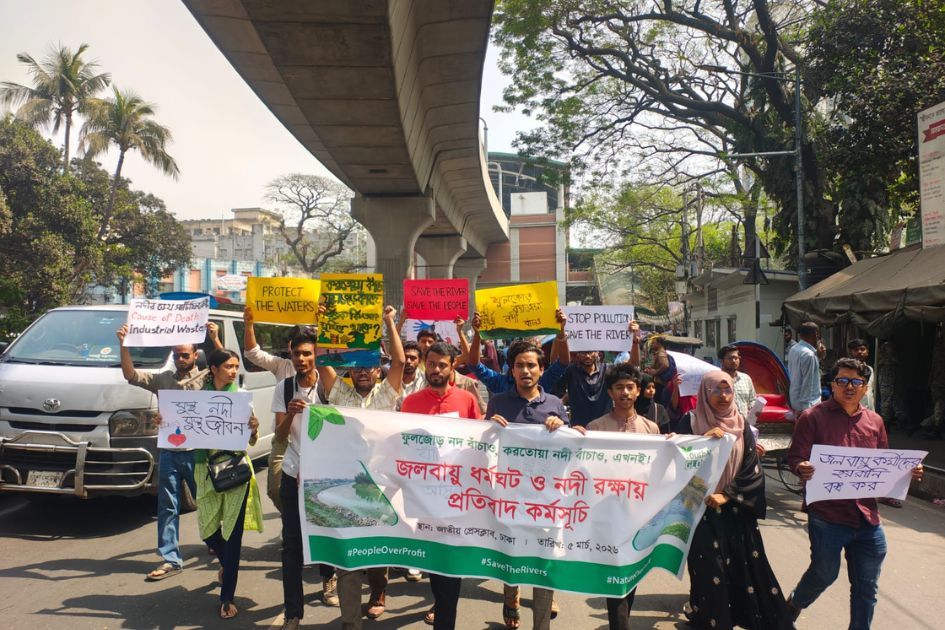
SR Chemicals has denied allegations of river pollution. At a press conference held at the Bogura Press Club, the company stated that its waste treatment system complies with environmental standards and that its operations do not discharge untreated waste into nearby rivers. However, local residents and environmental groups have rejected the company’s claims and called for an independent investigation.
Bangladesh’s High Court recognised all rivers in the country as “living entities” in a landmark 2019 ruling, granting them legal rights and appointing the National River Conservation Commission as their guardian.
Participants warned that continued contamination threatens aquatic life, biodiversity and the livelihoods of communities dependent on these waterways. They demanded stronger monitoring, strict enforcement of environmental laws and accountability for industries responsible for pollution.
Speaking at the protest, Faisal Biswas, a youth environmental activist from Sirajganj, said:
“Our rivers are the lifeblood of our communities. If the government does not act to protect them, we face not only ecological disaster but also the loss of our livelihoods and our future. We will continue to stand for our rivers until they are safe, clean and protected.”
He also highlighted recent incidents of harassment, noting that two protesters were arrested after raising concerns about hazardous industrial waste.
Sohanur Rahman, Executive Coordinator of YouthNet Global, emphasised the urgency of action:
“Bangladesh’s rivers are vital ecosystems that sustain communities, agriculture and biodiversity. When these rivers are polluted, the consequences are felt far beyond the immediate area. Young people and local communities are standing together to demand stronger protection and responsible action.”
Ankita Saha, a protest organiser, added:
“If rivers are recognised as living beings, then harming them should be treated as harming a legal entity. Instead, those demanding protection for the river are being arrested.”
The protest followed heightened concern after the arrest of two environmental campaigners, Touhidur Rahman, 45, and Ali Reza Biswas, 50, who were detained in northern Bangladesh after leading demonstrations over alleged industrial pollution. Residents reported that stretches of the Phuljor River had turned toxic, resulting in widespread fish deaths. Both activists were later granted interim bail while environmentalists say the case was filed in retaliation for their demonstrations.
Local residents mobilised after large-scale chemical discharges were reported on 21–22 February. Discoloured water, strong chemical odours and deaths of fish and other aquatic species, including snakes, frogs, crabs and snails, were observed.
Environmental groups subsequently formed the Karatoya and Phuljor River Protection Movement, staging human chains and submitting memoranda to authorities demanding urgent intervention. Further demonstrations were later held in Raiganj and Sherpur where protesters gathered near factories accused of discharging untreated waste into waterways connected to the Phuljor River system.
The demonstrators concluded the protest by reiterating four key demands: a transparent investigation into industrial pollution, strict enforcement of environmental regulations, protection for environmental defenders and immediate action to restore and protect the Phuljor River ecosystem.




