

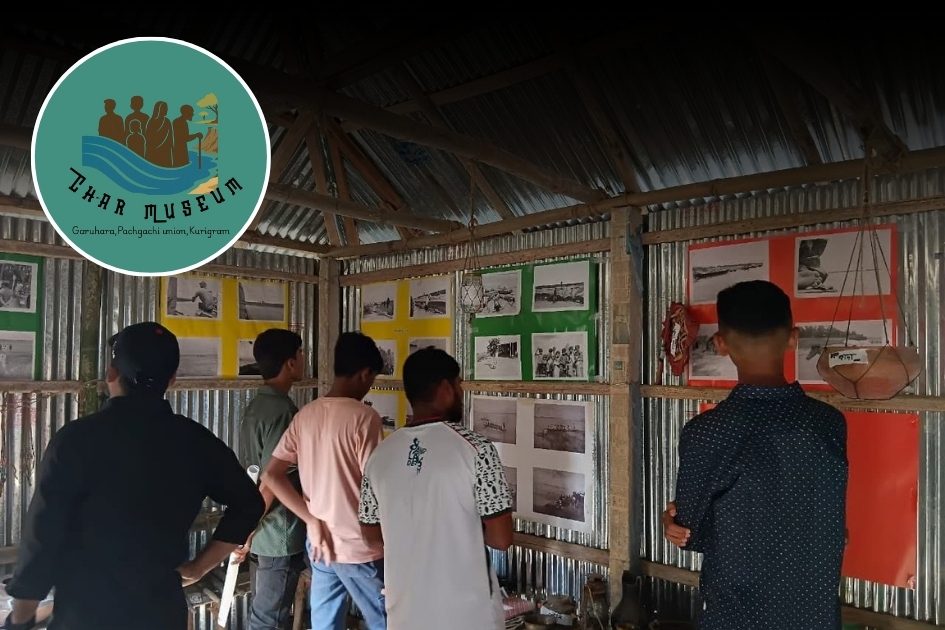



Young climate activists open Bangladesh’s first char museum in Kurigram, documenting erosion-hit lives, culture and non-economic loss, while inspiring locally led adaptation and youth leadership across vulnerable riverine island communities.
Amid growing threats from climate change, floods and riverbank erosion, a group of young people has launched Bangladesh’s first-ever char-based museum in Kurigram to preserve the history, culture and lived realities of char communities.
The museum, named Char Museum, has been temporarily set up in a tin-shed structure at Garuhara School Bazar under Panchgachhi Union in Kurigram Sadar Upazila. The initiative aims to document the lives of people who have lost homes, livelihoods, cultural belongings and other aspects of life due to non-economic loss and damage caused by repeated flooding and erosion.
The museum displays earthen pots and household utensils used in char homes, hand-made fans crafted by women, traditional clothing, agricultural tools, samples of river water and char-grown crops, along with other cultural artefacts that reflect the everyday life of char dwellers.
The initiative is led by Swapan Kumar Sarker, a young climate advocate and char development researcher, under his justice-based platform Justice for Char and Local Research. Swapan said he was inspired by the Char YouthNet Village, a community initiative that empowers young people in chars to take leadership in climate adaptation and locally led adaptation projects.
Youth climate justice activist Swapan Kumar Sarker, the initiator of the museum, said the lives of char people are full of struggle but rarely documented. “The stories of char communities have long remained invisible. We want to ensure these stories are not lost but presented accurately to future generations and the wider world,” he said.
Co-founder and programme coordinator Rajib Rana said the initiative was taken to preserve the struggles of char communities as historical documentation. He added that the positive response from visitors is encouraging the team to expand their work.
The museum has already attracted visitors from diverse backgrounds. School student Ishita Parvin said she had never seen such a collection before. “I liked visiting the museum very much. It helped me learn about char life,” she said.
Char resident Sirajul Islam became emotional after seeing a traditional hand fan on display. “This fan reminds me of my childhood. We used to use such fans together. Now they are disappearing,” he said.
Communication officer Nimmi Islam said the Char Museum demonstrates how young people can take leadership in preserving the history and culture of marginalised communities.
Site operation head Shakil Islam said many visitors are learning about char life for the first time through the museum. “It has opened a new horizon for char-focused initiatives,” he said.
The museum has been established entirely with the personal savings of the young founders without any government or private funding. Local teachers, civil society members and residents have welcomed the initiative, describing it as a source of pride for Kurigram and the country.
The Char Museum is currently open to visitors.
Background on Char Areas
Chars are riverine islands formed by sedimentation in the major rivers of Bangladesh, particularly in the Brahmaputra, Jamuna, Teesta and Meghna river systems. These areas are highly dynamic and frequently change due to river erosion and deposition. Life on chars is extremely challenging. Residents face seasonal flooding, displacement, limited access to education and healthcare and scarce livelihood opportunities.
Non-economic loss and damage, such as the loss of cultural heritage, social networks and traditional knowledge, is widespread. Despite these hardships, char communities possess rich cultural traditions and resilient social practices. Historically, chars have often remained neglected in development planning, making local initiatives like the Char Museum vital for preserving their heritage, culture and voices.
Commenting on the museum, Sohanur Rahman, Executive Coordinator of YouthNet Global, said, “This museum is a powerful example of youth-led action. It shows how young people can preserve culture, document history and inspire communities to face climate challenges with creativity and courage.”
Locally led adaptation efforts, including youth-driven initiatives, are essential to strengthening resilience and empowering communities to address climate impacts.




