

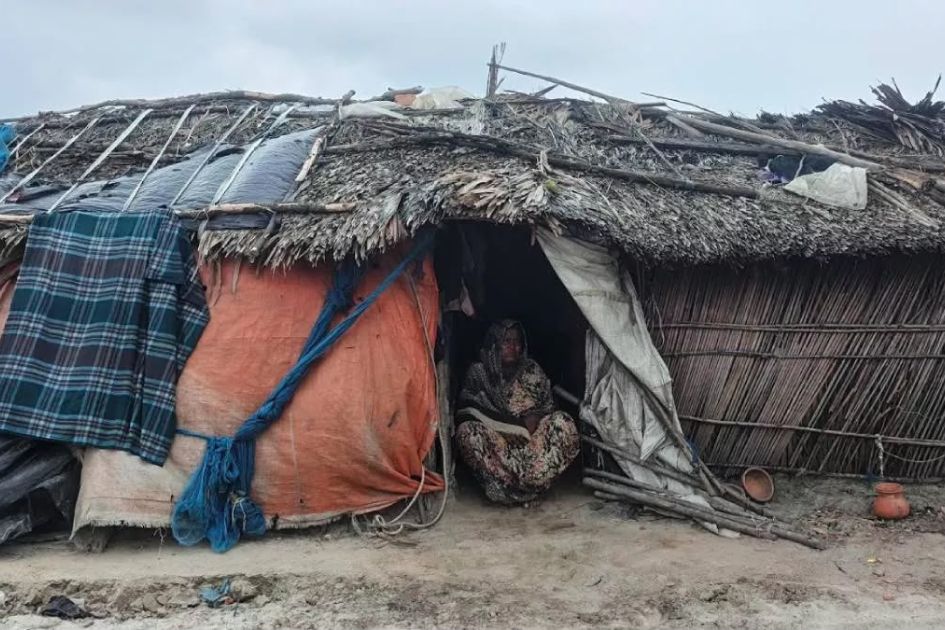



Widowed by disaster and displaced by erosion, Jarina struggles to feed four grandchildren as Sundarbans conservation restrictions expose the urgent need for stronger climate resilience and social protection.
On the fragile frontier of the Sundarbans, the world’s largest mangrove forest, 68-year-old Jarina Khatun lives in a makeshift shack stitched together from torn plastic sheets, fishing nets and burlap sacks. With the Shakbaria River pressing in on one side and the dense, predator-filled forest on the other, her shelter, balanced precariously on a government embankment, offers the only protection for her and her four grandchildren against wind, water and uncertainty.
In the coastal belt of Koyra in Khulna district, communities like North Bedkashi Union have endured years of overlapping crises. For Jarina, the turning point came five years ago when Cyclone Amphan and relentless river erosion erased her ancestral home. Soon after, her husband, a fisherman, died, leaving her widowed and displaced. Like thousands across Bangladesh’s exposed coastline, she was pushed onto the embankment, an unstable strip of land that has become both a refuge and a last resort.
A cycle of loss and restricted livelihoods
The family’s already fragile lifeline has now narrowed further. Jarina’s grandson, the sole income earner, depends on the resources of the Sundarbans for survival. But since June 1, authorities have imposed a three-month seasonal restriction on entry, fishing and honey collection in the Sundarbans to protect wildlife during its breeding cycle and preserve the region’s fragile biodiversity.
“Our luck is as scorched as the earth,” Jarina said, wiping away tears. “My grandson goes to the river with his nets, but many days he returns empty-handed. With the forest closed, we have no income. We survive on half-meals, sometimes nothing at all.”
Beyond hunger and income loss, the family faces another daily struggle: access to safe drinking water. Salinity intrusion and water scarcity force them to walk long distances each day to collect water that is safe for basic consumption.
The looming monsoon threat
As the monsoon season approaches, fear deepens. Strong winds, tidal surges and flooding routinely batter embankment settlements, and Jarina’s fragile shack offers little protection.
“Before the storms arrive, if someone could just give me a few corrugated iron sheets, I could reinforce these posts,” she said. “At least then we could sleep without fear on rainy nights.”
While she receives a modest government widow’s allowance, it is far from sufficient to support five people amid rising living costs and persistent inflation, which continues to erode rural purchasing power.
Between conservation and survival
Officials acknowledge the tension between conservation policy and human vulnerability. The seasonal restriction in the Sundarbans is designed to protect the breeding cycles of fish, deer and other wildlife while safeguarding the forest ecosystem that buffers Bangladesh against cyclones and storm surges. However, for families living on the margins, advocates say such measures expose gaps in social protection and emergency livelihood support.
Local representative Ashok Kumar Shil, a member of the Union Parishad, said the family remains under consideration for rehabilitation support. He noted that previous attempts to relocate them to NGO-supported housing were unsuccessful because they were reluctant to move away from their current location. However, he added that they remain a priority for future government or private resettlement initiatives.
Rethinking conservation with human security
Experts and practitioners increasingly argue that conservation in climate-vulnerable regions must be paired with stronger social protection systems. They point to several emerging priorities:
- Conservation safety nets that provide seasonal stipends or emergency food support during periods of restricted access to forest areas.
- Community-led forest management models that formally recognize local residents as co-stewards of biodiversity while ensuring both conservation and income.
- Resilient livelihood pathways, including climate-smart agriculture and vocational training, to reduce dependence on high-risk forest resource extraction.
- Basic climate-resilient infrastructure, including safe drinking water systems and durable housing, as a minimum standard for embankment communities.
Climate and youth activist Sohanur Rahman, Executive Coordinator of YouthNet Global, said forest-dependent communities are often left to bear the costs of environmental protection without adequate safety nets.
“Conservation efforts are vital for the Sundarbans’ survival, but they cannot come at the cost of human lives,” he said. “When seasonal restrictions are imposed, there is a moral and administrative responsibility to ensure that the most marginalized forest-dependent families are supported through alternative livelihoods and emergency food assistance. Without that, the burden of conservation falls disproportionately on those already living on the edge.”
A life suspended between water, forest and uncertainty
For now, Jarina’s family remains in limbo, shaped by a rising river system that redraws the coastline, a shrinking forest governed by seasonal restrictions and an economy that offers little protection for the rural poor.
In these embankment settlements, survival is determined as much by policy as by nature. As the three-month restriction continues through August, families like Jarina’s wait in uncertainty, hoping that the next storm holds back a little longer and that conservation and survival will no longer be treated as competing realities.




