

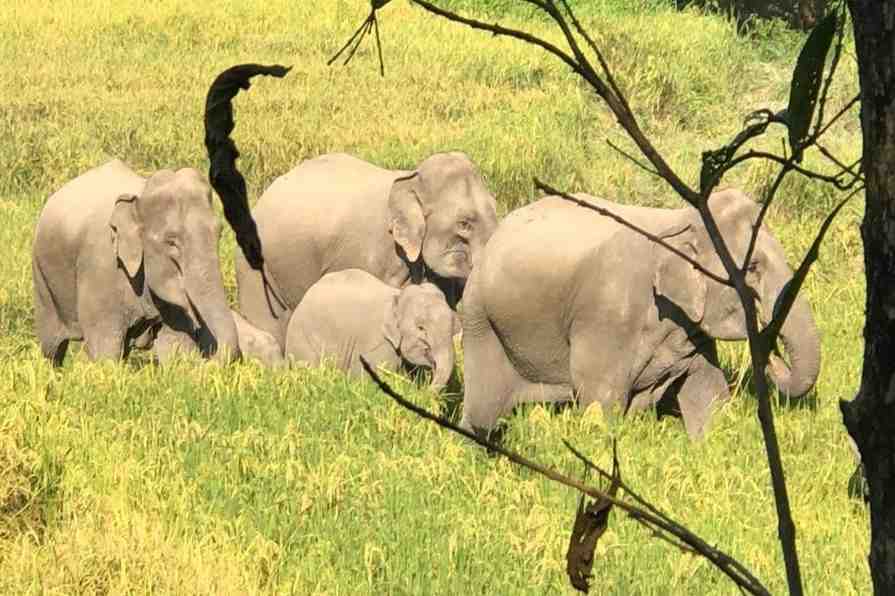

Elephant habitats in Cox’s Bazar and Chattogram are rapidly disappearing due to refugee camps, railways, fencing, and development. Blocked migration corridors have trapped herds, with fatalities rising. Conservation efforts exist, but experts warn urgent action is needed to prevent further decline.
Just a few decades ago, the forests of Cox’s Bazar, Chattogram, and the Chittagong Hill Tracts echoed with the footsteps of roaming elephant herds. They moved freely between habitats, following ancient routes to find food, water, and breeding grounds.
Today, those routes are vanishing. The establishment of Rohingya refugee camps, military bases, border fencing, landmines, and new railway infrastructure has steadily choked the elephants’ natural range.
The first major blow came on 25 August 2017, when more than one million Rohingya refugees fled to Bangladesh, seeking safety in Ukhia and Teknaf. Around 10,000 acres of forest — identified as prime elephant habitat — were cleared to accommodate them.
The challenges didn’t stop there. In November 2023, the Dohazari–Cox’s Bazar railway line opened, slicing through three forest areas in Chattogram and Cox’s Bazar. It crosses 16 elephant crossing points and three major migration corridors, further fragmenting the species’ habitat.
A 2016 survey by the International Union for Conservation of Nature (IUCN) found Bangladesh had just 268 elephants left. That same year, the species was listed as critically endangered. Since then, the Forest Department reports 146 elephants have died in the past nine years.
Between 2013 and 2016, IUCN mapped 12 key elephant corridors in Cox’s Bazar and Chattogram — eight of them in Cox’s Bazar alone. Many of these routes have now been blocked by fish farms, betel leaf plantations, and railway lines.
“Some of these corridors have been occupied, others damaged by infrastructure. There is no uninterrupted route for elephants anymore,”
— Abu Naser Mohammad Yasin Newaz, Divisional Forest Officer, Chattogram Wildlife and Nature Conservation Division, told The Climate Watch.
“Saving elephants will require coordinated action from the administration, the Forest Department, and all stakeholders.
35 elephants trapped
Professor MA Aziz, from Jahangirnagar University’s Department of Zoology, explained that elephant herds once crossed freely into Myanmar via the Ghumdhum corridor in Bandarban. But in 2017, following the Rohingya influx, a barbed-wire fence went up along the border, cutting off the route and leaving 35 elephants trapped in the Teknaf and Ukhia areas.
Another route along the Rezu Canal in Cox’s Bazar has also been blocked — this time by military installations on one side and crocodile and fish farms on the other.
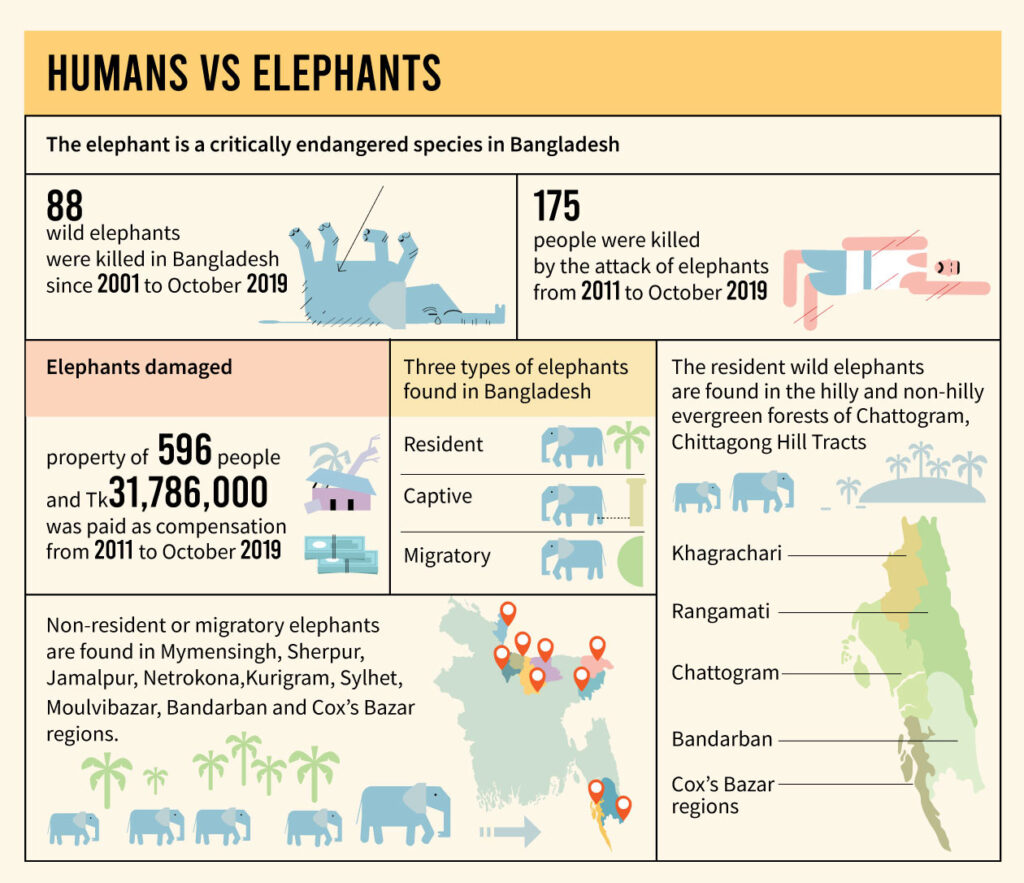
Professor Aziz said the new Chattogram–Cox’s Bazar railway runs through 27 kilometers of forest. Although one overpass and two underpasses were included for elephant movement, they were poorly designed. Already, one elephant has been killed in a train collision.
“Elephants are now geographically isolated as corridors close. The Forest Department has a conservation project, but urgent, practical fieldwork is needed,” Aziz stressed.
The elephant overpass that few elephants use
On a recent Sunday afternoon, The Climate Watch visited the elephant overpass in the Jangalia area, about 700 meters north of the Chunati Wildlife Sanctuary range office.
The signs weren’t promising. Banana plants and bamboo clusters planted as elephant food were untouched. There were no footprints, no droppings — only cattle tracks and the occasional human passerby. Local residents said they hadn’t seen elephants use it in at least six months.
The overpass was funded under the Asian Development Bank’s Dohazari–Cox’s Bazar railway project.
“We are installing AI-powered cameras here. If elephants are detected within 50 meters on either side or 100 meters ahead, the train will stop automatically,”
— Asif Imran, ADB environmental consultant, told The Climate Watch.
“In June, elephants crossed the overpass only twice. We’ve recorded far more human use than elephant use.”
Once kings of the forests, Bangladesh’s elephants now navigate a patchwork of barriers, shrinking forests, and human settlements. Without urgent action to restore corridors and protect habitats, their future could be as narrow and fragmented as the paths they are now forced to walk.




