

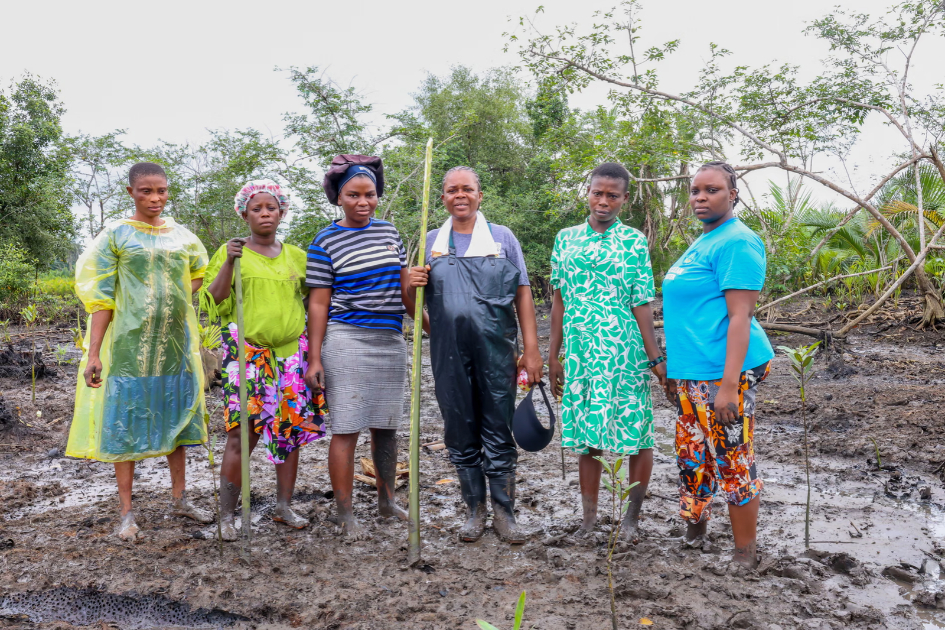



Through the Lokiaka Community Development Centre, Martha Agbani has trained more than 400 women in mangrove restoration, helping communities reclaim degraded wetlands and revive vital sources of food and income.
In Nigeria’s oil-scarred Niger Delta, environmental campaigner Martha Agbani is training women to restore mangrove forests devastated by decades of pollution, helping communities recover damaged ecosystems, livelihoods and control over their ancestral wetlands.
Agbani, who grew up in Ogoniland, witnessed crude oil spills contaminate rivers, kill trees and destroy the livelihoods of communities across the oil-producing region. She now leads efforts to bring the mangroves back, planting one sapling at a time.
Her commitment to environmental restoration was shaped by her mother, Theresa Terabiewaa Agbani, an activist, and the 1995 execution of Ogoni playwright and campaigner Ken Saro-Wiwa alongside eight other environmental activists.
“The execution of Ken Saro-Wiwa and the other Ogoni land defenders decades ago opened my eyes to what really lay behind the destruction of my home town,” she says.
In 2003, shortly after her mother’s death, Agbani established the Lokiaka Community Development Centre to help female Ogoni farmers protect the environment and restore mangrove forests damaged by more than five decades of oil pollution.
Her work aims not only to replant trees but also to rehabilitate wetlands, revive livelihoods and peace, and restore the sense of ownership communities lost as their mangrove forests disappeared.
In the muddy wetlands of Teenama, Joy Lebewi works alongside a dozen women, planting mangrove saplings while watching for crabs and periwinkles they can collect. Trained by Agbani’s centre, the women have planted more than 150,000 mangrove saplings in the area.
“We want to space the mangroves right,” Lebewi says, concentrating on the work. “This is our forest.”
The women learned the importance of proper spacing after beginning restoration work in 2018. Their initial plantings were too close together, allowing the trees’ canopies to crowd one another out. They now use a two-metre stick, pressing one end into the muddy ground to mark the position of each new sapling.
Teenama lies between the Kwawa and Kpean oil settlements in the Yorla oilfields of Ogoniland, where decades of oil production and spills have severely damaged the environment.
Across the region, communities that once depended on mangrove-lined creeks for fishing and shellfish gathering have lost important sources of food and income.
In Bodo, Shell was ordered to pay £55 million in compensation to local residents following two major oil spills in 2008 and 2009. Dr Ferdinand Giadom, deputy project director of the Bodo Mediation Initiative, a stakeholder group overseeing oil cleanups in the region, said the scale of the destruction remained substantial.
About 1,000 hectares (2,500 acres) of mangroves were directly destroyed in the 2008 Ogoniland spill. Giadom estimates that more than 500,000 barrels of crude oil have entered the environment in less than 20 years.
“Two decades have been lost,” Giadom says. “Livelihoods over that span of time have been lost.”
The wetlands face another threat from nipa palm, an invasive species originating in Southeast Asia that has spread through disturbed parts of the Niger Delta. Its dense growth displaces native vegetation and obstructs local people’s access to wetlands.
Removing the palms is labour-intensive. In Teenama, men from nearby communities clear the land before the women plant native mangrove saplings.
The Niger Delta’s mangrove ecosystem is the largest in Africa and the third-largest in the world, covering about one million hectares. The forests provide habitats for fish, shrimps and molluscs while serving as nurseries for other aquatic life. They also protect coastlines, store carbon and sustain communities that depend on wetlands for food and income.
“Millions of people’s livelihoods depend on healthy mangroves,” says Oluwakemi Odufuye, a coastal ecologist at the Nigerian Institute of Oceanography and Marine Research.
For Agbani, the environmental damage is inseparable from its impact on people’s lives. Having witnessed pollution transform the landscape of her childhood and deprive women of access to essential forests and waterways, she developed an approach that combines environmental justice, gender inclusion and biodiversity conservation.
At Lokiaka, women receive practical training in swamp forests rather than conventional classrooms, working under the supervision of experienced restorers.
Agbani aims to enable women across the Niger Delta to restore their wetlands independently. More than 400 women from different communities have received training, with many subsequently replicating the techniques in their own areas.
Since 2018, Lokiaka’s teams have restored three million mangroves and reclaimed 190 hectares of swamp forest in Ogoniland.
The return of fish and crabs is among the signs of progress for Agbani.
“Life is returning,” she says.
Environmental scientist and campaigner Erabanabari Kobah, who is from Ogoniland, says restoration must be assessed by the long-term health of forests rather than simply the number of trees planted.
“Planting in unsuitable areas won’t ensure long-term success,” he says.
Successful restoration requires an understanding of how water moves through the wetlands, where mangroves can survive and how recovering forests can once again sustain marine life.
Collins Lebeteh, an environmentalist involved in community-led conservation, says the people carrying out restoration must also be central to decisions about it.
“What is really important is who is doing the planting. Many women who rely on and are affected by the degraded environment are often left out of decisions around the restoration of ecosystems,” he says.
Agbani is seeking to change that by involving local communities directly. Her organisation also works with fishers, training them to identify species and manage mangrove buds.
She wants restoration to remain under community control rather than become another “top down” intervention.
Back in Teenama, Lebewi presses her spacing stick into the mud once more. The mark is barely visible across the vast wetland, but it indicates where another sapling will take root and begin to grow.
This post is republished from The Guardian.




