

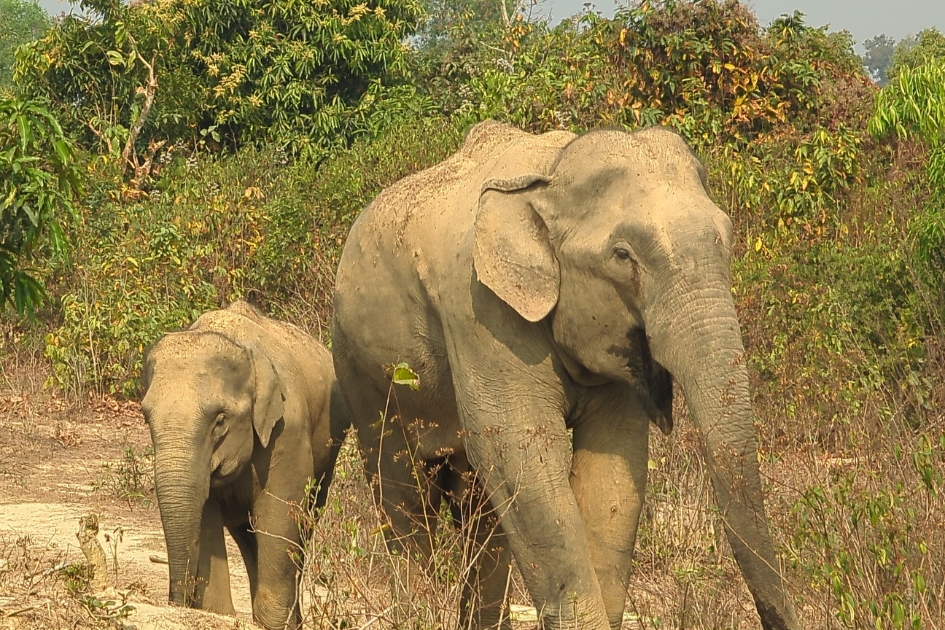



Wildlife in the Chattogram Hill Tracts faces growing threats from deforestation, habitat loss and illegal hunting, as conservationists urge stronger forest protection and coordinated action to save endangered species locally.
The wildlife crisis in Bangladesh’s Chattogram Hill Tracts is becoming increasingly alarming as deforestation, habitat loss, food shortages and illegal hunting threaten many species in the region.
March 3 marks World Wildlife Day. The Chattogram Hill Tracts, comprising Khagrachhari, Rangamati and Bandarban, contain about 90 percent of the country’s hill forests and are home to nearly 80 percent of Bangladesh’s biodiversity.
However, experts say the number of several species is declining due to continuous forest destruction and human activities.
Officials and conservationists say species such as Asian elephants, barking deer, sambar deer, great hornbills, bears, jungle fowl, hill mynas and langurs are gradually disappearing from the forests of the three hill districts including Khagrachhari.
The Biodiversity Conservation Society of CHT, a voluntary organisation working to protect wildlife and biodiversity in the hill tracts, says wildlife conservation is impossible without protecting forests.
Pranto Roni, one of the organisers of the organisation, said the green cover of the hill region is shrinking rapidly due to deforestation and illegal encroachment.
“When forests are destroyed, wildlife habitats shrink and the balance of the ecosystem is disrupted. If people become more aware and help protect forests, the animals that are struggling to survive will also be able to live safely,” he said.
Sabuj Chakma, founder of the organisation, said the total area of hill forests in the Chattogram Hill Tracts is about 322,331 hectares.
“In this vast forest area, many species including Asian elephants, hornbills and langurs are now under threat. Restoring natural forests and protecting the remaining forest areas are essential for the survival of these animals,” he said.
He also stressed the importance of coordinated efforts involving the government, NGOs, various organisations and volunteer groups to protect wildlife.

In January 2026, the Khagrachhari Forest Department and the Wildlife Management Division conducted a joint operation and rescued a rare Asiatic black bear, six barking deer and two monkeys from the house of former union parishad member Nabodip Chakma.
During the same period, a rare Himalayan griffon vulture was rescued from the Bhaibonchhara area. The rescued animals were later handed over to a safari park.
Mahfuz Russel, founder of the Pitachhara Forest and Wildlife Conservation Initiative, said illegal hunting, deforestation, population pressure and lack of awareness are major barriers to wildlife conservation in the hill tracts.
“In many cases, weak enforcement of existing laws has made the situation even more complicated,” he said.
He added that forests are being rapidly destroyed as wood from the forests is widely used as fuel for brick kilns. The expansion of cassava cultivation is also reducing water sources in the hills.
Short term profitable crops such as pineapple, taro and tobacco cultivation are also damaging natural forests, which directly affects wildlife habitats.
According to Russel, wildlife conservation will remain difficult unless forests are restored, hunting is strictly controlled through proper law enforcement, public awareness increases and long term employment opportunities are created for people in the hill region.
He warned that without effective steps the existence of wildlife in the Chattogram Hill Tracts may shrink further in the future.




