

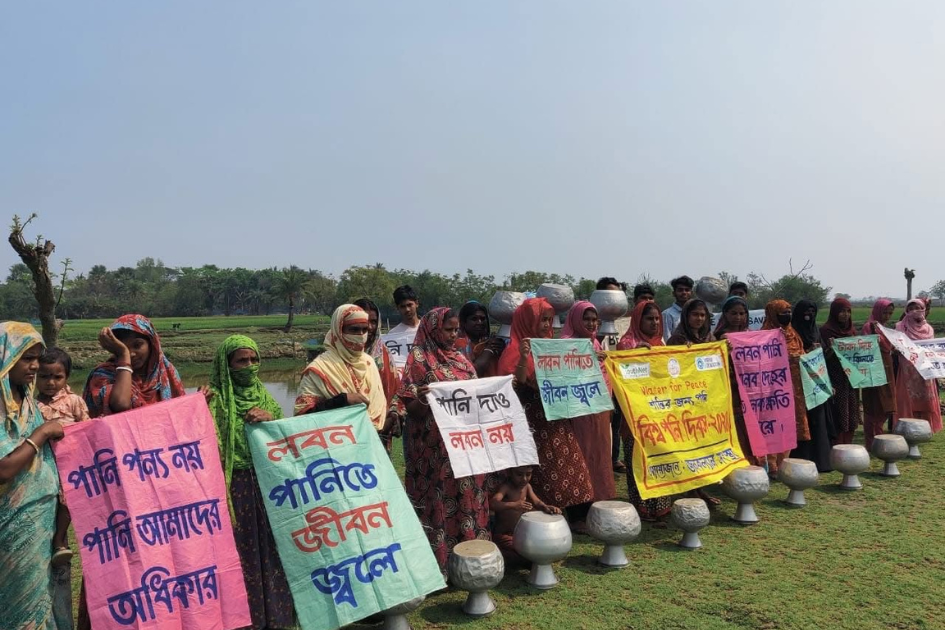

In coastal Shyamnagar, long walks for safe water keep girls out of school. Salinity and cyclones worsen shortages, while weak governance and uneven climate finance deepen hardship.
Shyamnagar, a low-lying coastal upazila in Satkhira district near the Sundarbans mangrove forest and the delta of the Ganges-Brahmaputra-Meghna rivers, faces a daily struggle for safe drinking water. The region is highly vulnerable to flooding, cyclones and salinity intrusion. Cyclone Aila in 2009 and Cyclone Amphan in 2020 devastated freshwater sources, submerged wells and destroyed 57 kilometers of embankments. Many communities have since become dependent on distant ponds or purchased water to meet basic needs.
Even though the region is surrounded by rivers, canals and ponds, very little water is safe to drink. Mostafizur Rahman, Shyamnagar’s public health engineer, says families must walk long distances to fetch water, sometimes up to four kilometers daily. Women and girls bear the heaviest burden, collecting water for drinking, cooking and household chores. Children often spend two to three hours daily on water collection, leaving little time for school or study.
Government and NGO initiatives, including rainwater harvesting tanks, pond sand filters and reverse osmosis plants, provide partial relief. However, these programs cover only some areas of the upazila, leaving many households struggling. SM Shahin Alom, a young climate activist in Satkhira, says poor governance and a lack of water justice mean climate finance often does not reach those who need it most. Many families remain reliant on unsafe or distant water sources.

Experts call for targeted and integrated solutions. Expanding safe water access, increasing rainwater harvesting, mapping vulnerable households and ensuring climate finance reaches frontline communities are essential steps. Gender-transformative approaches, including engaging men and boys in household work, are critical to reducing absenteeism and empowering girls. Girls should not have to choose between survival and education, says Sohanur Rahman, Executive Coordinator of YouthNet Global. That choice undermines climate resilience and regional development.
For 15-year-old Shuvra Mondal, the crisis defines her daily life. Living in West Dhankhali village with her parents, who are daily wage laborers and her younger siblings, she begins each morning carrying a 10-liter water jug 1.5 kilometers to a safe water source. On days when she must collect water twice or complete household chores, she cannot attend school. Hundreds of girls in Shyamnagar face the same dilemma, balancing survival and education in an environment where climate shocks are frequent.
Girls are disproportionately affected. Priya Rani Mondal, an eighth-grade student, fetches water twice daily while caring for her younger brother. “Sometimes I have no time to go to school. I submit a leave letter explaining I went to fetch water,” she says. Teachers report that many girls miss school two to three days per week due to chores and water collection. Some also face harassment while traveling to distant water points. The psychological stress of these journeys, combined with fatigue, further impacts learning and well-being.
Programs such as EcoMen, which engage men and boys to share household responsibilities, aim to reduce the burden on girls. When men and boys participate in water collection and domestic chores, girls can attend school more regularly, says Md Hafiz, district coordinator. This approach promotes gender equity, challenges traditional norms and supports educational access.
Water scarcity also imposes financial strain. Families often pay up to one taka per liter of water, a significant cost for households relying on daily wages. Limited access to water contributes to early marriage, interrupted schooling and long-term economic vulnerability. In some cases, communities are forced to drink saline water, risking health issues such as hypertension, kidney disease and reproductive health problems.
Research shows that Shyamnagar’s challenges reflect broader trends. A 2023 MDPI study revealed that girls across South Asia and Africa spend hours daily collecting water, often missing 37 to 51 school days per year. Water collection responsibilities, combined with household work, limit girls’ educational and social opportunities.
Sohanur Rahman emphasizes that this is not just a local issue but a systemic problem affecting millions in climate-vulnerable regions. Urgent action is needed to integrate reproductive health into climate adaptation strategies and protect vulnerable communities globally. “The people are trapped,” he says. “In Bangladesh, the climate-driven encroachment of seawater inland is a dire reality, with profound implications for reproductive health. Salt in the womb imperils women’s well-being, leading to pregnancy complications, premature births and long-term health risks.”
For Shuvra, Priya and hundreds of girls across Shyamnagar in Satkhira district, the daily struggle is a balancing act between life and learning. Without water, families cannot survive. Without school, children lose the chance to build a better future. Rising sea levels, salinity intrusion and increasingly frequent cyclones make Shyamnagar a stark example of how climate change, gender inequality and education intersect, highlighting the urgent need for climate justice and international support.
Experts call for expanding safe water access, ensuring climate finance reaches frontline communities and promoting gender-sensitive programs that redistribute household labor. Girls should not have to choose between fetching water and attending school, Sohanur Rahman insists. Tackling these challenges in Shyamnagar is critical not only for Bangladesh but also as a model for global climate justice and gender-sensitive adaptation strategies.




