

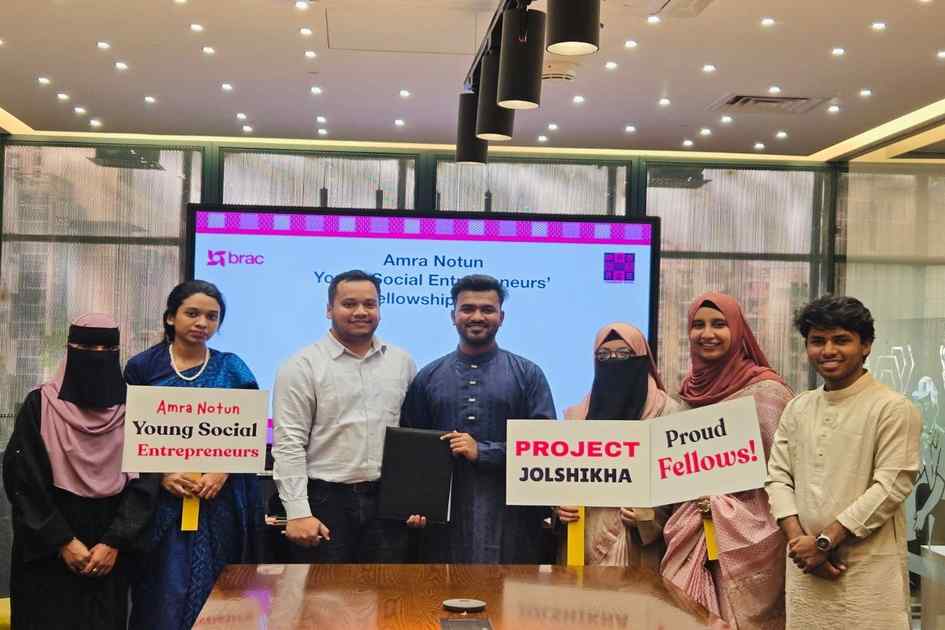

A youth-led Chattogram startup is converting discarded coconut shells into eco-friendly charcoal, tackling urban waste while creating jobs for river erosion-affected communities and building a sustainable, scalable green business model.
A youth-led venture in Chattogram has turned a persistent urban waste problem into an eco-friendly fuel business by producing charcoal from discarded coconut shells while creating jobs for people displaced by river erosion.
The project, called Jolshikha, was launched in response to two of the port city’s recurring problems: waterlogging during the monsoon and dengue outbreaks in winter. Its co-founders said plastic waste and discarded coconut shells clogged drains and canals, worsening both crises.
Seeking a practical solution, the team began converting thrown-away coconut shells into environmentally friendly charcoal branded as Eco-Coal. The idea took shape after they found what they described as an effective answer to the problem through BRAC’s Amra Notun Network classroom.
From there, the founders developed a broader plan to address the city’s waste problem while working with people affected by climate change. That thinking led to the birth of Jolshikha.
After people drink coconut water or eat coconuts, the shells are usually discarded. Jalshikha collects those shells and uses them to make charcoal. The charcoal is produced by people who lost their homes and livelihoods to river erosion, creating employment opportunities and helping them become self-reliant while also tackling waste management problems.
The team later found floating fishing families living in the Rasmoni Ghat area of Sagarika in the city, where they had settled after being displaced by river erosion. Work on the project began with them.
At first, several fishers were given hands-on training. After several attempts, they became skilled and learned how to mix the materials in the right proportions to produce good-quality charcoal.
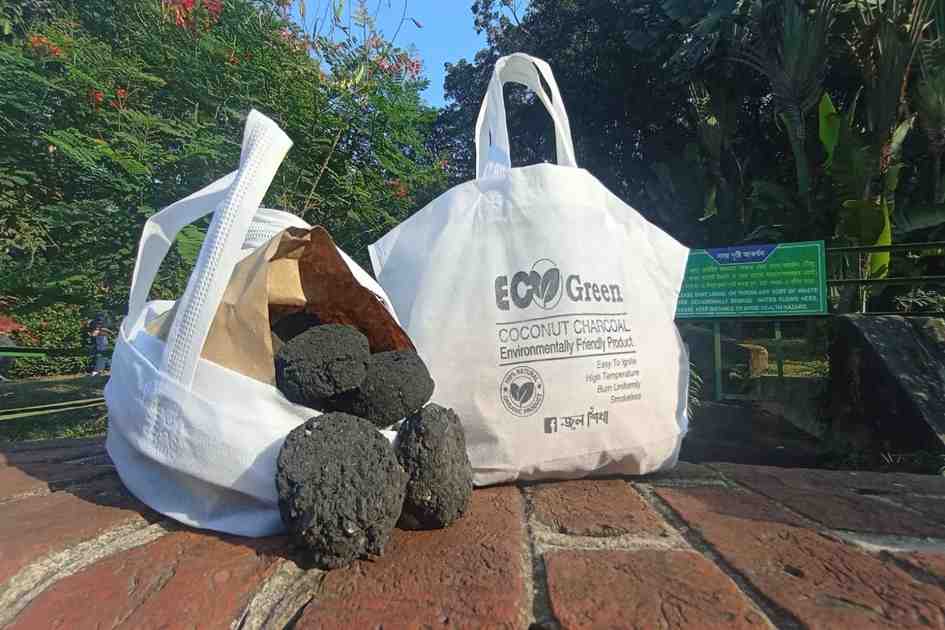
Production initially relied entirely on manual methods. In the absence of modern technology, the team kept the process running using local techniques. After going through several stages, the charcoal is prepared for the market.
The charcoal is fully environment-friendly, the founders said. It is made by processing coconut shells collected from scrap shops, wholesale markets and districts across the country.
At present, the project can produce around 100 kilograms of charcoal per month, though that rises or falls depending on demand.
Coconut shells are widely available in the country and remain a largely unused form of waste. Charcoal made from them produces less smoke, burns for a longer time and reduces the release of gases harmful to the environment, making it an effective and affordable solution for the environment, the economy and ordinary people.
In the beginning, many people did not take the idea seriously. Some even treated it as a joke. There was doubt over whether charcoal could really be made from coconut shells. Some members left the team over the uncertainty. But the founders did not give up and continued working persistently.
At first, they supplied charcoal free of charge to different restaurants and collected user feedback. Demand gradually increased and the product gained wider recognition.
Later, they developed an organised business plan outlining how the product could be distributed across the country, marketed more effectively and established as a brand.
After getting the chance to display the product in several super shops, customer interest grew and sales increased. The charcoal is now used regularly at different events, barbecue parties and in some restaurants. Orders are also coming in through the project’s Facebook page.
Demand rises significantly during winter in particular.
Co-founder Ripon said: “Jolshikha is an environmentally friendly initiative. We are turning waste into resources, creating employment and playing a role in protecting the environment. Our goal is to move these three things forward together.”
The founders said they want to expand production on a larger scale in future, bring more people into employment and involve women as well. But the lack of modern machinery remains a major challenge.
The team’s six members have already completed a partnership agreement and are continuing efforts to raise funds from different sources.
Co-founder Nurjahan Mustari said: “Jolshikha is not just a project for me, it is a responsibility. It is a commitment to change and a reflection of accountability to people. This initiative has taught me that even small efforts can create a big social impact.”
The project recently won the Young Changemakers Award 2025 at Carnival of Change 2025, organized by BRAC Youth Platform’s Amra Notun Network, in recognition of its social impact and contribution to local development.
It was also selected among the top 12 teams from Chattogram division in JAAGO Foundation’s Imagine Ventures 2025.
The six-member team comprises Maria Jahan Riva, Silvia Alam, Asadujjaman Ripon , Nurjahan Mustari, Mohammad Nazmul Khan and Popy Akter.
All of them are co-founders and business partners.
Asadujjaman Ripon is chief executive officer, Maria Jahan Riva is managing director and Mohammad Nazmul Khan leads operations.




