

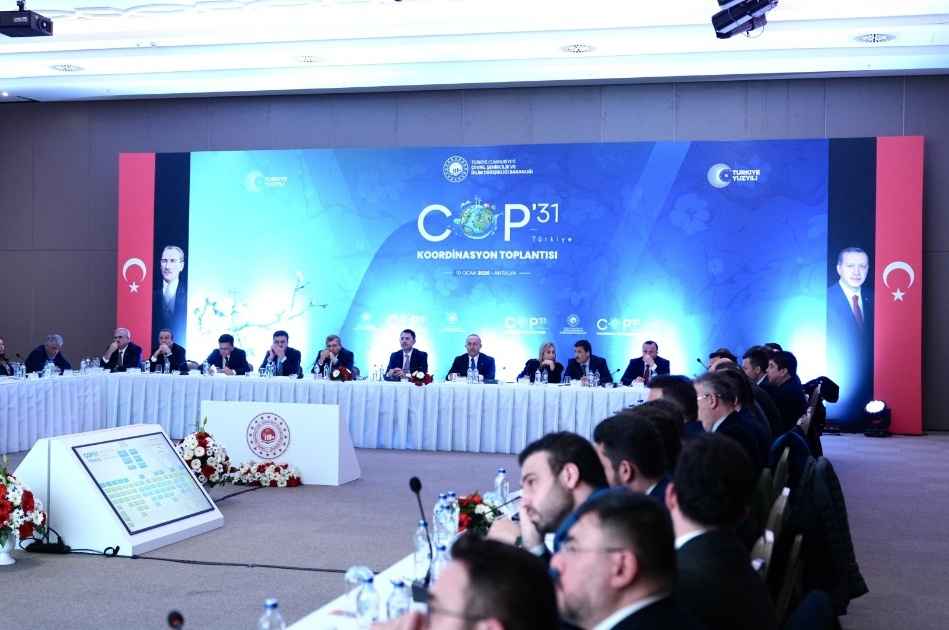

Türkiye has begun planning to host COP31 in November 2026, with Antalya as venue and an Istanbul leaders’ summit, aiming to strengthen diplomacy and guide negotiations on emissions and finance.
Türkiye has launched preparations to host the UN climate summit COP31 in 2026, with Environment, Urban Planning and Climate Change Minister Murat Kurum saying countries would look to Ankara for guidance as they make critical decisions in the fight against global warming.
The first preparatory meeting for the 31st Conference of the Parties was held Saturday in Antalya, a Mediterranean city that hosts a major diplomatic forum and is also a popular tourist destination.
Addressing the meeting, Kurum said the leadership of the summit was crucial because every country announcing a decision on tackling climate change would heed Türkiye’s direction. COP31 is scheduled for November 9-20, 2026, primarily in Antalya, with a leaders’ summit in Istanbul.
Türkiye secured the hosting and presidency of COP31 after negotiations led by Kurum at the UN climate conference COP30 in Brazil last year. The hosting battle pitted Türkiye against Australia, with Ankara ultimately prevailing. Türkiye and Australia had both submitted bids in 2022 and neither side agreed to step down before a deal reached in Brazil set out that Türkiye would host the summit while delegating negotiating responsibilities to Australia.
On Saturday, Kurum met representatives from six ministries to coordinate preparations. As the official chair of the summit, he visited the Antalya EXPO Fairgrounds, the venue for the conference, held talks with local administrators and told reporters the world’s focus would be on Antalya.
“More than 80,000 people from 196 countries will be here and we will show them Türkiye’s power to hold such summits and our hospitality,” he said, adding Türkiye would be a signatory to every major decision made at the summit.
The Conference of the Parties is held annually in a different country, bringing governments together to discuss greenhouse gas cuts, policies to combat climate change, climate funding and carbon market regulations. COP meetings also set rules for implementing the Paris Agreement, the flagship accord to limit global warming. Hosting a COP boosts a country’s diplomatic visibility by placing it at the heart of global climate policy.
Expectations were high at COP30, held in Belem in November 2025, for a concrete, time-bound road map to phase out fossil fuels. Instead, the final document included no firm commitment to exit fossil fuels, leaving what many see as the most critical issue in the climate crisis unresolved.
Speaking last week to Anadolu Agency, Ümit Şahin, coordinator of Climate Change Studies at Sabancı University’s Istanbul Policy Center, said COP30 was severely undermined by the absence of the United States, one of history’s biggest polluters, after President Donald Trump decided to withdraw from the Paris Agreement and pursue policies openly hostile to expanding renewable energy.
Şahin said the strong competition between Australia and Türkiye to host COP31 has already raised expectations.
“COP31 is expected to be both ambitious and distinctive,” he said.
He also pointed to growing climate cooperation among Mediterranean civil society organisations in recent years. With Antalya as the venue, Şahin said forest fires, heat waves, extreme temperatures and other Mediterranean-specific climate risks are likely to feature prominently on the agenda for coastal countries.
“Deforestation was one of COP30’s clearest failures,” he said. “I believe Türkiye has a genuine opportunity to drive progress on this issue at COP31.”
Electrification, faster moves to phase out fossil fuels and stronger mitigation commitments are also expected to dominate discussions, he added.
As host and president, Türkiye will also face scrutiny over its own climate policies, starting with how ambitious its updated Nationally Determined Contribution is, Şahin said. He argued that credible leadership at home is essential, urging Türkiye to fully embrace its 2053 net-zero pledge, publicly commit to a clear coal phase-out timeline and align national policies with global climate goals.
COP meetings have rotated across continents since 1995. Notable hosts include Germany in Berlin for COP1, Japan in Kyoto for COP3, Denmark in Copenhagen for COP15, France in Paris for COP21 where the Paris Agreement was adopted, the United Kingdom in Glasgow for COP26, Egypt in Sharm el-Sheikh for COP27, the United Arab Emirates in Dubai for COP28, Azerbaijan in Baku for COP29 in 2024 and Brazil in Belem for COP30 in 2025.
Hosting a COP requires vast organisational capacity. The host country must provide infrastructure for more than 100,000 participants, including large meeting halls and media centres plus space for side events and comprehensive security arrangements. The scale also demands robust logistics and transport planning.
Hosts must meet UN security standards and implement zero-waste practices, sustainability criteria and a carbon-neutral operations plan. With heads of state and government attending, the host also needs high-level diplomatic preparation and must coordinate pre-negotiation meetings and technical committee sessions without disruption.
For Türkiye, the summit would place the country at the centre of global climate diplomacy for two weeks, a process expected to increase international interest in Türkiye in areas such as climate finance, clean energy and green technology. Türkiye’s climate policies, emissions-reduction targets and green transition programmes would be showcased globally as an example.




