

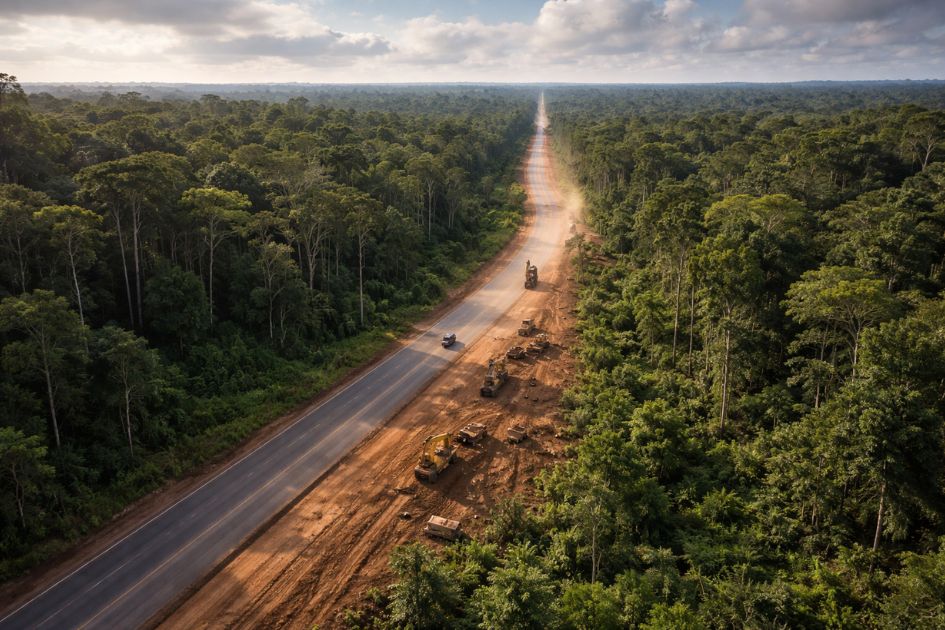



Observatório do Clima plans legal action against Brazil’s government over BR-319 paving, warning the project bypasses environmental licensing and could sharply increase deforestation, emissions, and risks to Indigenous communities.
Brazil’s leading climate network Observatório do Clima said it will sue the government over a planned paving project on the BR-319 highway, warning it could undermine deforestation control in the Amazon.
The lawsuit will target public bidding notices issued on Monday by the National Department of Transport Infrastructure (Dnit) for works on the so-called “Middle Section” of the highway, which cuts through one of the most preserved areas of the rainforest.
The group said the bid violates Brazil’s Constitution and principles of environmental and administrative law, and poses a major risk to efforts to curb deforestation.
The government announced on March 31 that it plans to pave 339.4 kilometres of the road between km 250.7 and km 590.1, linking Manaus in Amazonas state to Porto Velho in Rondônia. The stretch runs through the heart of the Amazon region.
However, Observatório do Clima said the project lacks the required environmental licence. The licensing process has been under legal challenge since January 2024, when the group filed a case against a preliminary licence issued during the administration of Jair Bolsonaro.
It also said there has been no prior, free and informed consultation with Indigenous communities affected by the project, as required under Convention No. 169 of the International Labour Organization, to which Brazil is a signatory.
Brazil’s environmental regulator Ibama has not issued the installation licence needed for paving to begin, partly because Dnit has not submitted the necessary documentation for review, the group added.
Ibama technical staff have repeatedly raised concerns about the project’s environmental impact during the licensing process.
In June 2025, Brazil’s Ministry of the Environment and Climate Change warned in a technical note that deforestation in the BR-319 region could be up to four times higher than without the project, with emissions reaching 8 billion tonnes of CO₂ by 2050, putting national climate targets at risk.
The ministry has classified the project as having significant environmental impact, requiring an Environmental Impact Assessment and report, known as EIA/Rima. This requirement is also set out in Article 225 of Brazil’s Constitution.
Despite this, the government now argues that environmental licensing is not necessary. To support this position, the office of Luiz Inácio Lula da Silva is invoking provisions from a new General Environmental Licensing Law.
The provisions had been vetoed by Lula in August 2025 but were later reinstated by Congress. Article 8, item VII of the law states that licensing is not required for maintenance and improvement of existing infrastructure, including previously paved roads.
The BR-319 highway was originally built between 1968 and 1976 during Brazil’s military dictatorship but was never fully completed and later abandoned.
Suely Araújo, public policy coordinator at Observatório do Clima, said the bidding notices are clearly unconstitutional.
“If the project is classified by the licensing authority as having significant impact, then Article 225 of the Constitution applies and cannot be overridden by the General Licensing Law,” she said. “Licensing is mandatory regardless of what is written in Article 8 or the wishes of Dnit and regional politicians.”
At the time of his veto, Lula had warned that the rule could allow projects carried out irregularly to bypass licensing, effectively legitimising environmental damage. He has since shifted position and plans to visit part of the highway stretch.
Marcio Astrini, executive director of Observatório do Clima, rejected Dnit’s claim that the project is merely maintenance of existing infrastructure.
“People in that region have the right to mobility with dignity, but the project cannot come at the cost of forest destruction,” he said. “As it stands, the highway will drive an explosion in deforestation and benefit environmental crime.”
Founded in 2002, Observatório do Clima is Brazil’s largest civil society network focused on climate issues, bringing together 161 organisations including research institutes and social movements. It publishes the country’s annual greenhouse gas emissions estimate, known as SEEG.




