

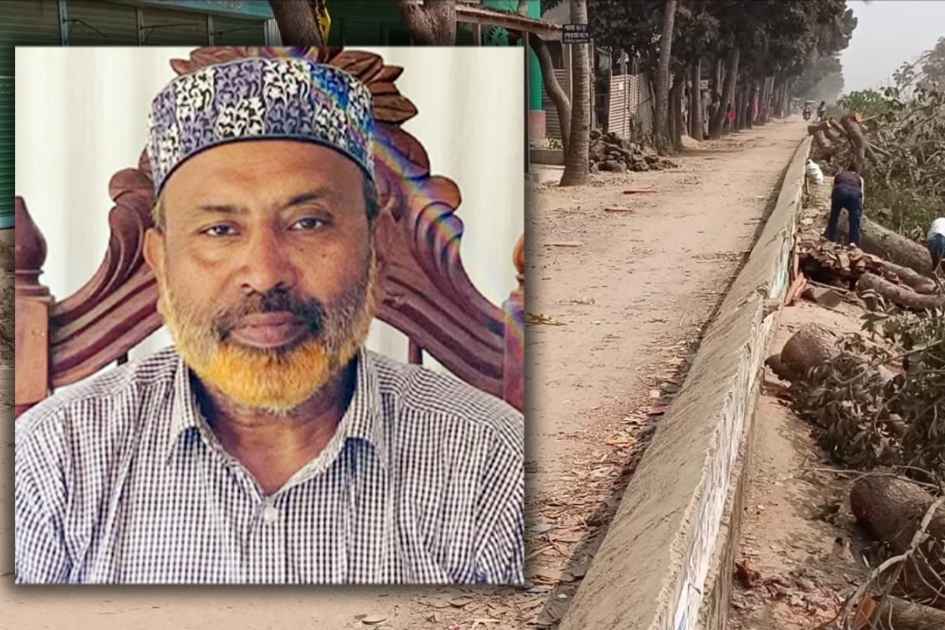



Cutting mahogany trees from a flood embankment in Kishorgonj’s haor wetlands has triggered legal disputes, political fallout and fresh concerns over climate resilience, public property protection and environmental accountability.
The removal of mahogany trees along a flood protection embankment in the low-lying haor wetlands of northeastern Bangladesh has sparked public outrage, legal confusion and political fallout, highlighting broader concerns about the management of climate-critical infrastructure in one of the country’s most flood-prone regions.
The controversy comes amid a growing national discourse on environmental accountability, with residents questioning why a case was filed under theft laws given that the trees were cut openly during the daytime, and whether current legal frameworks effectively safeguard public ecological assets.
Local authorities filed the case after trees planted to prevent riverbank erosion were felled in the Kamalpur area of Mithamain upazila. Upazila Engineer Faizur Razzak accused a man named Angur Mia of transporting the trees to a sawmill. Police said the investigation remains ongoing.
Officials and political statements have offered differing figures, with some claiming around a dozen trees were cut and others suggesting up to 20, reflecting uncertainty over the scale of the incident and increasing public scrutiny.
Mahogany trees belong to the genus Swietenia within the family Meliaceae and are widely cultivated across South Asia for timber and soil stabilisation along roads and embankments due to their deep root systems, which help bind soil and reduce erosion.
In Bangladesh, embankments are regarded as vital public flood protection infrastructure. Vegetation planted along them serves as green infrastructure that reduces erosion, slows runoff and strengthens resilience against seasonal floods.
Debate grows over legal classification and responsibility
The decision to classify the case as theft has become central to debate among residents, local observers and environmental advocates, who argue that if the trees were part of public flood protection infrastructure, environmental or public property laws might be more appropriate.
The issue reflects broader governance challenges in rural Bangladesh, where unclear land status, overlapping authorities and local power dynamics often hinder the protection of public resources.
Residents say discussions have spread across the community and on social media, with many questioning how climate protection assets are monitored and safeguarded.
Political response and contrasting pledges
The incident has drawn added attention because of its contrast with national political messaging. Tarique Rahman, chairman of the Bangladesh Nationalist Party, has pledged that his party will plant 250 million trees nationwide under its election manifesto, presenting large-scale afforestation as a key element of environmental policy.
The contrast has intensified scrutiny of the embankment incident and prompted debate over the gap between political promises and actions on the ground.
The BNP suspended Mithamain upazila BNP president Zahidul Alam Jahangir from all party posts including primary membership following allegations that trees on the embankment were cut for personal gain, reportedly to facilitate vehicle access to his residence. In a statement signed by senior joint secretary general Ruhul Kabir Rizvi, the party described the act as a breach of discipline and ethics.
Jahangir denied any wrongdoing, claiming the land and trees were not government property and that individuals had cut trees from their own land.
Community accounts and environmental risks
Residents speaking anonymously out of fear of retaliation said trees had been gradually removed over recent months, with the latest incident involving 10 to 12 trees cut using electric saws. Locally, each tree is valued at approximately Tk20,000 to Tk25,000.
Local sources said the trees were originally planted during the tenure of former president Abdul Hamid, who represented the area in parliament, as part of efforts to protect the embankment from erosion in the haor basin.
Environmental experts warn that removing vegetation from embankments can weaken their structural integrity, increasing the risk of erosion, overtopping and flood damage in wetlands like Mithamain, where communities rely heavily on such protections to safeguard homes, crops and livelihoods.
Future steps and accountability
Residents and local leaders say the controversy has strengthened calls for clearer legal regulations regarding embankment ownership, improved monitoring of public infrastructure and immediate assessment of whether the affected section requires restoration or replanting.
Authorities said further action will depend on the outcome of the police investigation as community and political debates continue over environmental safeguards, the rule of law and accountability.




