

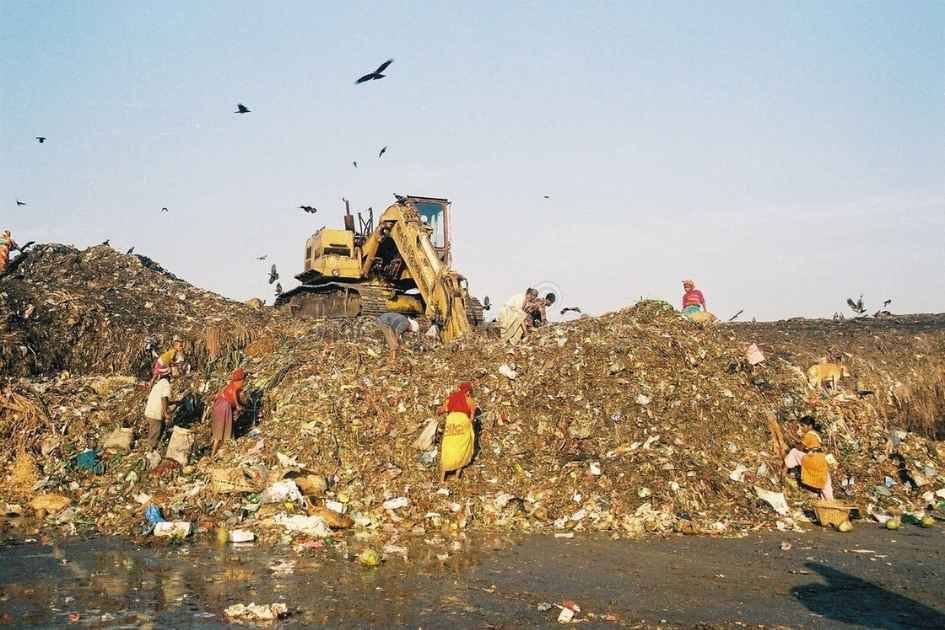



Towering garbage mountains in Dhaka release toxic smoke and methane, threatening public health, contaminating water and soil, and accelerating climate change as activists demand urgent government action.
Towering piles of burning waste are turning parts of Bangladesh’s capital into a toxic landscape, posing severe health risks for nearby residents and threatening local ecosystems.
During election campaigns, the Bangladesh Nationalist Party promised to resolve waste management problems across Dhaka and the country. Activists now urge the ruling party to demonstrate its commitment by taking immediate action at the Aminbazar and Matuail landfills.
Globally, open-air landfills are largely obsolete. Modern waste technologies such as pyrolysis, which heats waste without oxygen, gasification, which turns waste into energy, and sanitary landfills can process waste more safely without harming people or the environment. Yet in Dhaka, towering garbage mountains still rise under the open sky, taking a heavy toll on communities, wildlife and surrounding ecosystems.
In Aminbazar and Matuail, areas that once supported seasonal farming and fishing have been overtaken by sprawling landfills. Originally converted in 2009 to manage Dhaka’s growing waste, these sites now rise nearly 90 feet above the ground, cover roughly 55 acres and receive around 3,500 tons of solid waste daily without any modern processing technology.
Residents describe daily struggles living near the landfills. Saidul Islam, a Boliarpur resident, says, “The smoke irritates my eyes and lungs. I have to see a doctor regularly and the stench drives people away from their homes. Even walking past the landfill, I must cover my nose and mouth.” Many locals have abandoned farming or fishing and taken low-paying day labor jobs to survive.
Researchers from Jahangirnagar University’s Department of Environmental Science confirm alarming environmental hazards. The landfills release roughly 50,000 tons of methane annually, along with carbon dioxide, microplastics and leachate, a toxic liquid that seeps into soil and groundwater. “Leachate contaminates crops and water, posing long-term health risks including cancer,” says Professor Mostafizur Rahman. “Technologies exist that can safely process this waste without harming people or the environment. Authorities must act now.”
The environmental impact is visible. Green fields surrounding the landfills have turned brown, vegetation is wilting and toxic smoke spreads across residential areas. Public health expert Dr. Amjadul Haque warns that gases from burning waste enter the bloodstream, hinder oxygen transport and can damage the liver, kidneys and lungs over time.
Bangladesh’s laws prohibit open-air waste burning, yet enforcement remains minimal. The Air Pollution Control Rules 2022 allow penalties of up to two years in prison or fines of 200,000 taka, approximately 2,000 US dollars. Without active enforcement, the landfills continue to pollute both air and water, affecting thousands of residents.
Bangladesh, one of the world’s most climate-vulnerable countries, has been identified as a major hotspot for methane emissions, a greenhouse gas far more potent than carbon dioxide. The culprit is Dhaka’s Matuail Sanitary Landfill.
According to Montreal-based GHGISAT, satellites detected that the landfill emits around 4,000 kilograms of methane every hour, equivalent to the pollution produced by 190,000 cars. Methane traps 84 times more heat than carbon dioxide over 20 years, making Matuail a critical source of global warming. Despite support from the Japan International Cooperation Agency for waste and greenhouse gas management, precise emissions data remain unclear.
Earlier this year, Paris-based analyst Cairns SS identified Bangladesh as one of the top 12 global methane hotspots. Experts warn that unchecked emissions accelerate global warming, raise sea levels and threaten Bangladesh’s low-lying coastal communities.
The Matuail and Aminbazar landfills are not just local problems. They are global warnings. Every day of inaction worsens the climate crisis, threatens public health and endangers livelihoods. Immediate measures are essential to protect communities, restore ecosystems and reduce greenhouse gas emissions.
“Every hour, Bangladesh’s landfills are contributing to a crisis that is felt worldwide,” said Sohanur Rahman, executive coordinator of YouthNet Global. “Immediate action is needed to mitigate emissions and protect vulnerable communities.”
As Dhaka continues to expand, the city’s waste crisis raises a pressing question. Can authorities adopt modern waste technologies, enforce environmental laws and protect the health of millions, environmental activist groups ask? Without urgent action, the toxic garbage mountains will continue to grow, with consequences that may take decades to reverse.




