

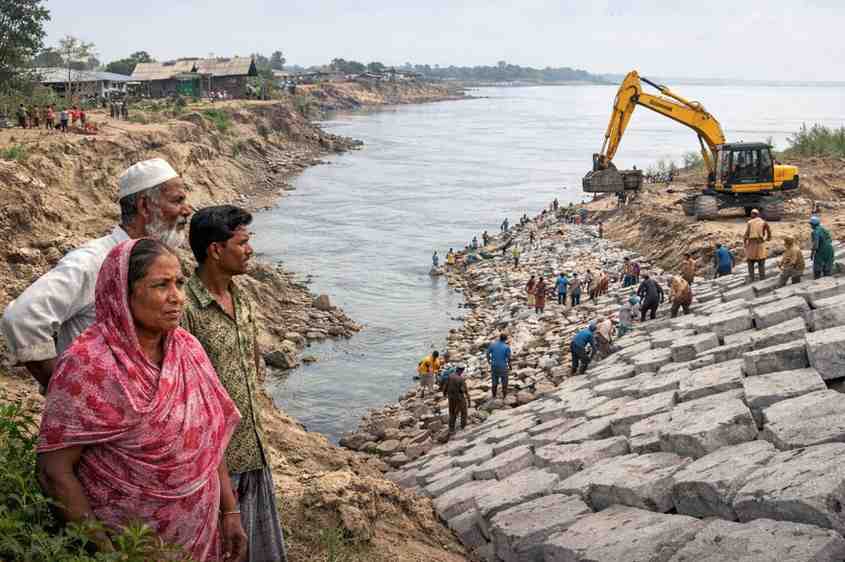



A new riverbank protection project along the Teesta River in northern Bangladesh is raising hopes among erosion-hit communities in Kurigram, where thousands of families who have repeatedly lost homes and farmland now see a chance for long-term safety and stability.
Construction of a government riverbank protection project along the Teesta River in northern Bangladesh is raising hopes among thousands of residents who have long faced displacement from relentless erosion.
Work has recently begun in Ulipur subdistrict of Kurigram district to strengthen vulnerable sections of the riverbank, part of an initiative aimed at protecting communities that have spent decades battling the shifting course of the Teesta.
Riverbank erosion along the Teesta has repeatedly displaced families, forcing many to rebuild homes and livelihoods as the river gradually swallowed farmland and settlements.
Golapi Bewa, a widow from Fakirpara village, said the ongoing work offers rare relief after years of uncertainty.
“I no longer worry about losing my home,” she said. “For 20 years this river has washed away our lives. I never thought I would see the riverbank being protected.”
Shafial Haque, an auto-rickshaw driver from Hokdanga village, said repeated promises of erosion control had previously left residents sceptical.
“I had already bought land near Fashi Deoa Bazaar to move my house,” he said. “Now that the work has started, I feel relieved. My home has been destroyed four times before.”
Residents from nearby villages including Kumarpara and Bhandarpara say the project could bring long-awaited stability to communities that have lived for years under the threat of erosion.
Officials estimate that once completed, the embankment protection will safeguard nearly 30,000 families, more than 120,000 people, living along the Teesta River from the recurring danger of riverbank collapse.
During a recent visit to the area, construction work was underway along vulnerable sections of the river’s left bank in Thetorai and Bajra unions. Local residents often gather along the riverbank to watch the progress, with some assisting contractors during the work.
For people living along the Teesta, the project represents more than infrastructure. Each monsoon season has historically brought fear that rising waters would claim homes, farmland and livelihoods.
According to the Bangladesh Water Development Board, the project is being implemented under the Kurigram Flood Control and Drainage Project (South Unit). The initiative includes erosion prevention measures along 2.5 kilometres of riverbank in Thetorai Union and 3 kilometres in Bajra Union.
The project, costing around 250 million Bangladeshi taka (about $2.3 million), is being carried out during the 2024–2025 fiscal year. Six project packages have been awarded to five contracting companies, with completion scheduled by June 30.
Former chairman of Thetorai Union, Nuruzzaman Sarkar, said he had visited the site several times to observe the progress.
“If the work is completed properly, people in around 50 villages will finally be protected from river erosion,” he said.
Engineer Zahid Hasan, site manager of Belal Construction, said roughly 80 percent of the work had already been completed and the remaining portion was expected to be finished within the next two weeks.
Environmental campaigners say riverbank protection must be part of broader, long-term river management strategies.
“Riverbank erosion is a social and economic crisis for thousands of families living along rivers in northern Bangladesh,” said Sohanur Rahman, executive coordinator of YouthNet Global.
“Projects like this are important, but they must be implemented with long-term planning, proper monitoring and community participation to ensure lasting protection,” he added.
For residents such as Golapi Bewa, the project represents something simple but profound, the possibility of living without the constant fear of losing their homes again.




