

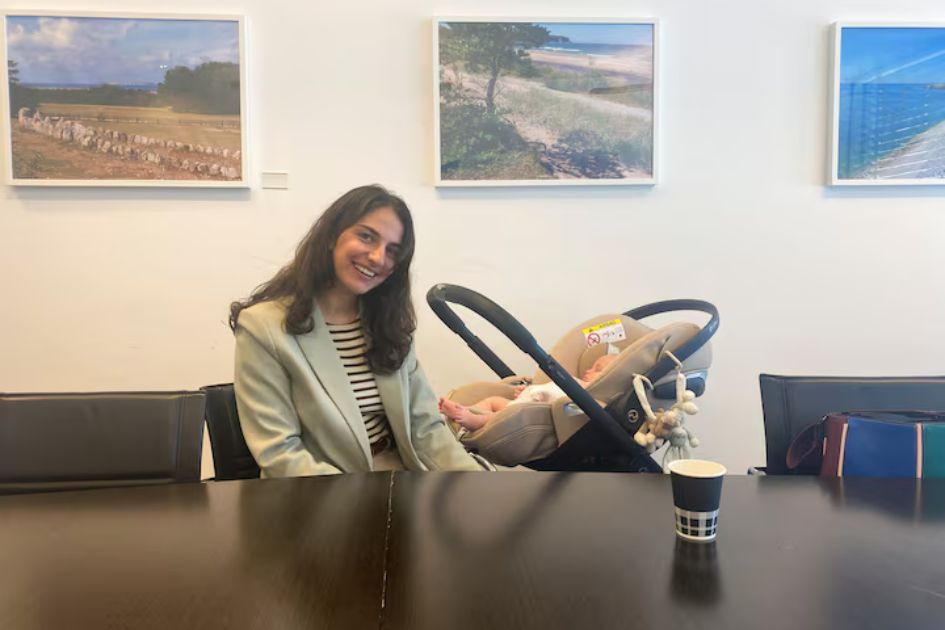



Sweden’s climate minister Romina Pourmokhtari made history by bringing her three-month-old son to an EU ministers’ meeting, highlighting family-friendly policies, shared parental leave and workplace flexibility.
European Union climate ministers were joined by an unexpected participant during talks in Luxembourg on Thursday when Sweden’s climate minister Romina Pourmokhtari brought her three-month-old son Adam to a council meeting, marking what officials said was a first for the bloc.
The appearance of the infant at the meeting was intended to highlight the value of parental leave policies that allow parents, particularly women, to continue their careers without having to choose between work and family life.
“I wanted to showcase being an example of not having to make that choice. Which, of course, also requires having a partner that’s not a dinosaur, someone who’s quite modern and up for it to tag along,” Pourmokhtari told Reuters.
An official from the EU Council said it was the first time, to the institution’s knowledge, that a baby had attended a meeting of EU government ministers.
Pourmokhtari, 30, became Sweden’s youngest government minister when she took office in 2022. She recently returned from parental leave while her husband is taking leave until Sweden’s election in September. He travelled with her to Luxembourg to look after Adam.
Sweden has one of the world’s most generous parental leave systems, financed through the country’s high-tax model. The policy has become a politically sensitive issue during the ongoing election campaign.
Parents in Sweden are entitled to around 16 months of paid parental leave. Of that total, 90 days are reserved exclusively for each parent and cannot be transferred. If either parent does not use their allocated days, they lose them.
These non-transferable periods, often referred to as “dad months”, were introduced to encourage fathers to spend more time caring for their children.
Pourmokhtari said those policies, together with support from her staff, had made it “much less controversial” for her husband to stay home with Adam while she resumed her ministerial duties.
She added that supporting working families is not only about extending paid leave through public spending. Governments, she said, should also consider introducing more flexible rules for sharing parental leave and expanding access to affordable childcare.
“It’s creating a lot of value that shouldn’t be underestimated. Value that might not always be economic but in the end, might also be economic, in not having burnt-out workers,” she said, referring to the pressures many parents face in balancing work and family responsibilities.
Poland’s Deputy Climate Minister Krzysztof Bolesta also welcomed Adam’s presence at the meeting.
“I think it’s great,” he told Reuters. “It’s not a handicap, it’s just a part of life.”
Reporting by Kate Abnett; Editing by William Maclean.
This post is republished from Reuters.




