

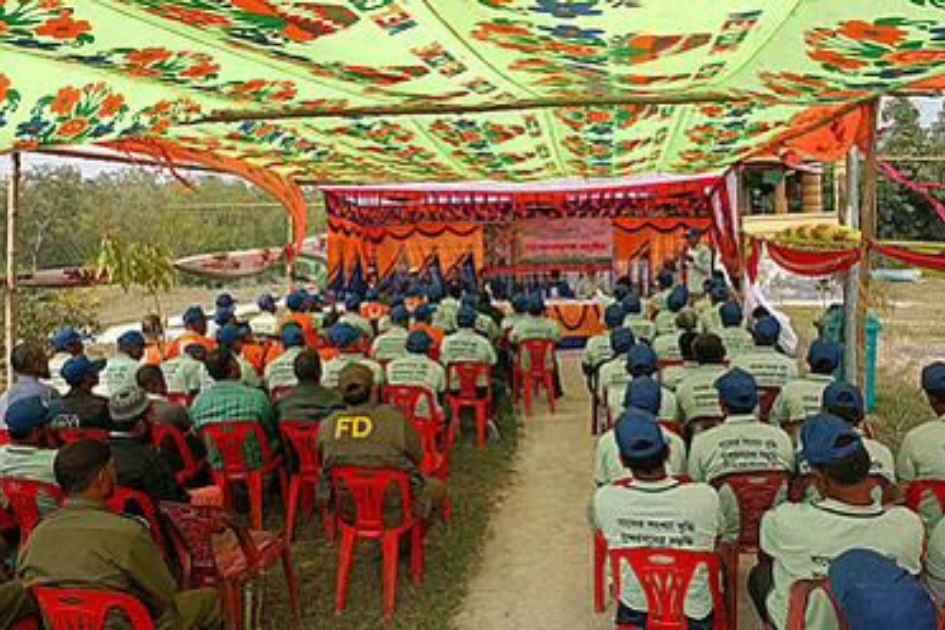

An awareness programme held deep inside Bangladesh’s Sundarbans has drawn criticism for disturbing wildlife, as conservationists warn such mechanised gatherings worsen pressure on the fragile tiger ecosystem.
An awareness programme organised by Bangladesh’s Forest Department inside the Sundarbans has sparked controversy, as environmentalists and local residents question the irony of holding a large mechanised event within one of the world’s most fragile tiger habitats, already under severe pressure from climate change and human intrusion.
The Sundarbans, a UNESCO World Heritage Site and home to the endangered Royal Bengal Tiger, plays a critical role in protecting Bangladesh’s coast from cyclones and storm surges. Conservationists warn that safeguarding the forest requires not only strong laws and funding but also practising restraint, especially when conservation efforts themselves risk adding pressure to an ecosystem already on the frontlines of the climate crisis.
The meeting took place on Thursday from 11:00am to 3:30pm at the Bajbaja patrol camp area, located deep inside the Sundarbans at the confluence of the Jhopjhopia and Shakbaria rivers. Around 120 people attended the programme, which involved the installation of a temporary stage, generator-powered electricity and sound systems, despite nearby populated localities being available for such activities.
Interestingly, the event banner listed the venue as Kashiyabad Forest Station in Koyra upazila, an area within human settlements. However, the programme was ultimately held inside the forest, raising questions over transparency and decision-making.
The banner carried the slogan “Increase in Tiger Population, Prosperity of the Sundarbans” and stated that the programme aimed to raise awareness on reducing human-tiger conflict, preventing tiger and deer poaching and discouraging fishing using poison. The event was organised by the Khulna Range of the Forest Department with support from the Sundarbans Tiger Conservation Project.
Several participants said they were transported by trawlers arranged by the Forest Department, while many forest-dependent fishers and wood collectors arrived in their own boats. Lunch was provided in the form of packaged biryani brought from a hotel in Koyra town and participants were also given caps and T-shirts.
Monirul Islam, a resident of Koyra, said he was invited by a forest official a day before the event. “When we reached the venue, we saw wild boars roaming nearby. As soon as people got off the trawlers, the animals ran back into the forest. No one explained why the programme was moved from the locality to inside the forest,” he said.
Forest-dependent fisher Tapan Kumar said awareness meetings had previously been held in villages. “This is the first time forest officials gathered us inside the forest itself. Sitting in rows of chairs under a decorated canopy and eating biryani felt more like a picnic than an awareness programme,” he said.
Members of the Forest Department’s Community Patrol Group confirmed that a decorator was hired from Koyra to set up the venue inside the Sundarbans. As there is no electricity in the forest, a generator was used throughout the nearly four-and-a-half-hour event, along with continuous use of loudspeakers. Local journalists said they were also transported by trawler to and from the venue.
The meeting was chaired by Khulna Range Assistant Conservator of Forests Md Shariful Islam and attended by local government officials, education officers, journalists, members of community patrol groups and forest-dependent communities.
Environmental organisations have strongly criticised the move. Saiful Islam, member secretary of the Sundarbans and Coastal Conservation Movement, said there was no justification for transporting people into the forest for such programmes. “Instead of raising awareness, this kind of event places additional stress on an already vulnerable ecosystem. Using tiger conservation funds to create human gatherings inside tiger habitats is inappropriate,” he said.
Tarikul Islam, convener of the Koyra Conscious Citizens’ Committee, warned that crowding, noise, generator vibration and artificial lighting could disrupt wildlife movement. “The Sundarbans is already under stress from rising salinity, cyclones and habitat loss driven by climate change. Any unnecessary human disturbance only compounds these risks,” he said.
Bajbaja patrol camp officer-in-charge Sakib Talukder said the programme was initially planned for Kashiyabad Forest Station but was later shifted due to logistical considerations. “To conduct the programme properly, arrangements such as a canopy and sound system were made,” he said.
Kashiyabad Forest Station officer Nasir Uddin claimed that no high-volume sound was used and microphones were only utilised for speeches.
Assistant Conservator of Forests Md Shariful Islam said the programme was limited in scope and focused mainly on fishers and wood collectors. He added that holding the event in a locality ahead of national elections could have drawn larger crowds and created political complications.
However, AZM Hasanur Rahman, divisional forest officer of the Sundarbans West Division and director of the Sundarbans Tiger Conservation Project, acknowledged that the decision was flawed. “Awareness activities should have been conducted in local communities. Bajbaja patrol camp is inside the Sundarbans and such programmes should not be organised there. The matter is being reviewed and instructions will be issued to ensure similar events are not held inside the forest in the future,” he said.




