

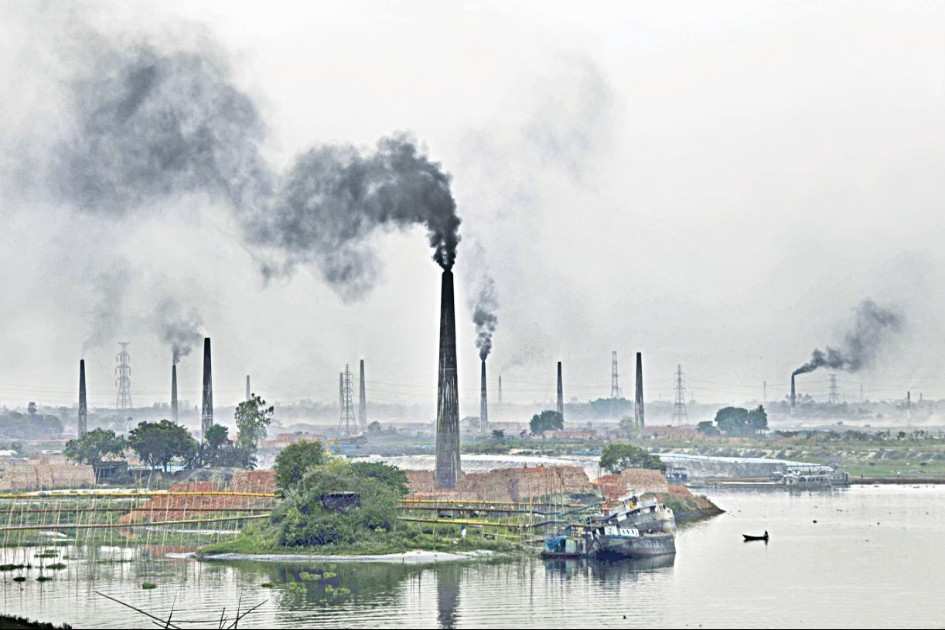



Air pollution remains South Asia’s deadliest health threat, with Bangladesh, India, Nepal, and Pakistan suffering extreme PM2.5 levels. Bangladeshis lose 5.5 years of life, Delhi residents 8.2 and underscoring urgent regional action to curb dirty air.
South Asia is suffocating under the world’s dirtiest air, with fine particulate pollution silently cutting billions of years from human life across the region.
According to the Air Quality Life Index (AQLI) 2025 Annual Update, published by the University of Chicago’s Energy Policy Institute on Thursday, air pollution has become the single greatest external threat to life expectancy across the region dwarfing the impacts of malnutrition, unsafe water, and infectious disease.
The new analysis finds that South Asia has once again topped global pollution rankings, with residents breathing levels of fine particulate matter (PM2.5) many times higher than what international health guidelines consider safe. The toll is stark: across Bangladesh, India, Nepal, and Pakistan the most polluted countries in the region exposure to dirty air reduces life expectancy by more than one-and-a-half times the impact of childhood and maternal malnutrition and more than eight times the impact of unsafe water, sanitation and hand washing.
A region in perpetual smog
The AQLI reveals that after a brief decline in 2022, particulate concentrations in South Asia rose again by 2.9 percent in 2023, leaving the region’s air the most polluted in the world. While this figure remains slightly lower than 2021 levels, the long-term trajectory offers little comfort: year after year, South Asia dominates the global pollution charts, with few signs of meaningful policy progress.
For the more than 1.8 billion people living in the region, this toxic exposure translates into years of lost life. If South Asia were to meet the World Health Organization’s PM2.5 guideline of 5 µg/m³, the region’s residents would gain on average 3.6 additional years of life expectancy, a collective windfall of billions of life years.
Bangladesh: The Global epicenter of pollution
Among South Asian nations, Bangladesh stands out as the world’s most polluted country. In 2023, the national annual average PM2.5 concentration was 60.8 µg/m³, more than twelve times the WHO guideline and nearly double the country’s own national standard of 35 µg/m³.
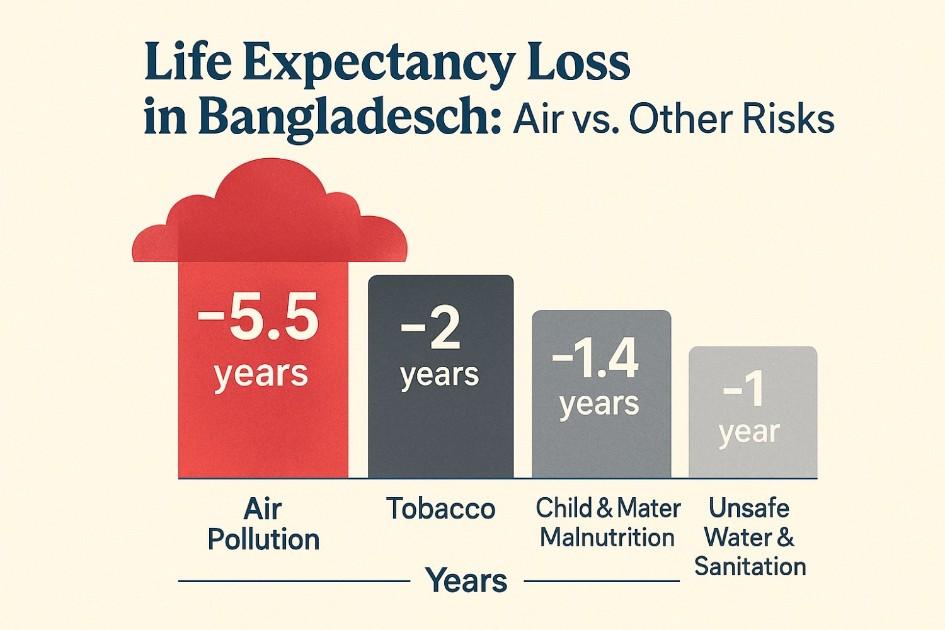
For Bangladeshis, the health costs are staggering. The average citizen could live 5.5 years longer if air quality met WHO standards. Between 1998 and 2023, PM2.5 concentrations increased by 66.2 percent, cutting an additional 2.4 years from life expectancy.
The threat far outstrips other risks: while tobacco use shortens Bangladeshi lives by about 2 years and child and maternal malnutrition by 1.4 years, air pollution alone slashes 5.5 years. In fact, every one of the country’s 166.8 million residents lives in areas that exceed both WHO and national standards. Even in Lalmonirhat, Bangladesh’s least polluted district, particulate levels are seven times above WHO guidelines.
Dhaka and Chattogram: Epicenters of crisis
Bangladesh’s two largest cities, Dhaka and Chattogram, are at the heart of the emergency. Together, they are home to nearly half the country’s population. In Dhaka, annual average PM2.5 concentrations reached 76.4 µg/m³ in 2023. If the city’s air were brought into line with WHO standards, residents would gain 6.9 years of life expectancy. Even under the weaker national standard, life expectancy would rise by 4.1 years.
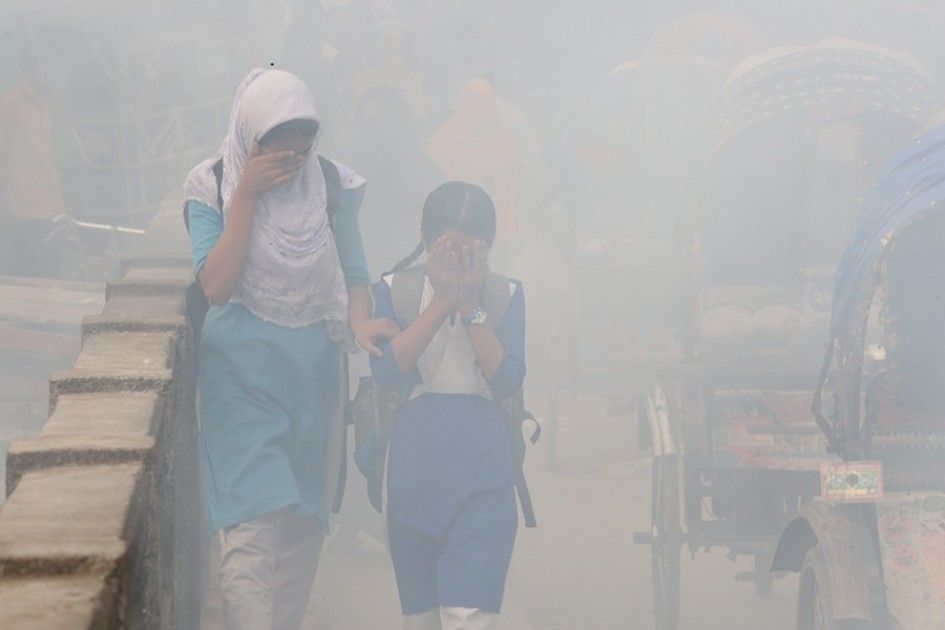
In Chattogram, residents stand to gain 6.2 years of life expectancy if WHO standards were met. Districts such as Gazipur, Narayanganj, and Tangail show similar figures, with Gazipur topping the chart: at 77.4 µg/m³, residents could live 7.1 years longer if the WHO guideline were achieved.
India: A crisis of scale
India, South Asia’s and the world’s most populous nation, also ranks among the dirtiest. In 2023, the country recorded an average PM2.5 concentration of 41 µg/m³, more than eight times the WHO guideline and slightly above its national ambient standard of 40 µg/m³.
For the average Indian, this means a life expectancy loss of 3.5 years. But in Delhi, the world’s most polluted capital, the losses are much greater: residents could gain 8.2 years of life expectancy if the city met WHO standards the single largest potential gain anywhere on the planet.

India’s Northern Plains, spanning Bihar, Uttar Pradesh, Punjab, Haryana, Chandigarh, Delhi, and West Bengal, remain the country’s most polluted belt. Here, residents could live 5 years longer with clean air. Even beyond this zone, heavily industrialized states like Chhattisgarh, Tripura, and Jharkhand show severe pollution, with residents potentially gaining 3.7 years of life expectancy if WHO standards were met.
Nepal: Rising pollution, shrinking lives
Nepal, nestled in the Himalayas, is not immune. The country’s PM2.5 concentration rose to 38.3 µg/m³ in 2023, up 10 percent from the previous year. On average, Nepalese citizens could live 3.3 years longer if WHO standards were achieved. In some districts of Madhesh province, such as Mahottari and Rautahat, potential gains exceed 5.3 years.
Pakistan: Unyielding smog
In Pakistan too, pollution exacts a devastating toll. Many cities and agricultural regions record PM2.5 concentrations far above both WHO and national standards. The AQLI notes that in Pakistan, as in its neighbors, air pollution’s impact on life expectancy now vastly exceeds that of other health risks such as malnutrition or waterborne disease.
Beyond borders: A regional catastrophe
What unites Bangladesh, India, Nepal, and Pakistan is not just geography but a shared public health catastrophe. Collectively, the four countries are home to nearly a quarter of the worlds population, and all are breathing air that is shortening their lives by years.
The AQLI draws a stark comparison: in these nations, the impact of air pollution is greater than the combined toll of unsafe water, sanitation, and maternal malnutrition. It is not an abstract environmental problem but the region’s defining public health challenge.
Policy and governance gaps
Despite overwhelming evidence, South Asia’s governments have failed to act with the urgency the crisis demands. In Bangladesh, brick kilns remain the largest single source of particulate matter, yet enforcement is weak and modernization efforts have stalled. In India and Pakistan, reliance on coal-fired power plants and unchecked vehicle emissions continues to choke cities. Across the region, poorly maintained buses and trucks, outdated factories, and agricultural burning add to the haze.
Regional cooperation remains minimal, even though transboundary smog drifts freely across borders each winter, binding the region in a shared cloud of pollution. The AQLI warns that environmental institutions across South Asia lack both the capacity and the political power to confront entrenched industrial interests. Standards exist on paper, but enforcement is sporadic, and compliance remains the exception rather than the rule.
Lessons from elsewhere, a window of hope
The report stresses that South Asia’s pollution crisis is not inevitable. It cites examples from other parts of the world: in China, a “War on Pollution” launched in 2014 cut particulate levels by nearly 40 percent within a decade; in the United States, the Clean Air Act reduced pollution by more than 60 percent since 1970, adding 1.4 years to average life expectancy.
For South Asia, similar gains are within reach. If Bangladesh alone were to meet WHO standards, its people would collectively gain nearly one billion additional life years. Across South Asia, the potential gains stretch into billions more.
“Air pollution is not an unavoidable cost of development but the result of policy choices,” the report concludes. “Few other interventions whether in healthcare, infrastructure or education could deliver such immediate and profound benefits”.




