

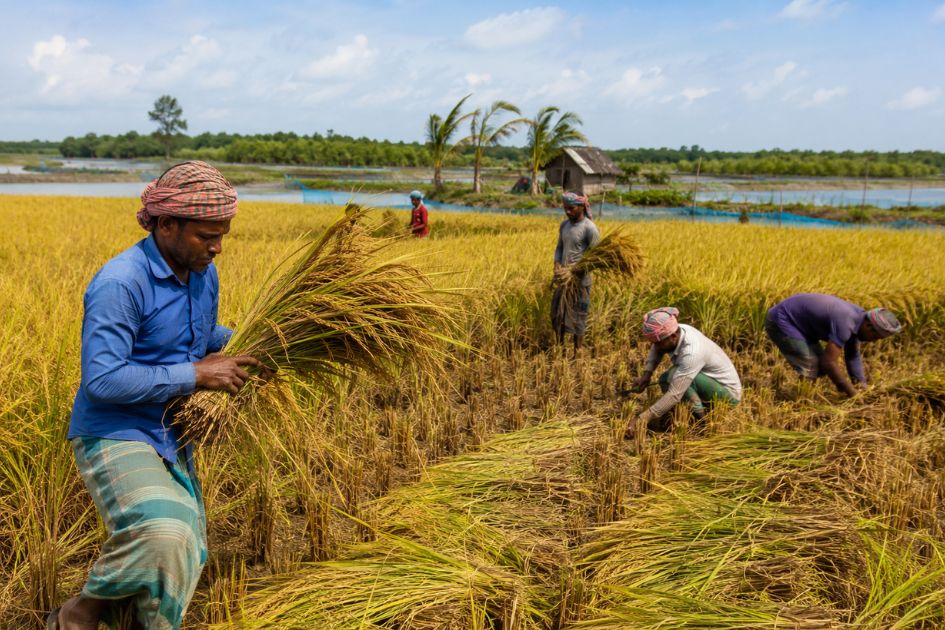



Farmers in Satkhira’s saline coastal lands are harvesting bumper Boro rice crops after adopting salt-tolerant varieties and climate adaptation methods with support from agricultural authorities and researchers.
The vast croplands of the coastal district of Satkhira were continuously used for shrimp farming for more than four decades by drawing brackish water from rivers. As a result, rice and other crop production nearly stopped because of rising salinity. However, due to the long-term efforts of local farmers and strong support from the Agriculture Department, rice cultivation in these coastal saline lands is now improving significantly.
For many years, these lands remained either uncultivated or were cultivated on a limited scale. That picture has started changing over the last few years as farmers returned to the fields by cultivating salt-tolerant Boro rice varieties. This season, farmers are busy harvesting paddy.
In May 2020, the tidal surge caused by Cyclone Amphan inundated vast coastal areas with saline water once again, damaging agricultural land. Many farmers were forced to stop cultivation for several years. Later, local agriculture gradually began to recover through the advice of the Department of Agricultural Extension, agricultural research and the traditional experience of farmers passed down through generations.
The sight of paddy harvesting on land once considered uncultivable due to salinity is not just a farming success story. It has become an effective adaptation strategy for coastal farmers that others can follow to improve their livelihoods.
Sheikh Abdul Majid, a farmer from Kurikahania village in Asashuni upazila, cultivated 12 bighas of land this season. After Cyclone Amphan, he could not cultivate the land for several years. Later, he resumed farming by conserving fresh water, reducing soil salinity and using early Boro cultivation methods along with salt-tolerant rice varieties. This year, his fields produced a good yield and paddy harvesting has already begun.
Abul Hossain, a farmer from Pratapnagar village in Asashuni upazila, said the high salinity in most of the land in his area makes it difficult to cultivate all rice varieties. Following the advice of the upazila agriculture officer, he has been cultivating the salt-tolerant BRRI dhan67 variety for several years. This season, he cultivated the variety on 15 bighas of land. Last year, he harvested about 27 maunds of paddy from the same land. Many farmers in his village are now following the same method.
Azharul Islam, a farmer from Barakupat village in Shyamnagar upazila, said salinity levels in their area remain high. Even a few years ago, Boro rice production there was limited to only 10 to 12 maunds per bigha, which was lower than the production cost. Over the last four years, the introduction of salt-tolerant rice varieties has changed the situation. Many farmers are now cultivating rice alongside shrimp and fish, making it possible to produce both fish and rice on the same land.
According to the Satkhira District Agricultural Extension Department, Boro rice was cultivated on 79,800 hectares of land across the district’s seven upazilas during the 2024-25 season. Of this, salt-tolerant rice varieties were cultivated on around 20,000 hectares, compared to 16,000 hectares in the previous season.
Although the target for Boro cultivation in the district this season was set at 80,800 hectares, cultivation was carried out on 82,735 hectares in total.
Deputy Director of the Satkhira Agricultural Extension Department Md. Saiful Islam said, “Salinity is increasing in coastal areas due to climate change. Farmers are now adopting various adaptation strategies. The cultivation of salt-tolerant Boro rice is increasing every year. We are assisting farmers through early cultivation methods, improved seeds and modern agricultural technology.”
Dr. Md. Sajjadur Rahman, Chief Scientific Officer of the Bangladesh Rice Research Institute’s Satkhira Regional Office, said, “Climate change is rapidly affecting coastal areas. In response, we have already developed 14 salt-tolerant rice varieties. Among them, BRRI dhan67, BRRI dhan97 and BRRI dhan99 are notable. These varieties can tolerate salinity levels of 12 to 14 dS/m and can produce yields of 26 to 27 maunds per bigha.”




