

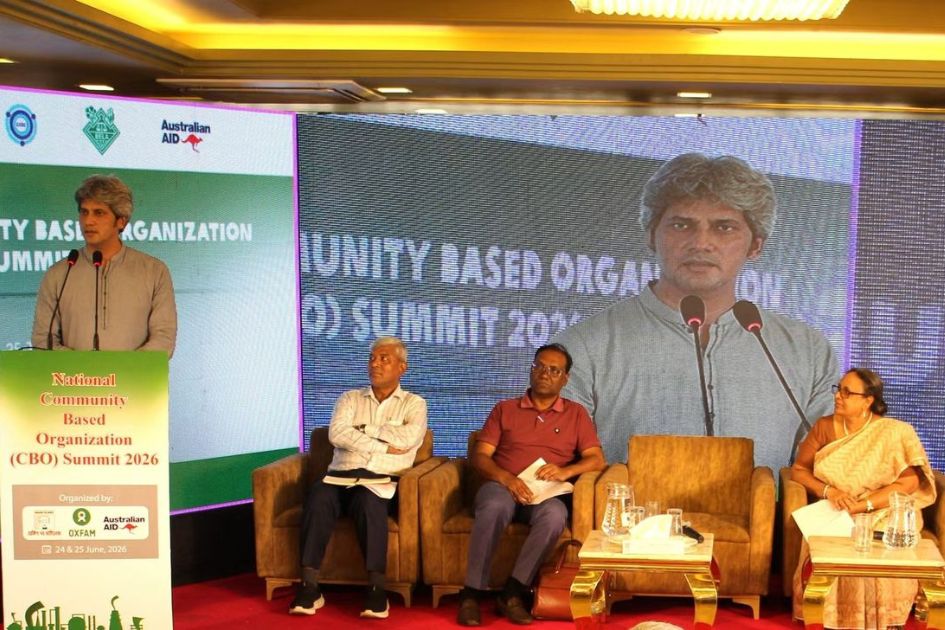

Planning State Minister Jonaed Abdur Rahim Saki urged integrated action on climate displacement as community organizations adopted a 10-point declaration demanding climate finance reforms, stronger local leadership and policy action.
Bangladesh Planning State Minister Jonaed Abdur Rahim Saki on Thursday called for coordinated and integrated programmes to address climate displacement, saying isolated interventions are insufficient to tackle the scale of the crisis.
“Rehabilitation, employment and education for climate-displaced people cannot be ensured through single projects alone,” he said. “We need integrated programmes combining multiple interventions so that they can collectively address the scale of the problem.”
He made the remarks while speaking at the closing session of the two-day National Community-Based Organizations (CBO) Summit 2026, held at the Krishibid Institution Bangladesh in Dhaka.
The summit was jointly organized by Breaking the Silence (BTS) and Oxfam in Bangladesh with support from Australian Aid.
CBOs unveil 10-point agenda for climate justice
Coastal community-based organizations (CBOs), youth groups and women representatives at the summit called for urgent reforms, including easy-term loans for coastal populations, localization of climate finance, increased investment in women-led climate adaptation and the green economy and stronger protection of environmental and climate rights defenders.
Their demands were formally adopted in a 10-point declaration at the summit’s closing session.
The declaration said coastal communities face escalating climate risks, including cyclones, tidal surges, salinity intrusion, river erosion, livelihood insecurity and displacement. Despite these challenges, they continue to develop locally driven adaptation solutions rooted in indigenous knowledge and lived experience.
It emphasized that women and youth must be recognized as central actors in climate justice and resilience building.
Key proposals include simplified and decentralized registration systems for CBOs and youth organizations, localization of climate finance and direct funding access for local organizations and women-led initiatives.
It also calls for expanding soft loans and financial services in coastal areas, ensuring institutional recognition of CBOs and strengthening the participation of women and youth in local government decision-making.
Other recommendations include integrating youth research and community knowledge into national policy, increasing investment in women-led climate adaptation and green economy initiatives, ensuring protection of environmental and climate rights defenders and enforcing Free, Prior and Informed Consent (FPIC) in all development and climate-related projects affecting land, forests, water and coastal resources.
Community knowledge must guide policy decisions
Dr Mohammad Emran Hasan, Head of Climate Justice and Natural Resources Rights at Oxfam in Bangladesh, said the summit highlighted the importance of combining community experience with academic knowledge to develop effective climate adaptation strategies.
He urged the government to act on the declaration’s recommendations without delay, stressing that implementation gaps must be addressed urgently.
“Over 50 organisations shaped declaration”
Breaking the Silence (BTS) Chairperson Samia Afrin said the declaration reflects the collective input and commitments of more than 50 organizations working on climate resilience and community empowerment.
She said stronger integration of CBOs into national planning and implementation frameworks is both necessary and achievable.
Community innovations showcased
The closing session featured presentations of locally driven climate adaptation initiatives by various CBOs. Twelve coastal organizations also showcased eco-friendly products and practical resilience solutions through exhibition stalls.
Participants pledged to strengthen accountable and effective community-based organizations, promote women and youth leadership, expand locally led climate adaptation initiatives and advance evidence-based advocacy for marginalized communities.
The declaration concluded with a renewed call for urgent policy action, warning that intensifying climate risks in coastal Bangladesh demand immediate and coordinated national responses. It reaffirmed a collective commitment to building a resilient, inclusive and sustainable Bangladesh grounded in local leadership, gender equality, youth participation and climate justice.




