

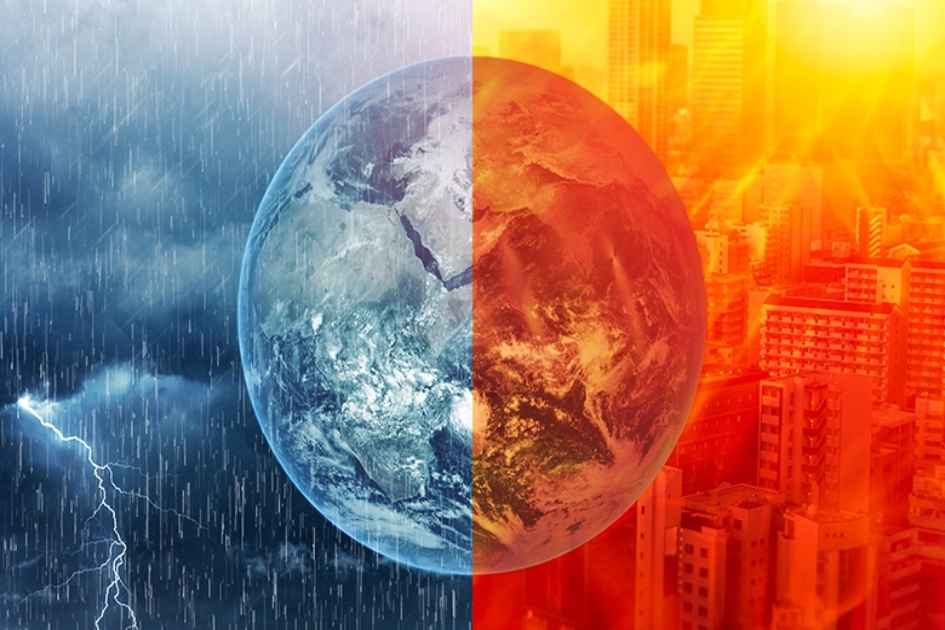

Experts warn modern warfare and climate change reinforce each other, as fossil-fuel-intensive militaries increase emissions while climate disruption intensifies instability, conflict risks and global security threats.
War worsens climate change in multiple ways and climate disruption in turn increases the likelihood of conflict, experts warn, highlighting a dangerous feedback loop between warfare and environmental breakdown.
The human toll of the United States-Israel attack on Iran has already been severe. Hundreds of people have reportedly died including 175 young girls and teachers who were killed at the Shajareh Tayyibeh primary school, in what observers describe as a tragedy that underscores the devastating civilian cost of modern warfare.
Beyond the loss of life, the conflict is raising serious global economic concerns. Disrupted supply chains, rising energy prices and shaken stock markets are emerging as early warning signs of wider instability.
There are also growing fears that the conflict could escalate further. The war was launched by two nuclear-armed states, increasing the risk that additional powers across the Middle East and beyond could be drawn into the confrontation.
Running through all these developments is another critical issue that often receives less attention: the deep connection between warfare and climate change.
Experts say the relationship works in both directions. Armed conflicts produce enormous quantities of greenhouse gas emissions while climate change itself increases the risk of instability and violence.
Russia’s war in Ukraine illustrates the scale of the problem. The conflict has generated emissions equivalent to the entire annual emissions of France, according to analyses of the war’s carbon footprint.
Those additional emissions intensify global heating, which leads to deadlier heatwaves, prolonged droughts, stronger storms and other climate shocks. These disruptions damage livelihoods, weaken economies and increase migration pressures, conditions that can heighten the risk of future conflict.
British intelligence agencies MI5 and MI6 warned in January that unchecked climate disruption and biodiversity loss could trigger “crop failures, intensified natural disasters, and infectious disease outbreaks,” developments that could worsen existing conflicts, ignite new ones and threaten global security and prosperity.
Despite the seriousness of the issue, the climate consequences of war often receive limited attention when conflicts erupt.
Wars dominate headlines because they unfold rapidly and produce dramatic images and immediate threats that drive news coverage. Climate change, by contrast, typically unfolds over longer timeframes and often struggles to maintain media attention except during major disasters such as hurricanes or wildfires.
Yet analysts say ignoring the climate dimension of modern warfare would be a major mistake.
At a time when the world is approaching potentially irreversible climate breakdown, overlooking the environmental consequences of three of the world’s deadliest militaries going to war would amount to journalistic malpractice.
Another key question surrounding the conflict concerns oil.
Iran possesses the third largest oil reserves in the world. That fact has inevitably revived questions about whether access to fossil fuels played a role in the decision to attack.
The history of US-Iranian relations includes long-standing disputes over Iran’s oil wealth, including the CIA-backed overthrow of a democratically elected Iranian leader who attempted to nationalize the country’s oil industry.
More recently, President Donald Trump openly stated in January that he wanted to gain control of Venezuela’s vast oil reserves during a US attack on that country.
Further reporting will be required to determine how significant a role oil may have played in the decision to launch military strikes against Iran.
What remains clear is that modern warfare itself depends heavily on fossil fuels.
Aircraft carriers, jet fighters and the extensive logistical systems that support them consume massive quantities of oil. This dependence explains why the US Department of Defense is considered the world’s largest institutional emitter of greenhouse gases.
Neta Crawford, a professor at Oxford University, documents this in her book The Pentagon, Climate Change, and War.
When combined, the world’s militaries produce a larger annual carbon footprint than all but three countries globally.
Given the enormous implications of the conflict, scrutiny over why the war began remains essential.
Within 24 hours of the initial strikes, The Washington Post cited four administration sources saying US intelligence assessments saw no immediate threat from Iran.
Nevertheless Trump chose to launch the attack after what the newspaper described as a weeks-long lobbying effort by Israel, which considers Iran a major enemy, and Saudi Arabia, Iran’s long-standing regional rival and fellow oil-producing state.
As with most wars the heaviest burdens are likely to fall on the poorest and most vulnerable people.
Analysts say climate change is not a peripheral issue in modern warfare but a structural component embedded in how conflicts unfold.
Journalists therefore cannot fully cover a war that is so carbon intensive, destabilizing and globally consequential if its climate dimensions are treated as optional rather than central to the story.




