

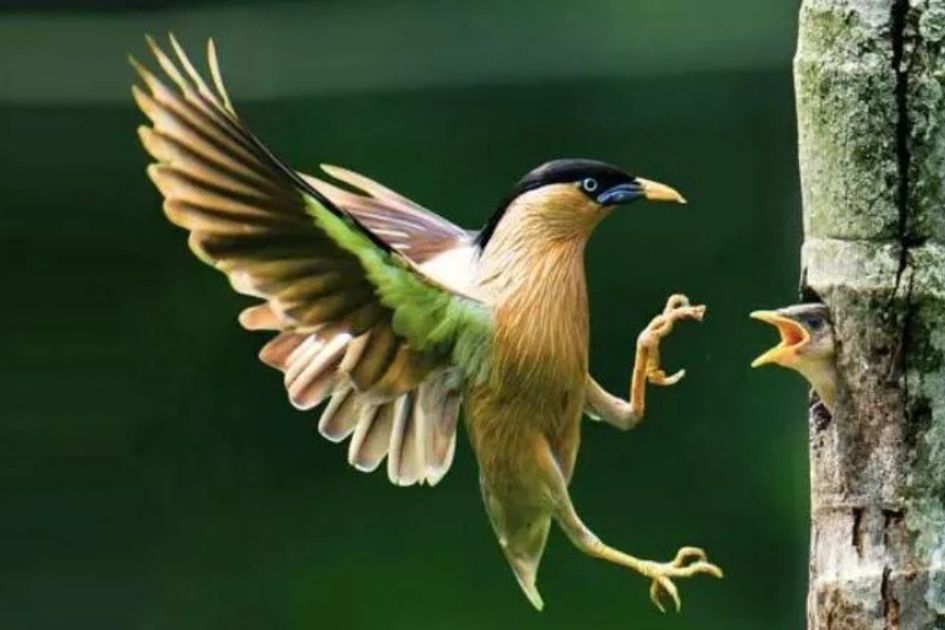



Rajshahi University’s diverse greenery, water bodies and abundant food have helped the rare Bamune Shalik establish a year-round habitat on campus.
Rajshahi University has emerged as a year-round safe habitat for the rare Bamune Shalik, or Brahminy Starling, a bird that is disappearing from many parts of Bangladesh.
Favourable habitat, plentiful food and safe shelter have enabled the species to establish a permanent presence on the campus, making the university one of the country’s notable habitats for the bird.
While Common Myna, Chestnut-tailed Starling and Bank Myna are commonly found across Bangladesh, the Bamune Shalik is comparatively rare.
The bird is more frequently found in tree-rich areas of the Rajshahi division, particularly on the Rajshahi University campus, where natural conditions are favourable for its survival.
The Bamune Shalik is about 21 centimetres long, with little visible difference between males and females. An adult has a black crest, a grey back, a buff-coloured throat and tail and white patches beneath the tail.
Its strong beak is distinctive, with a bluish base, a greenish middle section and a yellow tip. The bird is also known for its swift flight and ability to mimic the calls of other birds.
Bamune Shalik typically builds nests from dry leaves and grass in wall holes, tree hollows or earthen pots hung by people. The birds lay three to four bluish eggs.
During the breeding season from March to July, their diet mainly consists of fruits and insects.
The birds can be spotted in several areas of the Rajshahi University campus, including the Shaheed Minar, Zuberi Building, Silsila area, helipad and main gate.
Professor Dr Aminuzzaman Md Saleh Reza of the university’s Department of Zoology said the Bamune Shalik had established the campus as its permanent habitat because it provides adequate food, security and a suitable environment for survival.
He said the natural environment of Rajshahi is favourable for the species, much as some native birds are closely associated with particular regions such as the Sundarbans and Chattogram.
“No separate artificial measures are needed to protect the species. Preserving its natural habitat and keeping bushes intact can help ensure its survival,” he said.
Saleh Reza said the Rajshahi University campus is a rich sanctuary for avian biodiversity in Bangladesh, with more than 100 resident and migratory bird species living in its green spaces, old trees and water bodies.
The campus contains a variety of natural habitats, including woodlands, croplands, grasslands, tall trees, bushes, herbs, ponds, canals, pools and low-lying areas, supporting a diverse range of birdlife.
Professor Dr Md Anisur Rahman, also of the Department of Zoology, said tall trees, open water bodies and abundant food make the campus a preferred destination for migratory birds, particularly during winter.
Talking to BSS on Thursday, Rajshahi University Vice-Chancellor Professor Faridul Islam said killing birds on the campus is strictly prohibited.
“The birds are not subjected to any kind of disturbance or fear,” he said.
He said university authorities remain vigilant to ensure that the free movement of indigenous and migratory birds is not hindered in any way.
Fahim Muntasir Rafin, a student of the university’s Bengali Department and a photographer, said he first photographed the bird behind the Siraji Building in February 2024.
He said the birds are drawn to the campus by the easy availability of food, particularly around garbage dumping sites.
Rafin urged the university authorities to strengthen surveillance to prevent disturbance to the birds during their breeding season and stop the theft of chicks.




